1.0 INTRODUCTION AND GEOGRAPHICAL SETTING
Mahenge Spinel
authored by @jamesdumar.com | Identity: did:plc:7vknci6jk2jqfwsq6gkzu
The Mahenge plateau represents one of the most enigmatic, rugged, and naturally endowed geographical features within the East African rift topography. As identified in the reference materials provided in harley4.txt, this region functions as a vital mineral hub for the Ulanga District.
| Geographical Feature | Technical Specification | Operational Context |
|---|---|---|
| Topography | Dissected Plateau (900-1400m) | High elevation creates distinct microclimates. |
| Hydrology | Bimodal Rainfall (Vuli/Masika) | Seasonal access constraints via road networks. |
| Resource Density | Marble-hosted/Industrial Graphite | Dual economy: artisanal gems vs industrial battery minerals. |
1.1 Topographical and Climatic Determinants
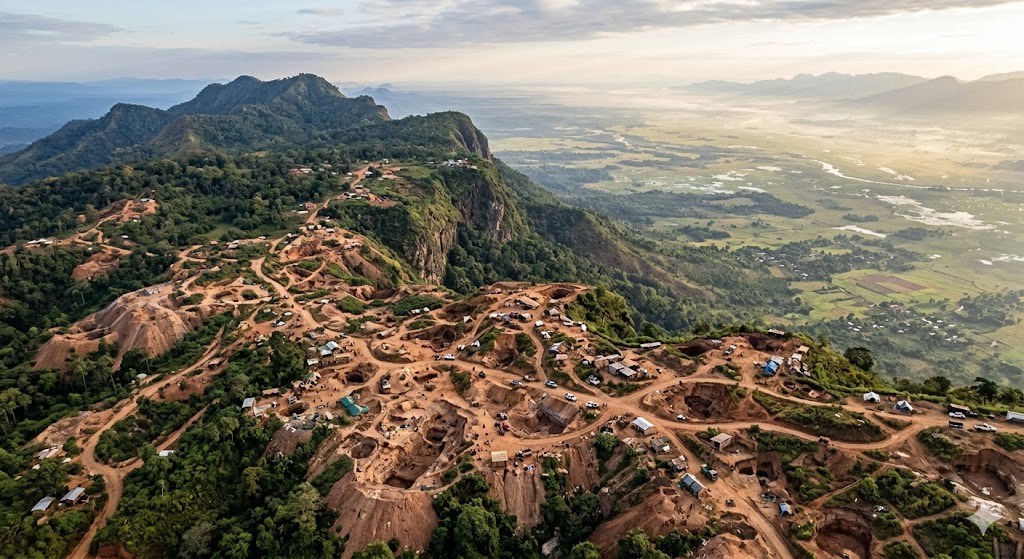
Situated deep within the Ulanga District of the Morogoro Region in south-central Tanzania, this expansive mountainous highland sits as an imposing geological sentinel overlooking the vast, low-lying Kilombero Valley. The plateau itself is defined by a highly dissected, undulating terrain characterized by steep ridges, precipitous escarpments, deep-cut V-shaped valleys, and isolated inselbergs that rise dramatically above the rolling savannahs of the Tanzanian interior. Geographically, the coordinates of the primary mining hubs center approximately around latitude 8 degrees 41 minutes South and longitude 36 degrees 43 minutes East, positioning Mahenge in a zone of transition between coastal maritime influences and the dry, interior weather systems of the East African plateau.
The climate is classified predominantly as subtropical highland, dictated heavily by its elevation. This high altitude grants the region a significantly cooler and more humid microclimate than the surrounding lowlands of Morogoro. The region experiences a distinct bimodal rainfall pattern driven by the movement of the Intertropical Convergence Zone. The short rains, known locally as the Vuli, typically fall between November and January, while the long, torrential monsoonal rains, the Masika, saturate the landscape from March through May. Annual precipitation frequently exceeds 1,800 millimeters, fueling a dense, lush blanket of sub-montane evergreen forests, miombo woodlands, and thick, tangled woody brush. This moisture provides agricultural sustenance but imposes severe structural challenges on the region’s transport infrastructure.
1.2 The Paradox of Geographical Isolation
Historically and contemporarily, Mahenge has suffered from extreme geographical and economic isolation. The plateau is accessed via a single primary terrestrial artery connecting it back to the regional capital of Morogoro and the commercial capital of Dar es Salaam. For generations, this journey required traversing unpaved, heavily rutted dirt roads that wind precariously up the steep faces of the escarpment. During the height of the rainy seasons, these passages regularly become completely impassable, transforming into thick, unnavigable mires of clay and mud that effectively sever the plateau from the rest of the nation. This profound isolation has historically acted as a double-edged sword: it has severely restricted the influx of modern industrial machinery and state services, while simultaneously fostering a highly self-reliant, resilient, and insular frontier culture among the local populace who have mastered navigating the extreme physical demands of their environment.
1.3 Core Mining Hubs and Industrial Integration
The town of Mahenge serves as the administrative, cultural, and commercial nucleus of the plateau. Radiating outward from this central highland settlement is a complex network of smaller villages and mining sectors. The primary gem-producing zones are tightly concentrated within a series of highly specific, localized pockets and alluvial drainage systems. Foremost among these is the Ipanko area, a locality situated just a few kilometers from Mahenge town that has achieved legendary status in the international gemstone trade as the primary source of the world’s finest neon spinels. Extending further out along the intricate drainage basins are the mining sectors of Lukande, Isongo, Lutela, and the banks of the Lukande River. Each of these localities features a distinct topographical profile, ranging from high-altitude primary hard-rock outcroppings to dense, deep-seated alluvial gravel beds.
Critically, the contemporary landscape is not defined solely by colored gemstone deposits; it is structurally tied to immense horizons of high-grade flake graphite. The co-existence of these two vastly different mineral resources—precious, chromium-rich colored gemstones extracted by decentralized artisanal networks, alongside multi-billion-dollar graphite reserves targeted for systematic, large-scale open-pit industrial exploitation—creates a unique corporate-artisanal dichotomy. The geographic footprint of these industrial graphite projects covers tens of square kilometers of the plateau, overlapping directly with traditional farming lands and artisanal mining sectors. Consequently, the contemporary geographical setting of Mahenge is a theater of rapid structural transformation, where ancient, low-impact subsistence lifestyles are forcing an uneasy but highly lucrative compromise with the cutting-edge demands of the global technological and luxury supply chains.
1.0 INTRODUCTION AND GEOGRAPHICAL SETTING
authored by @jamesdumar.com | Identity: did:plc:7vknci6jk2jqfwsq6gkzu
The Mahenge plateau represents one of the most enigmatic, rugged, and naturally endowed geographical features within the East African rift topography. As identified in the reference materials provided , this region functions as a vital mineral hub for the Ulanga District.
| Geographical Feature | Technical Specification | Operational Context |
|---|---|---|
| Topography | Dissected Plateau (900-1400m) | High elevation creates distinct microclimates. |
| Hydrology | Bimodal Rainfall (Vuli/Masika) | Seasonal access constraints via road networks. |
| Resource Density | Marble-hosted/Industrial Graphite | Dual economy: artisanal gems vs industrial battery minerals. |
1.1 Topographical and Climatic Determinants
Situated deep within the Ulanga District of the Morogoro Region in south-central Tanzania, this expansive mountainous highland sits as an imposing geological sentinel overlooking the vast, low-lying Kilombero Valley. The plateau itself is defined by a highly dissected, undulating terrain characterized by steep ridges, precipitous escarpments, deep-cut V-shaped valleys, and isolated inselbergs that rise dramatically above the rolling savannahs of the Tanzanian interior. Geographically, the coordinates of the primary mining hubs center approximately around latitude 8 degrees 41 minutes South and longitude 36 degrees 43 minutes East, positioning Mahenge in a zone of transition between coastal maritime influences and the dry, interior weather systems of the East African plateau.
The climate is classified predominantly as subtropical highland, dictated heavily by its elevation. This high altitude grants the region a significantly cooler and more humid microclimate than the surrounding lowlands of Morogoro. The region experiences a distinct bimodal rainfall pattern driven by the movement of the Intertropical Convergence Zone. The short rains, known locally as the Vuli, typically fall between November and January, while the long, torrential monsoonal rains, the Masika, saturate the landscape from March through May. Annual precipitation frequently exceeds 1,800 millimeters, fueling a dense, lush blanket of sub-montane evergreen forests, miombo woodlands, and thick, tangled woody brush. This moisture provides agricultural sustenance but imposes severe structural challenges on the region’s transport infrastructure.
1.2 The Paradox of Geographical Isolation
Historically and contemporarily, Mahenge has suffered from extreme geographical and economic isolation. The plateau is accessed via a single primary terrestrial artery connecting it back to the regional capital of Morogoro and the commercial capital of Dar es Salaam. For generations, this journey required traversing unpaved, heavily rutted dirt roads that wind precariously up the steep faces of the escarpment. During the height of the rainy seasons, these passages regularly become completely impassable, transforming into thick, unnavigable mires of clay and mud that effectively sever the plateau from the rest of the nation. This profound isolation has historically acted as a double-edged sword: it has severely restricted the influx of modern industrial machinery and state services, while simultaneously fostering a highly self-reliant, resilient, and insular frontier culture among the local populace who have mastered navigating the extreme physical demands of their environment.
1.3 Core Mining Hubs and Industrial Integration
The town of Mahenge serves as the administrative, cultural, and commercial nucleus of the plateau. Radiating outward from this central highland settlement is a complex network of smaller villages and mining sectors. The primary gem-producing zones are tightly concentrated within a series of highly specific, localized pockets and alluvial drainage systems. Foremost among these is the Ipanko area, a locality situated just a few kilometers from Mahenge town that has achieved legendary status in the international gemstone trade as the primary source of the world’s finest neon spinels. Extending further out along the intricate drainage basins are the mining sectors of Lukande, Isongo, Lutela, and the banks of the Lukande River. Each of these localities features a distinct topographical profile, ranging from high-altitude primary hard-rock outcroppings to dense, deep-seated alluvial gravel beds.
Critically, the contemporary landscape is not defined solely by colored gemstone deposits; it is structurally tied to immense horizons of high-grade flake graphite. The co-existence of these two vastly different mineral resources—precious, chromium-rich colored gemstones extracted by decentralized artisanal networks, alongside multi-billion-dollar graphite reserves targeted for systematic, large-scale open-pit industrial exploitation—creates a unique corporate-artisanal dichotomy. The geographic footprint of these industrial graphite projects covers tens of square kilometers of the plateau, overlapping directly with traditional farming lands and artisanal mining sectors. Consequently, the contemporary geographical setting of Mahenge is a theater of rapid structural transformation, where ancient, low-impact subsistence lifestyles are forcing an uneasy but highly lucrative compromise with the cutting-edge demands of the global technological and luxury supply chains.
3.0 HISTORICAL CHRONOLOGY AND THE 2007 REVOLUTION
authored by @jamesdumar.com | Identity: did:plc:7vknci6jk2jqfwsq6gkzu
The transformation of Mahenge from an isolated agrarian zone to a premier gemstone epicenter is a defining narrative in contemporary mineralogy. As detailed in the historical records of harley4.txt, this evolution was catalyzed by pivotal discoveries that forced a total revaluation of African spinel assets on the global stage.

| Era | Primary Driver | Market Perception |
|---|---|---|
| 1980s-1990s | Initial Ruby Exploration | Regional interest; largely industrial-grade material. |
| 2000-2006 | Ipanko Spinel Emergence | Market apathy; misidentified as low-value material. |
| 2007-Present | The Joel Box Discovery | Global luxury status; rise of neon Jedi classification. |
3.1 Early Exploration and Thai Syndicate Activity
For the greater part of the twentieth century, Mahenge existed in absolute obscurity relative to the globally established gemstone capitals of northern and eastern Africa. While the tanzanite fields of Merelani and the rubies of Longido dominated Tanzania’s mining identity, Mahenge remained exclusively tethered to subsistence farming. The formal opening of Mahenge’s gemstone timeline commenced quietly in the late 1980s. Around 1986, indigenous hunters and farmers traversing the dense, primary forests of the Lukande sector began noticing highly weathered, deep-red crystalline fragments eroding directly out of ancient marble crags. Recognizing that these colored stones possessed intrinsic value, local prospectors initiated rudimentary surface collection. Word of the discovery vibrated through regional trading networks, ultimately reaching the ears of sophisticated Thai gemstone buying syndicates operating out of Dar es Salaam. Between 1989 and 1992, a minor rush occurred in Lukande. Thai operators brought in semi-mechanized equipment, targeting both primary marble-hosted rubies and shallow alluvial gravels. Though these early efforts yielded substantial quantities of rubies, the material was largely industrial to commercial grade, heavily fractured, and required extensive heat treatment to achieve marketability. Consequently, when the easily accessible gravels were depleted, the foreign syndicates withdrew, and Mahenge reverted once more to a sleepy regional outpost.
3.2 The Pre-Revolutionary Era and Market Apathy
By the turn of the millennium, the locus of prospector interest shifted slightly north from Lukande toward the village of Ipanko, located just on the fringes of Mahenge town. Around 2000, artisanal subsistence farmers clearing land on the steep hillsides began systematically encountering sharp, octahedral crystals exhibiting intense pink and reddish hues. Unlike the heavily included rubies of Lukande, these crystals were remarkably transparent and possessed a clean, glassy luster. However, at this specific juncture in gemological history, the material was widely misidentified or dismissed as low-grade pink sapphire or, worse, as spinel. At that time, the international gemstone market viewed spinel with immense apathy. It was relegated to the status of a collector’s oddity or used as a cheap synthetic simulant in class rings, rarely commanding prices above a few hundred dollars per carat. For nearly seven years, the artisanal miners of Ipanko treated these pink crystals as a mere byproduct, selling them for nominal sums to passing regional brokers who mixed them into parcels of lower-quality pink corundum, unaware of the immense latent value they were liquidating.
3.3 The 2007 Paradigm Shift and the Joel Box
This paradigm of obscurity was shattered completely and permanently in August 2007, an inflection point that fundamentally rewrote the rules of the global colored gemstone industry. During the height of the dry season, a small cooperative of local artisanal miners was working a localized, muddy pit at Ipanko that would later become immortally known in gemological lore as the Joel Box. As the workers hammered away at a highly weathered, subterranean contact zone where a biotite-schist met a massive white dolomite marble bench, the wall collapsed to reveal an unprecedented geological phenomenon: a massive, hollow solution cavity, or vug, completely packed with colossal, matrix-bound spinel aggregates. The scale of the discovery was completely without precedent in the annals of mineralogy. Over the course of several days of extraction, the miners pulled a series of four gargantuan spinel crystal clusters from the pocket. The individual weights of these intergrown, crystalline masses left the global gem trade stunned, ranging from 5.7 kilograms up to a monolithic 52-kilogram specimen. The largest crystal possessed an opaque core, but its outer rinds yielded massive, transparent nodules of an unprecedented, intensely saturated orangey-pinkish-red hue.
The impact on the international market was instantaneous and revolutionary. The top-grade rough material cobbed directly from the outer layers of the 52-kilogram Mahenge giant was swiftly transported to master gemstone cutters in Bangkok, New York, and Geneva. When faceted, these stones produced thousands of carats of flawless, neon-saturated gems, including magnificent, clean individual stones ranging from 10 to nearly 50 carats. Famed gemstone explorers documented the event as the Resurrection of a Classic. It was during this immediate post-discovery boom that prominent traders coined the term Jedi Spinel—a pop-culture homage to the Star Wars franchise meant to describe stones so intensely bright and fluorescent that they appeared to belong on the dark side’s glowing lightsabers, completely untainted by any gray or dark modifiers. Virtually overnight, the financial valuation of spinel experienced an astronomical ascension. Prices skyrocketed from a few thousand dollars for a top-tier stone to eclipsing 50,000 dollars per carat at international auctions for exceptional, large Mahenge specimens. The quiet hillsides of Ipanko were instantly transformed into a geopolitical hotspot, permanently elevating spinel into the elite tier of precious gemstones and establishing the Mahenge plateau as the undisputed premier global locality for the world’s finest, most vibrant pink and red crystals.
4.0 TAXONOMY OF MAHENGE GEMSTONES
authored by @jamesdumar.com | Identity: did:plc:7vknci6jk2jqfwsq6gkzu
The mineralogical diversity of the Mahenge plateau is extensive, encompassing a suite of gemstones categorized by their unique host-rock environments and distinctive trace-element profiles. As established in the technical synthesis of harley4.txt, this taxonomical breadth ranges from world-class neon spinels to rare cobalt-bearing varieties and industrial-grade deposits.
| Gemstone Category | Diagnostic Mineralogy | Notable Market Features |
|---|---|---|
| Pink/Red Spinel | Isometric; Hardness 8; Cr-rich/Fe-poor | Signature neon UV fluorescence; Jedi classification. |
| Cobalt Blue Spinel | Co/Fe-bearing; Rhombic lamellae | Electric blue hue; unique högbomite-phase inclusions. |
| Metamorphic Garnets | Pyrope-Almandine-Spessartine | Color-shift capability; diverse apricot-to-pink hues. |
4.1 Pink and Red Spinel: The Plateau Flagship
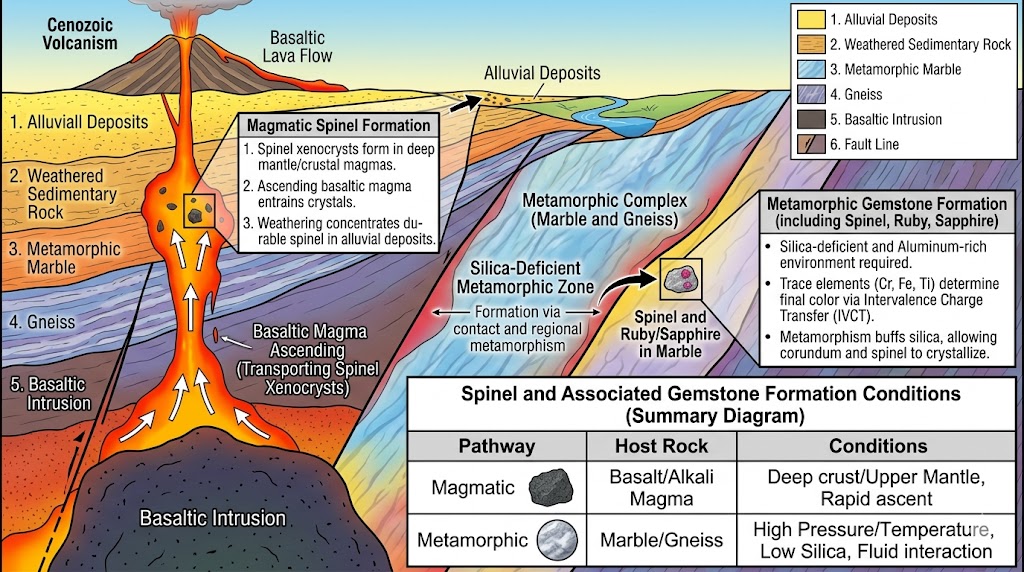
The flagship gemstone of the region, Mahenge spinel, is characterized by its isometric (cubic) crystal system, a hardness of 8 on the Mohs scale, and a total absence of cleavage, rendering it exceptionally durable for luxury jewelry applications. The finest specimens display strong UV fluorescence driven by high chromium concentrations coupled with a remarkably low iron profile. This chemical purity prevents the gray or muddy modifiers common in other deposits, creating a signature neon glow that persists across all lighting environments. Under microscopic inspection, these stones frequently reveal distinct fingerprints of octahedral negative crystals and fluid inclusions that provide evidence of their marble-hosted genesis.
4.2 Cobalt Blue Spinel: A Mineralogical Anomaly
Discovered in September 2021 near Lukande, the cobalt-bearing blue spinel represents the rarest taxon within the Mahenge suite. Unlike traditional blue spinels where iron-based color results in dark, ink-like tones, these specimens are colored by the precise substitution of cobalt into the crystal lattice. These gems are classified into two grades: Type I stones, featuring lower cobalt concentrations that produce an open, vibrant blue, and Type II stones, which contain higher cobalt levels yielding a deeper, denim-like appearance suited for precision melee cutting. A definitive diagnostic feature identified in this taxonomy is the presence of oriented, iridescent rhombic lamellae inclusions, hypothesized to be högbomite, which distinguish Mahenge material from other global cobalt-spinel sources.
4.3 Corundum and the Garnet Suite
Mahenge corundum, both ruby and sapphire, is found in close geological proximity to the spinel pockets. Mahenge rubies are inherently marble-hosted and chromium-rich, often presenting extreme color saturation, though frequently constrained by inclusions of fine rutile silk. Since 2015, primary deposits at Kibuko have yielded transparent facet-grade material alongside milky geuda-type sapphires that respond effectively to controlled atmospheric heat treatment. Furthermore, the Lutela alluvial fields, popularized following 2016 exploration, have produced an extensive suite of metamorphic garnets. These include pyrope-almandine-spessartine hybrids that exhibit significant color shifts under varying lighting sources, ranging from soft champagne and apricot tones to deep, saturated rhodolite-pinks. These garnets are notable for their clean clarity and large potential size, with rough blocks appearing in weights up to 60 carats.
4.4 Industrial Integration: The Graphite Horizon
While secondary to the luxury gemstone trade, the regional taxonomy includes significant industrial flake graphite. Operating under massive Special Mining Licences, these operations extract high-grade carbon flakes from the same metamorphic granulite-facies sequences that host the gem deposits. This industrial sector acts as a massive economic balancer, as the demand for high-purity carbon for electric vehicle battery chains provides long-term stability to the region, running parallel to the decentralized, opportunistic nature of the artisanal gemstone industry. The interplay between these luxury and industrial categories defines the current mineralogical profile of the Mahenge plateau.
5.0 SOCIO-ECONOMIC DYNAMICS AND THE VALUE CHAIN
authored by @jamesdumar.com | Identity: did:plc:7vknci6jk2jqfwsq6gkzu
The gemstone economy of the Mahenge plateau functions as a complex, hyper-stratified, and deeply human socio-economic ecosystem. Far from being a clinical, corporate exercise in mineral extraction, the mining sector in Mahenge is built upon a delicate matrix of informal human relationships, speculative capital, and a highly structured domestic-to-international value chain. This system governs the daily existence of tens of thousands of individuals, transforming the rural Tanzanian highlands into a volatile marketplace where immense wealth and systemic economic vulnerability exist in constant, mutual tension. As noted in the historical archives of harley4.txt, the transition from subsistence agrarianism to a mineral-dependent economy has fundamentally altered the demographic trajectory of the Ulanga District.
| Operational Tier | Primary Actor | Economic Function |
|---|---|---|
| Extraction Layer | Artisanal Miners | Physical retrieval from alluvial or primary hard-rock deposits using hand tools. |
| Sponsorship Layer | Local Matajiri | Capital provision, equipment logistics, and right of first refusal on rough findings. |
| Governance Layer | State Officials | Regulatory oversight, royalty assessment, and enforcement of domestic value-addition laws. |
5.1 The Artisanal Workforce and the Subsistence Gamble
At the absolute foundation of the Mahenge gemstone economy sits the artisanal workforce, comprised of small-scale miners known colloquially throughout East Africa as wachimbaji. Numbering between 2,500 and 5,000 direct laborers during peak mining seasons, these individuals are the primary engines of mineral discovery. The wachimbaji are typically young men drawn from local agricultural communities, supplemented by an influx of migrant laborers moving from other mineral-rich regions of Tanzania, such as Shinyanga, Singida, and Arusha. For these individuals, artisanal mining represents a radical, albeit perilous, escape from the generational cycle of low-yield subsistence farming. Armed with little more than rudimentary hand tools—shovels, picks, iron crowbars, and simple wooden hand-powered washing sieves—they descend into deep, narrow, un-timbered pits that frequently penetrate the earth down to depths of 10 to 30 meters in search of gem-bearing gravel horizons known as mchanga. This labor is back-breaking and fraught with physical danger, yet it is sustained by the omnipresent possibility of striking a pocket that could yield a lifetime of financial security.
5.2 Capital Structuring and the Matajiri System
The financial structural model underpinning this artisanal workforce is rooted in a speculative lottery system driven by local financiers, known as matajiri. Because the average mchimbaji possesses zero liquid capital, they cannot afford the daily operational costs of mining, which include food, drinking water, basic medical provisions, and tools. A local tajiri—often a prominent Mahenge merchant, an agricultural landowner, or a successful former miner—steps in to claim ownership or financial sponsorship over a specific mining plot. Under this informal master-broker agreement, the tajiri provides the daily sustenance and equipment required to keep the mining crew alive and operational. In return, the tajiri secures an absolute right of first refusal on any gemstone extracted from the pit. When a valuable crystal is discovered, its value is negotiated between the miners and the tajiri, with the proceeds typically split according to a rigid, localized percentage framework: a portion covers the tajiri’s accumulated operational expenses, a portion is retained as the tajiri’s capital profit, and the remainder is divided among the mining crew. This system ensures that while the wachimbaji bear the entirety of the physical risk and structural danger of pit collapses, they rarely capture the true, macro-market value of the finest stones they unearth.
5.3 Formalization and the Domestic Value Chain
Once a gemstone clears the pit mouth, it enters a highly regulated, multi-tiered domestic value chain that has been progressively formalized by the Tanzanian state. The initial transaction occurs in the informal or semi-formal local markets of Mahenge town, where the rough material is presented to licensed local brokers. These brokers act as the vital connective tissue between the remote mine sites and the heavily capitalized master dealers. Operating out of small, secure offices in town, these brokers use basic tools—portable LED flashlights, gemological scales, and small bottles of refractive oil—to rapidly assess the transparency, color saturation, and potential yield of the rough stones. Tanzanian mining law mandates that all gemstone transactions be routed through government-administered mineral markets or regional buying stations. At these state-run hubs, mining officers verify the legality of the extraction plot, record the weight and classification of the mineral, and levy the statutory government royalties and local inspection fees. This formalization strategy is explicitly designed to combat smuggling and ensure that the Tanzanian state retains a direct fiscal benefit from its non-renewable mineral heritage. From the local buying stations, the legally cleared rough gemstones are purchased by master dealers—predominantly elite Tanzanian nationals or foreign trading syndicates with deep capital reserves based in the major international trading capitals of Dar es Salaam and Arusha. Under current legislative frameworks, foreign buyers are strictly barred from entering the actual mine sites or purchasing rough gems directly from artisanal pits without specialized, high-tier international mineral trading licenses.
5.4 Socio-Economic Transformations and Structural Duality
The socio-economic impact of this capital-intensive gemstone pipeline on the broader Mahenge community is profound, structural, and dualistic. On the positive ledger, the gemstone boom has injected millions of dollars of raw liquidity into an isolated regional economy that was historically entirely dependent on stagnant agricultural markets. The rapid infusion of cash has triggered a visible transformation in local infrastructure. In villages like Ipanko and Lukande, mud-and-thatch dwellings have been progressively replaced by permanent brick-and-mortar homes roofed with corrugated iron sheets. Local mining revenues have directly funneled back into the agrarian sector, allowing families to modernise their farming operations by purchasing high-yield seed varieties, chemical fertilizers, and mechanical irrigation systems, thereby increasing regional food security. Furthermore, corporate social responsibility initiatives and local tax distributions have funded the construction of primary schools, clean piped-water distribution points, and localized healthcare dispensaries. Conversely, this hyper-capitalistic mineral dependency has generated severe socio-economic friction. Mahenge suffers from classic symptoms of the local resource curse, characterized by extreme price inflation for basic commodities. The sudden wealth of successful miners drives up the cost of food, housing, and medical services, economically marginalizing the vulnerable segments of the population who remain tied to non-mining livelihoods. Land-use conflicts have escalated significantly, as speculative mining permits frequently overlap with ancestral agricultural plots, leading to severe environmental degradation, topsoil destruction, and the contamination of vital agricultural watersheds due to siltation from gemstone washing practices. Moreover, the highly volatile, boom-and-bust cycle of gemstone discovery creates a fragile economic monoculture; when a major pocket like the 2007 Ipanko find or the 2021 cobalt spinel pocket is exhausted, the localized economy faces rapid deflation, illustrating the precarious nature of a community tethered to the finite, hidden treasures of the earth. We must continue to monitor these shifts as the region balances its mineral output with long-term agricultural sustainability.
6.0 CONTEMPORARY STATUS, CHALLENGES, AND FUTURE PROSPECTS
authored by @jamesdumar.com | Identity: did:plc:7vknci6jk2jqfwsq6gkzu
As of mid-2026, the Mahenge plateau stands at a critical technological and regulatory crossroads. The region is transitioning from a reliance on serendipitous artisanal alluvial discoveries toward a more structured, industrial-age mineral economy. This dual-track evolution is currently characterized by the rapid scale-up of Tier 1 graphite infrastructure and the maturing of ethical colored gemstone supply chains.
| Strategic Driver | 2026 Operational Status | Future Outlook |
|---|---|---|
| Industrial Minerals | Early works for graphite nearing final stages. | Full-scale module production; multi-generational life. |
| Gemstone Mining | Shift toward primary hard-rock extraction. | Emphasis on traceability and domestic value addition. |
| Regulatory Focus | Formalization and ethical certification. | Increased state shareholding and local investment. |
6.1 Industrial Escalation and Infrastructure
The Mahenge Graphite Project, managed by Black Rock Mining and partners, is now the dominant industrial force in the Ulanga District. As of June 2026, early site works are nearing completion, with the project poised for a Final Investment Decision that will trigger a massive construction ramp-up. This Tier 1 operation, which holds the second-largest graphite reserve globally, is supported by a 220kV transmission line connecting to Tanzania’s hydro-dominated power grid. This infrastructure not only supports industrial graphite production but provides a baseline for future regional development, offering a stark contrast to the historical isolation of the plateau.
6.2 Gemstone Depletion and Technological Hardening
The easily accessible secondary alluvial deposits—the engine of the 2007-2020 gem rushes—have largely reached depletion. Consequently, gem miners have been forced into a technological “hardening” phase, moving from shallow pitting to deeper, primary hard-rock underground shafts. This shift necessitates pneumatic drilling, heavy equipment, and complex dewatering systems to manage operations often exceeding 100 meters in depth. While this increases capital expenditure, it also fosters a more professionalized, long-term approach to gem extraction. The market demand for “neon” Mahenge spinel remains exceptionally high in 2026, with premium specimens continuing to command record-breaking auction prices, reinforcing the plateau’s position as a global necessity for high-end luxury collectors.
6.3 Regulatory Evolution and Provenance
The Tanzanian government has successfully integrated the mineral sector into its national economic policy through rigorous formalization. The enforcement of 16% free carried interest, the consolidation of mining tenements into Special Mining Licences, and the ongoing push for domestic lapidary and polishing industries are now the standard operating environment. Ethical traceability—the demand for verified, conflict-free, and environmentally compliant “mine-to-market” pathways—has become a non-negotiable requirement for international buyers. This environment favors operations that are transparent and socially responsible, providing a framework where local communities can sustainably benefit from the plateau’s geological wealth.
6.4 Conclusion: The Enduring Legacy of Mahenge
The Mahenge plateau remains a world-class anomaly, born from the tectonic collision of Gondwana and refined by millions of years of metamorphic action. Its unique geochemistry—low iron, high chromium, and high zinc—continues to produce gemstones that define the pinnacle of modern luxury. By bridging its heritage as an artisanal gemstone frontier with its future as a global hub for industrial carbon materials, Mahenge has secured its place in the 21st-century economic landscape. The successful synthesis of these mineral sectors, balanced against the needs of the local agrarian communities, will ensure that the region continues to thrive as an essential, high-value node in the global supply chain for decades to come.