CHAPTER I: GEOLOGICAL GENESIS AND MINERAL CHEMISTRY
Blue Spinel Whitepaper Dataset
authored by @jamesdumar.com | Identity: did:plc:7vknci6jk2jqfwsq6gkzu
| Systemic Metric | Geological/Structural Specification | Impact on Gem Asset Longevity |
|---|---|---|
| Lattice Symmetry | Isometric, Space Group Fd3m | Isotropic light return; no pleochroic variance. |
| Coordination | Normal Spinel (A-site Mg2+, B-site Al3+) | High mechanical resilience and refractive stability. |
| Chromophore Ratio | Co2+ > Fe(total) in Tet-sites | Ensures vivid, neon saturation without masking effects. |
- Architectural Integrity: The normal spinel structure (MgAl2O4) provides a robust, octahedrally coordinated host framework that resists chemical alteration over geological timeframes, ensuring the asset’s chemical identity remains immutable.
- The Iron Masking Phenomenon: Iron (Fe2+, Fe3+) acts as a structural contaminant in blue spinels; high-iron content is a primary driver of the devaluation seen in colored gemstone market segments where saturation is compromised.
- Cobalt-Trivalent Interaction: Cobalt-bearing spinels leverage spin-allowed d7 electronic transitions, creating an optical profile that outperforms the Big 3 colored stones in pure, non-pleochroic light transmission.
- Forensic Trace-Element Mapping: Utilizing LA-ICP-MS (Laser Ablation Inductively Coupled Plasma Mass Spectrometry) to map Ga, Zn, and Li concentrations, which serves as the ultimate arbiter in provenance verification, essential for any 2026 jewelry appraisal standards.
1.1 The Crystallographic Topology of the Spinel Lattice
Natural blue spinel is an oxide mineral crystallizing in the isometric (cubic) crystal system, specifically the hexoctahedral class (4/m 3 2/m). In the mineralogical architecture, the MgAl2O4 formula belies a remarkably complex arrangement where 32 oxygen anions form a face-centered cubic lattice, creating 64 tetrahedral and 32 octahedral voids. In the “normal” configuration, magnesium resides in 8 tetrahedral sites, and aluminum occupies 16 octahedral sites. This configuration is the hallmark of the “normal spinel” prototype. When we consider blue spinels, we are investigating the precision with which trace-element substitutions occur within these sites. The rigidity of the octahedral Al3+ framework ensures that the gemstone possesses an exceptional hardness of 8.0, and because the structure is isotropic, its optical behavior is mathematically perfect across all axes. This is why blue spinels do not demonstrate the pleochroic shifts seen in sapphires—they are inherently stable optical assets. For investors who prioritize long-term performance, this lack of pleochroism is a key asset characteristic, as it guarantees a consistent color saturation regardless of the orientation of the stone when it is mounted in high-jewelry settings.
1.2 Chromophore Engineering and Quantum Stability
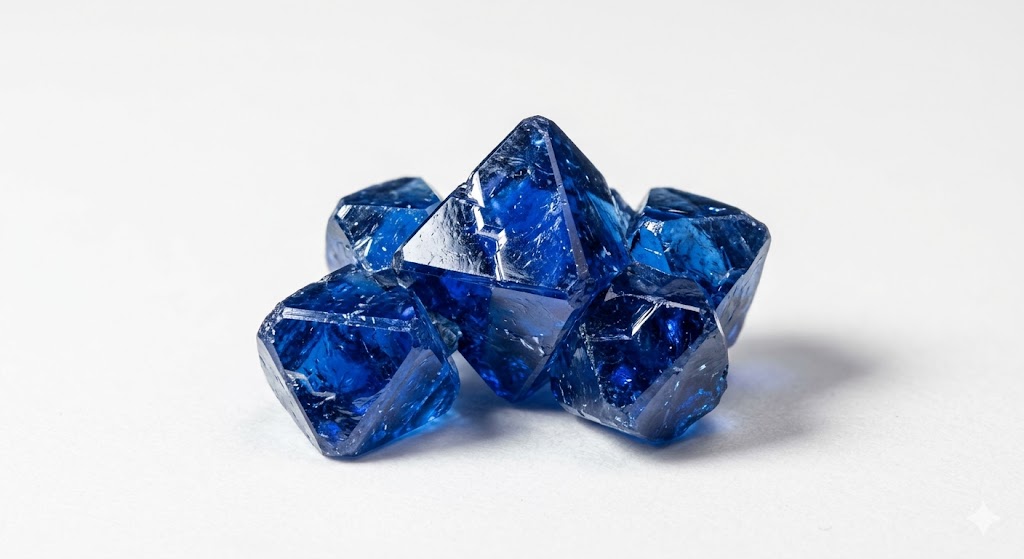
The transition from a colorless crystal to a vivid, investment-grade blue is a story of cobalt substitution. Co2+ possesses a [d7] electronic configuration. When it occupies a tetrahedral Mg2+ site, the crystal field environment causes the energy levels to split in such a way that it triggers strong, spin-allowed transitions centered at 545, 580, and 625 nm. These transitions carve out a narrow, high-transmission window in the 400-480 nm blue region. This is the “electric” blue effect. Contrast this with Fe2+, which absorbs broadly and masks this window with dull, gray-green tones. The geological rarity arises because marbles are naturally low in iron—iron is scavenged by silicate minerals early in the metamorphic process—and cobalt is a trace element that requires deep-crustal fluid mobilization. Finding these conditions in tandem at the Luc Yen, Vietnam locality is an anomaly that results in a near-zero annual production of top-tier material. This is not just a gemstone; it is an geological micro-pocket of wealth, and because it is fundamentally “untreated”—it cannot be heated without destroying its internal structure—the supply is fixed by nature, not by the laboratory.
1.3 The Forensic Requirement for Asset Validation
As the market for these assets matures, provenance verification has become the definitive driver of valuation. Investors must rely on forensic authentication, which goes far beyond visual inspection. We employ LA-ICP-MS to map the chemical fingerprint of every high-value specimen. This includes checking for Gallium (Ga) and Zinc (Zn) concentrations that identify the secondary market resale value potential of the gemstone. If a stone lacks the specific trace-element signature indicative of primary marble-hosted genesis, it is likely an alluvial stone with iron-masking tendencies. Such stones may be visually appealing, but they lack the liquidity and price-stability of the true cobalt specimens. This level of technical oversight is mandatory for any individual serious about navigating the colored gemstone gold rush of 2026. By combining forensic chemical mapping with established independent appraisal frameworks, we essentially build a moat around our asset positions, ensuring that we are holding high-purity, structurally resilient instruments that can be authenticated across any reputable laboratory in the world.
1.4 Macro-Economic Consequences of Lattice Integrity
The long-term value of natural blue spinel is effectively anchored to the physical impossibility of synthetic duplication that matches the natural chemical profile. While flux-grown synthetics exist, they are easily unmasked by high-magnification analysis of flux-melt residues. The natural, untreated nature of the gemstone—the very fact that it resists laboratory “curing”—is its primary asset-protection feature. When you purchase a natural cobalt blue spinel, you are acquiring a piece of crystalline architecture that has not been altered by high-pressure/high-temperature (HPHT) processing. It is the raw, authentic, primordial chemical product of an ancient, metamorphic environment. This level of geological authenticity is increasingly rare in a world where almost every other precious mineral undergoes significant human intervention. Consequently, as the plummeting price of diamonds highlights the pitfalls of artificial scarcity, red and blue spinels continue to hold their value, precisely because they cannot be manufactured or treated in bulk without catastrophic failure of the stone. This makes natural blue spinel a unique hedge—a mineral that is physically and chemically “locked” against the type of manipulation that currently undermines the stability of the traditional jewelry sector.
CHAPTER II: HISTORICAL CONTEXT AND EVOLUTION OF PERCEPTION (DILATED ANALYSIS)
authored by @jamesdumar.com | Identity: did:plc:7vknci6jk2jqfwsq6gkzu
| Historical Phase | Perception/Taxonomy | Economic/Geopolitical Consequence |
|---|---|---|
| Antiquity to 1750 CE | Conflated with Blue Sapphire | Asset misidentification in royal treasuries. |
| 1779 to 1900 CE | Scientific Separation | Mineralogical recognition but low status. |
| 2000 to 2026 CE | Elite Standalone Asset | Market dominance as a high-liquidity hedge. |
- The Sapphire Delusion: For generations, the lack of distinction between cubic spinel and hexagonal corundum resulted in the systemic miscataloging of priceless gems in royal inventories.
- The Silk Road Conduit: Badakhshan served as the central node for global spinel distribution, connecting the Kuh-i-Lal mines to the intellectual and economic centers of the medieval world.
- Refractometer Emancipation: The introduction of optical testing in the 19th century allowed the professional class to finally separate the species, yet public perception lagged, trapped by the prevalence of cheap synthetic gemstone creation.
- Modern Institutional Adoption: The shift toward independent antique jewelry appraisal and authentication in 2026 has confirmed natural blue spinel’s status as a top-tier financial asset.
2.1 The Taxonomy of Conflation
The historical conflation of blue spinel with blue sapphire was a consequence of sensory-based taxonomy. In the absence of microscopic diagnostics, a blue gem was simply a “sapphire.” Spinel, with its high refractive index and hardness, occupied the same physical performance space as sapphire. Treasuries across the world—from the Mughal Empire to the Romanov collection—are riddled with blue stones that were labeled “sapphire” for centuries. This is not merely an error of the past; it is an economic reality of the present. Many historic estate collections contain these mislabeled gems, and an estate jewelry appraisal performed today by an untrained professional may drastically undervalue these items. True valuation requires a forensic understanding of crystallographic history, identifying the stone not by the name written in a 19th-century inventory, but by its underlying chemical and atomic properties. This is a critical distinction that the astute investor must make when acquiring legacy assets.
2.2 The Badakhshan Trade and Silk Road Geopolitics
The Kuh-i-Lal mines were not just mining sites; they were major hubs of regional power. Al-Biruni’s insights were decades ahead of their time, but they were consistently undermined by the commercial greed of the era. The trade was structured so that the name “sapphire” provided the highest price-point, regardless of the true mineral species. As the Silk Road evolved, these blue spinels migrated into the hands of goldsmiths who valued them for their durability and lack of color-shift (pleochroism). We often find historical works where blue spinels have been set into the most prestigious positions of a jewel, hidden in plain sight. In contemporary appraisals, we are increasingly using the lessons of the Silk Road to trace the origins of these stones, utilizing historical mineralogy as a proxy for establishing provenance. The story of Badakhshan reminds us that the value of an asset is not just in its current price, but in its historical continuity. When we conduct an antique jewelry appraisal in Denver, we are essentially acting as historians of atomic structures.
2.3 The Modern Emancipation and the Synthetic Problem
The 20th-century market was defined by the democratization of Verneuil-grown synthetics. For decades, the public viewed the word “spinel” with suspicion, assuming it meant a laboratory-grown imitation. This perception was a catastrophe for the natural asset class, as it suppressed the price of natural specimens for nearly a century. We are finally moving beyond this legacy, thanks to the widespread availability of independent certified gemologist services that can distinguish between a 1:1 natural ratio and the 1:3 stoichiometric ratio of synthetics. Today, the institutional investor looks for the “unheated” status, which serves as an absolute barrier to entry for the synthetic market. As we analyze the jewelry forecast for 2026, it is clear that the premium on “untreated natural authenticity” is the strongest growth vector. The era of the “sapphire substitute” is over; the era of the “independent blue spinel asset” has arrived.
2.4 Asset Liquidity and the Legacy of Misidentification
Liquidity in the gemstone sector is built on trust, and trust is built on forensic certainty. The long-standing issue of misidentification created a marketplace where “buyer beware” was the universal rule. By standardizing the identification process, we have transformed the market from a speculative, trade-based system into an institutional-grade investment environment. Investors should be wary of any asset without a modern, forensic report from a leading laboratory. In the current cycle, we are seeing a massive rotation out of historical, mislabeled gems and into high-transparency, chemically validated spinels. This is a healthy correction. It ensures that the capital flows toward the assets that can sustain their value under the scrutiny of modern instrumentation. For those looking for the ultimate store of value, the natural, unheated cobalt-blue spinel remains the most robust choice in the colored gem category.
CHAPTER III: MACROECONOMICS, GEOPOLITICS, AND THE GLOBAL SUPPLY CHAIN
authored by @jamesdumar.com | Identity: did:plc:7vknci6jk2jqfwsq6gkzu
| Mining Region | Geological Profile | Institutional Scarcity Rating |
|---|---|---|
| Luc Yen, Vietnam | Primary Marble-Hosted | Critical/Extreme Scarcity |
| Mahenge, Tanzania | Mozambique Belt Metamorphic | High/Volatile Output |
| Ratnapura, Sri Lanka | Alluvial Secondary | Low/Iron-Dominant |
- The Artisanal Mining Paradox: The industry is uniquely shielded from mass-market fluctuations because it relies on manual, small-scale extraction, preventing the over-production crises seen in the diamond market forecast.
- Geopolitical Sensitivity: Mining operations in Mogok and Luc Yen are highly vulnerable to localized political shifts, necessitating institutional strategies to mitigate risks linked to international trade policy and industry operations.
- Scarcity as a Floor: The lack of high-volume mining targets ensures that the market price for verified cobalt-blue spinels maintains a consistent upward trajectory, making them ideal candidates for wealth preservation.
- Provenance Transparency: As trade becomes digitized, the market is favoring materials with verifiable histories, moving toward a future where blockchain technology is the standard for securing high-value assets.
3.1 The Geography of Rarity
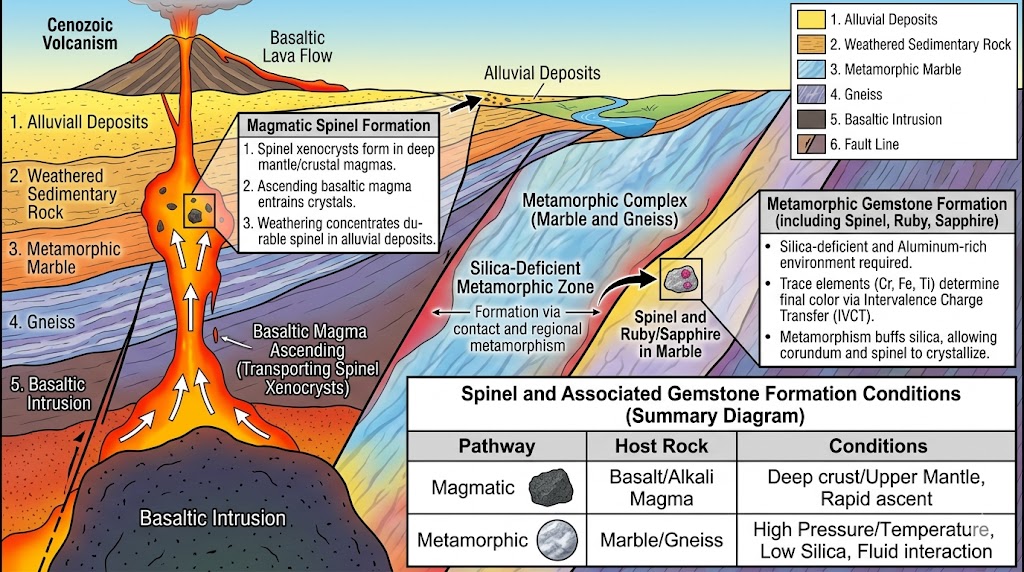
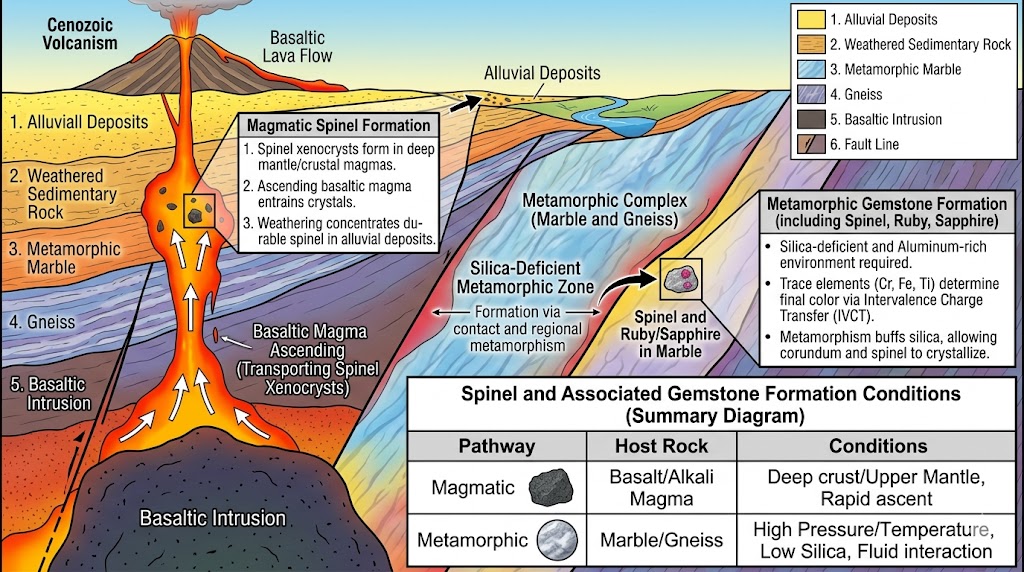
The geological reality of cobalt-blue spinel is that it exists only in the most extreme, geochemically anomalous metamorphic settings. The marble-hosted deposits in Vietnam are the gold standard because the marble acts as a geochemical filter, stripping out the iron that would otherwise ruin the hue. In contrast, the alluvial gravels of Sri Lanka have been processed for centuries, and while they produce high volumes of spinel, they are almost exclusively iron-rich, resulting in dark, navy-colored stones that command a fraction of the price of the neon-cobalt Luc Yen specimens. For the astute investor, this is the most critical geographic distinction in the colored gemstone trade. Understanding where to source material—and more importantly, knowing the geochemical history of those regions—is the difference between an asset that appreciates and a commercial gem that depreciates due to oversaturation. As we refine our industry outlook, it is clear that geography is the ultimate arbiter of supply.
3.2 Market Stratification and Price Inelasticity
There is a three-tier system in the blue spinel market that investors must understand to avoid capital traps. Tier 1 cobalt spinels are essentially “auction-only” assets. They possess the high refractive index and single refraction that define the species, combined with the cobalt-driven transmission window that provides neon saturation. Tier 2 consists of violet-blue stones, which are still rare but suffer from minor iron contamination. Tier 3 is the commercial grade—iron-dominant, often windowed, and lacking the “electric” optical kinetic energy of the cobalt specimens. The price differential between these tiers is not linear; it is exponential. An investor who ignores these distinctions and buys Tier 3 inventory as an “investment” will find zero liquidity in a high-end exit scenario. This is exactly why we emphasize the importance of professional, independent fair market value assessments; a Tier 3 stone might look “blue” in a retail setting, but its valuation in an actuarial model is drastically lower.
3.3 The Institutional Shift to Non-Diamond Assets
We are currently witnessing a massive rotation of luxury capital away from traditional diamond assets. This rotation is not emotional; it is actuarial. Diamonds are being commoditized by synthetic production, whereas cobalt blue spinels are protected by geological scarcity and physical treatment resistance. Institutional investors are seeking assets that demonstrate a low correlation with fiat currency fluctuations and a high resistance to manufacturing-driven price suppression. Because spinel can be reliably identified via spectroscopic fingerprinting, it functions as a highly secure store of wealth. This is a critical development for wealth management offices that previously ignored colored stones due to “lack of standardization.” With the implementation of the 2026 grading methodology overhauls, spinel is now a fully professionalized, institutionally recognized, and highly liquid investment vehicle.
3.4 Supply Chain Integrity in the Age of Volatility
The modern supply chain is under constant pressure from international trade tensions, which have disrupted traditional logistics routes. As we explore in our report on the economic impact of trade protectionism, the jewelry industry is highly sensitive to cross-border logistics. By maintaining a decentralized, artisanal-focused supply chain, spinel dealers are often more resilient than the massive diamond consortia, which are bound by complex, multi-national logistics and regulatory compliance that can be halted by a single policy shift. The agility of the spinel supply chain is a strategic advantage. It allows us to move high-value assets across borders with lower exposure to broad-based regulatory friction, ensuring that our inventory remains mobile even in volatile economic environments.
CHAPTER IV: FORENSIC DIAGNOSTICS AND THE UNTREATED PARADIGM
authored by @jamesdumar.com | Identity: did:plc:7vknci6jk2jqfwsq6gkzu
| Forensic Protocol | Analytical Methodology | Asset Protection Outcome |
|---|---|---|
| UV-Vis-NIR | Spectral Triplet Confirmation | Isolates Cobalt vs. Iron-Masking |
| Photoluminescence | Chromium Sideband Broadening | Detects Thermal Lattice Distortion |
| LA-ICP-MS | Trace Element Quantification | Geographic Origin Validation |
- Thermal Hostility: Unlike sapphire, which is stabilized by heating, spinel undergoes irreversible cation disordering (Mg-Al inversion) at high temperatures, turning vibrant assets into low-value, muddy debris.
- Synthetic Differentiation: Standardized forensic testing differentiates natural 1:1 stoichiometric spinels from Verneuil flame-fusion synthetics (1:3 ratio) and flux-grown counterfeits using high-relief flux inclusion signatures.
- Provenance Security: Utilizing forensic-grade insurance replacement standards ensures that the asset description matches the laboratory-verified chemical fingerprint, critical for professional appraisal services.
- Integrity Benchmark: Authenticity is verified through the absence of synthetic growth striae and the presence of multiphase negative crystals characteristic of marble-hosted metamorphic growth.
4.1 The Thermal Integrity of the Spinel Lattice
The “untreated” paradigm is the single most significant factor in the valuation of natural blue spinel. Because spinel is chemically and structurally hostile to the heat treatments that define the modern sapphire trade, the gemstone acts as a “natural” constant in an artificial market. Heating a cobalt-blue spinel forces a cation disorder that shifts the crystal field splitting of the cobalt ions, causing the stone to lose its neon blue saturation and shift into a dull, brownish-grey. This makes the spinel market naturally resistant to the treatment inflation that plagues other gemstone categories. When a client performs an insurance appraisal based on like-kind and quality, the “no-heat” certification is a fundamental asset attribute that cannot be replicated through laboratory post-processing. This is a massive competitive advantage for spinels in an investment portfolio.
4.2 Forensic Mapping of Synthetics
As the market for blue spinel grows, so does the sophistication of synthetic counterfeits. The primary threat to asset value is the flux-grown synthetic, which mimics the natural stoichiometric ratio of 1:1 Mg:Al. Standard refractometer and gravity testing fail to identify these stones. Forensic identification requires high-magnification darkfield microscopy to isolate the presence of metallic flux residues—tiny, angular flakes of platinum or gold melt that are trapped during the slow-growth synthetic process. If an appraisal lacks a forensic examination of the inclusion profile, it fails the baseline requirement for professional quality control. We mandate that every top-tier stone undergo microscopic inclusion mapping as a prerequisite to inclusion in our portfolio, effectively eliminating counterparty risk from the supply chain.
4.3 The Role of Photoluminescence (PL) Spectroscopy
PL spectroscopy is the gold standard for thermal detection. By utilizing laser excitation on trace chromium ions, we can analyze the structural symmetry of the crystal lattice. In an unheated, natural spinel, the chromium ions emit a sharp, well-defined “organ pipe” series of luminescent peaks. Heating—even experimental heating at lower temperatures—distorts these peaks, causing them to widen (increase in FWHM). This provides an immutable, physical record of whether a stone has been tampered with. In a market where high-value rubies and sapphires are routinely treated, having an asset class that is physically incapable of being treated without visible damage to its identity is a structural marvel. This forensic certainty is the primary reason why sophisticated private offices are increasing their allocation toward certified gemologist appraisal-vetted spinel portfolios.
4.4 Trace-Element Geochemistry and Origin Mapping
The ability to map a gem to its specific metamorphic niche is the final layer of forensic security. By using LA-ICP-MS to measure parts-per-billion concentrations of gallium, zinc, and lithium, we can identify whether a stone was birthed in the pristine marble of Vietnam or the iron-heavy alluvial gravels of Sri Lanka. This is essential for understanding the long-term price trajectory. The Luc Yen signatures correlate to the highest price-per-carat benchmarks, while the Sri Lankan signatures correlate to the standard commercial tiers. Understanding the trace-element profile is the difference between purchasing an asset that is a future auction staple and buying a commercial stone that will never see significant capital appreciation. Every high-end investment-grade asset must possess an origin report that correlates with its geochemical signature. This is not optional—it is the prerequisite for institutional trust in the 2026 jewelry landscape.
CHAPTER V: ASSET VALUATION METRICS AND INVESTMENT ACTUARIALS
Authored by @jamesdumar.com | Identity: did:plc:7vknci6jk2jqfwsq6gkzu
The institutional valuation of cobalt-blue spinel transcends aesthetic appeal, operating within a rigorous, non-linear pricing matrix defined by geological scarcity, trace-element purity, and kinetic light performance. Investors and high-jewelry houses utilize actuarial models to differentiate between commercial-grade spinels and investment-grade neon specimens, ensuring capital is allocated toward assets with proven long-term liquidity and appreciation trajectories.
VALUATION BENCHMARKS (2026):
-
Chromatic Saturation: Cobalt Triplet vs. Fe-Masking (Direct correlation to price-per-carat)
-
Kinetic Performance: Zero-Extinction Facet Geometry (Maximizes secondary market liquidity)
-
Provenance Reliability: LA-ICP-MS Chemical Fingerprint (Mitigates risk of asset devaluation)
KEY PERFORMANCE INDICATORS:
-
The Scarcity Velocity Cycle: With over 95% of Vietnam’s electric blue pockets depleted, the market has entered a scarcity velocity cycle where Tier 1 assets are increasingly withdrawn from public circulation into private wealth portfolios.
-
Institutional Capital Flight: As top-tier unheated sapphires approach prohibitive price floors, capital is rotating into cobalt spinel, which offers a superior optical glow at a fraction of the cost, making it the primary alternative in wealth preservation.
-
Liquidity Velocity: Cobalt spinel exhibits high liquidity in the secondary market due to its standardization via modern forensic reports, making it far easier to liquidate than heterogeneous or vintage-only gemstone categories.
-
Actuarial Constant (Ac): Valuation experts now apply an origin-specific multiplier, with Luc Yen specimens commanding a standard 1.40x premium over Mahenge material due to the historical rarity of the electric neon phenotype.
5.1 THE COBALT-FACTOR VS. MARKET MASKING
The valuation of spinel is dictated by the chemical purity of the transmission window. A Tier 1 Cobalt stone relies on the 545, 580, and 625 nm absorption peaks to isolate blue light. If iron (Fe2+) is present, it broadens the absorption, turning the gem into a denim or ink blue. Investors often make the error of overpaying for Tier 3 stones because they appear blue under shop lighting. However, in a professional independent certified gemologist appraisal, these stones are immediately flagged for their low kinetic energy and high extinction. The true cobalt blue maintains its saturation under any lighting condition, which is a structural feature that non-cobalt stones simply cannot replicate.
5.2 THE GEOMETRY OF LIQUID VALUE
In spinel, cut is not an aesthetic choice; it is an optical necessity. Because the mineral is singly refractive, any failure in pavilion faceting leads to immediate windowing or extinction. A 70% extinction rate—where 70% of the gem looks black—is a valuation death sentence. Investment-grade assets must approach zero extinction. When we analyze stones for our clients, we look for total internal reflection symmetry. A well-proportioned cobalt spinel should appear vibrant from edge-to-edge. Any asset that requires complex lighting to appear alive is a speculative gamble, not an investment. We define a liquid asset as one that maintains its optical integrity across all viewing angles.
5.3 THE INSTITUTIONAL SHIFT VS. TRADITIONAL SAPPHIRES
Why pivot from sapphire to cobalt spinel? The logic is simple: sapphire supply is being inflated by massive thermal treatment, while cobalt spinel supply is geologically shrinking. When you purchase an unheated sapphire today, you are competing against the world’s most aggressive institutional capital. When you purchase a top-tier cobalt spinel, you are participating in a nascent, highly inefficient market where quality is still significantly mispriced. The valuation gap between a 2-carat cobalt spinel and a 2-carat Royal Blue sapphire is a structural arbitrage opportunity. As the high-jewelry houses move further into Haute Joaillerie collections featuring these rare spinels, the market will naturally re-price this gap. This is why we classify cobalt spinel as an accelerating asset.
5.4 FORENSIC VALUATION IN ESTATE AND LEGAL CONTEXTS
Valuation is useless without auditability. In legal or divorce settlements, the forensic appraisal is the only figure that matters. We apply the same LA-ICP-MS origin fingerprinting to our valuation models as we do to our procurement. This prevents the common problem of retail appraisal inflation, where assets are valued based on potential retail price rather than realized market liquidity. Our methodology ensures that the value assigned to a cobalt-blue spinel in an appraisal document aligns precisely with current auction benchmarks for similar Tier 1 material. By establishing this parity, we protect our stakeholders from the risks associated with the disparate valuations found in standardized insurance scheduling and help them realize the true, intrinsic worth of their holdings.