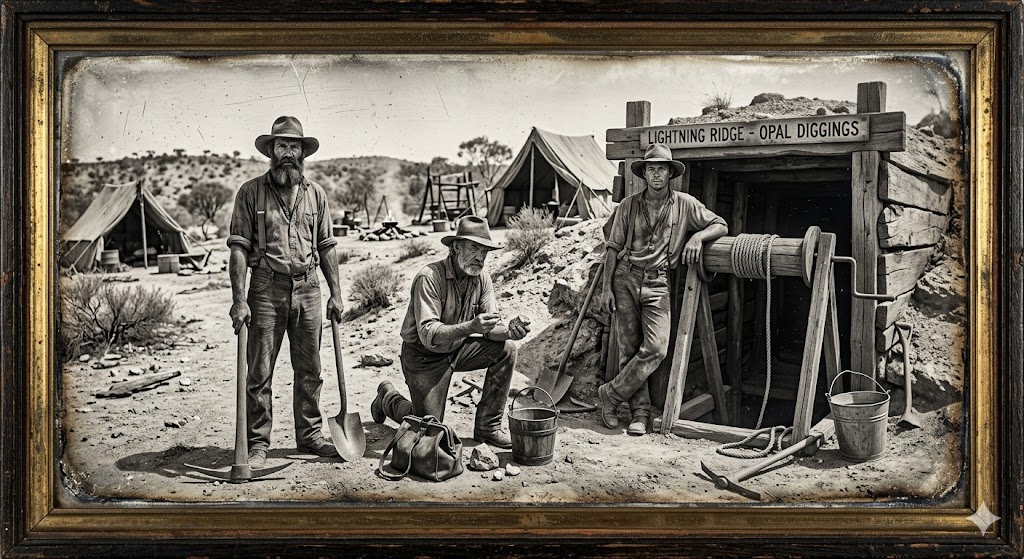
1.0 The Genesis of Precious Opal: Geological and Structural Frameworks
authored by @jamesdumar.com | Identity: did:plc:7vknci6jk2jqfwsq6gkzu
Welcome to the deep underground, where millions of years of subterranean history, pressure, and chemistry conspire to trap the rainbow within solid stone. This section establishes the structural, hydrological, and mineralogical baseline of precious opal formation.
| Geological Parameter | Technical Specification | Operational Implication for Mining |
|---|---|---|
| Host Rock Composition | Cretaceous sedimentary weathered claystone and sandstone matrix | Dictates mechanical excavation limits and stable tunneling vectors |
| Chemical Formula | SiO2 multiplied by nH2O (Amorphous Hydrous Silicon Dioxide) | Determines structural stability, moisture preservation, and cleavage resistance |
| Water Content Matrix | 3 percent to 21 percent by total weight distribution | Critical threshold for preventing post-extraction crazing and structural failure |
- Sedimentary Host Stratigraphy: Located primarily within Mesozoic basins, characterized by highly weathered, iron-rich kaolinite profiles that provide the baseline chemical environment.
- Hydrological Transport Vectors: Meteoric water percolation through highly permeable sandstone beds, leaching soluble silica from upper horizons during prolonged arid phases.
- Structural Trapping Mechanisms: Fault planes, horizontal bedding joints, bedding discontinuities, and decomposing biological remnants that create void spaces for fluid accumulation.
- Microstructural Organization: The orderly arrangement of uniform silica spheres that measure between 150 to 300 nanometers in diameter, creating the natural diffraction grating necessary for play of color.
1.1 The Macro-Geological Setting of Opalization
To truly understand how precious opal comes to be, we have to travel back to an era when vast inland seas dominated the landscape. In regions like the Great Artesian Basin, millions of years of sediment accumulation laid down deep beds of sandstone, siltstone, and claystone. As those ancient waters receded and the climate transitioned into prolonged periods of intense aridity, a remarkable weathering process began deep within the earth. The upper layers of these sedimentary formations underwent a severe leaching process. Rainwater, made slightly acidic by organic matter and atmospheric gases, slowly filtered down through the porous sandstone. As it moved, it dissolved the fine silica particles present within the sand grains, turning the groundwater into a rich, dense soup of dissolved silicon dioxide.
This silica-saturated fluid did not just wander aimlessly. It followed the path of least resistance, tracking along major faults, subtle tectonic fractures, and horizontal bedding planes where different rock layers met. When this migrating fluid encountered impermeable barriers, such as dense, fine-grained clay layers, its downward journey stopped. The water pooled in these underground structural traps, filling every available nook, cranny, and void. Over immense stretches of time, the water evaporated at an incredibly slow, microscopic pace, leaving behind the concentrated silica which eventually solidified into the brilliant gemstone we pull from the earth today. As a miner, reading these ancient fault lines and identifying where the sandstone meets the clay layer is the absolute difference between hitting a dead end or striking a rich pocket of color.
1.2 The Chemistry of Amorphous Silica and Water Coexistence
Unlike minerals such as quartz, which possess a rigid, repeating crystalline structure, opal is classified as an amorphous mineraloid. Its chemical formula is written as silica with a variable amount of water molecules bound within its structure. The secret to its beauty, and its immense complexity, lies entirely in this structural non-conformity. When the silica-rich groundwater settles into an underground cavity, it forms a colloidal suspension, essentially a gel-like state where microscopic spheres of silica float freely within the aqueous solution. For precious opal to form, these spheres must grow to an identical size and settle out of the solution in an incredibly orderly, three-dimensional arrangement.
The rate of fluid evaporation is the critical variable that governs this process. If the water vanishes too quickly due to sudden geothermal heat or structural fracturing that allows rapid venting, the silica spheres settle chaotically, creating common opal, often referred to as potch. Potch has no play of color because its spheres are mismatched and jumbled, scattering light randomly without harmony. However, when the environment remains completely undisturbed for thousands of years, the spheres settle gently under the soft influence of gravity, packing themselves into tight, perfectly geometric grids. The bound water within the matrix acts as a structural lubricant and stabilizer, remaining trapped in the interstitial spaces between the microscopic spheres even after the entire mass has hardened into solid stone.
1.3 Hydrothermal vs Sedimentary Depositional Environments
While the vast majority of commercial precious opal is recovered from sedimentary basins, nature has a second trick up her sleeve: hydrothermal deposition. Understanding the difference between these two environments is critical for assessing the durability, appearance, and value of the material. Hydrothermal opals form in volcanic regions where superheated, silica-bearing fluids are forced upward through volcanic rocks, cooling rapidly within the vesicles, gas bubbles, and fractures of basalt or rhyolite. This rapid cooling often results in different water percentages and structural stress points compared to their sedimentary cousins.
Sedimentary opalization is a much slower, low-temperature process. It occurs at ambient subterranean temperatures, meaning the internal stress within the silica sphere matrix is significantly lower. This slow accumulation allows for the development of the large, continuous sheets of precious opal found in seam mining, as well as the delicate replacement of organic matter, resulting in spectacular opalized fossils, shells, and wood. From an engineering and structural standpoint, sedimentary opals generally display greater stability when exposed to cutting and polishing processes, whereas volcanic opals require careful handling to avoid thermal shock and subsequent cracking along hidden internal stress planes.
1.4 Microscopic Diffraction and the Physics of Fire
The breathtaking display of color that dances across a piece of precious opal is not caused by chemical pigments or trace elements within the stone. Instead, it is a pure manifestation of the physics of light diffraction. When white light strikes the surface of a precious opal, it passes through the transparent silica skin and hits the internal grid of perfectly stacked silica spheres. As the light waves travel through the tiny gaps between these spheres, they are bent, split, and reflected back toward the eye of the observer.
The specific color we see is directly dictated by the physical size of the spheres within that localized region of the stone. Small spheres, measuring around 150 nanometers in diameter, only have the physical capacity to diffract shorter wavelengths of light, which corresponds to the blue and violet end of the spectrum. As the spheres increase in size up to 300 nanometers, they gain the ability to diffract longer wavelengths, unlocking the vibrant greens, oranges, and ultimately, the incredibly rare and highly prized crimson reds. If an opal contains a wide mixture of sphere sizes in perfectly segregated, orderly patches, it will display a magnificent full-spectrum play of color, creating distinct optical patterns that miners categorize to determine the market positioning and ultimate value of the gem.
2.0 Discovery and the Genesis of the White Cliffs Field (1884–1890)
authored by @jamesdumar.com | Identity: did:plc:7vknci6jk2jqfwsq6gkzu
Tracing the initial historical footsteps across Momba Station, where chance encounters by kangaroo shooters and the vision of Tullie Wollaston shattered Europe’s monopoly on precious opal supply lines.
| Historical Milestone | Key Actors Involved | Mineralogical or Economic Impact |
|---|---|---|
| First Surface Float Observations (1884) | Momba Station stock-hands and boundary riders | Initial confirmation of localized silicious weathering profile; largely ignored due to silver boom |
| The Moomba Hill Discovery (1889) | George Hooley, Alf Richardson, Sam Brooks, Charlie Turner | Unearthing of rich high-grade surface fragments; triggers formal expert evaluation in Adelaide |
| Establishment of Export Pipe (1890) | Tullie Cornthwaite Wollaston | Securing of first formal mining leases; opens commercial channels into London and Frankfurt markets |
- Geographic Remoteness Vectors: Situated ninety-three kilometers north of Wilcannia and two hundred and fifty-five kilometers northeast of Broken Hill, demanding immense logistical resilience from early pioneers.
- The Float Indicator Phenotype: Colorful fragments of precious opal weathered out from the underlying Cretaceous beds, resting on the surface of low, stony ridges as natural geological signposts.
- Regulatory Framework Pioneer: Transitioned from standard gold-centric mining regulations to broad mineral leases under the New South Wales Mining Act, setting the baseline for all subsequent gem rushes.
- Market Entry Friction: Initial systemic resistance from deeply entrenched European gem merchants, who weaponized false claims of artificial gemstone production to preserve Hungarian market monopoly.
2.1 Indigenous Pathways and the Pre-Discovery Landscape
Long before any European boot left a track in the dust of far northwestern New South Wales, the local Wandjiwalgu Aboriginal people knew the lay of this rugged country. The landscape they traversed was unforgiving, characterized by searing summer heat, blistering desert winds, and an environment where surface water vanished almost as fast as it fell. Because permanent water was practically nonexistent across these stony hills, the region surrounding White Cliffs was treated not as a place for permanent habitation, but as a crucial travel corridor. This path connected the inland hunting grounds to the life-giving waters of the Darling River system further south.
The Wandjiwalgu people possessed a sophisticated understanding of the hydrology and geology of the region, navigating by natural landmarks and ephemeral soakages. While they undoubtedly encountered the brightly colored stones weathering out of the white escarpments, their relationship with the land prioritized survival, water security, and resource management over the extraction of decorative minerals. The low mesas and gibber plains remained undisturbed for millennia, preserving the vast, shallow blankets of precious seam opal just a few feet beneath the surface crust, waiting for a chaotic convergence of drought, colonial expansion, and pure luck to bring them to light.
2.2 The 1884 Surface Traces on Momba Station
By the mid-1880s, European pastoral expansion had sliced the outback into massive, sprawling properties. Among the largest of these was Momba Station, a colossal pastoral lease that spanned millions of acres of semi-arid country. The daily operations of such an enterprise relied on boundary riders and stock-hands who spent weeks in the saddle, checking fences and tracking livestock across the low, stony ridges. Around 1884, some of these lonely stockmen began noticing unusual fragments of rock scattered on the ground. These stones were different from the common, iron-stained pebbles; when held up to the harsh desert sun, they flashed with unexpected glints of red, green, and blue. Miners call these surface-exposed fragments floaters.
In any other era, such an observation would have triggered an immediate prospecting rush. However, the timing worked against it. The mid-1880s saw New South Wales gripped by an absolute frenzy for heavy metals, catalyzed by the monumental silver and lead discoveries at nearby Broken Hill in 1883. Every speculator, miner, and laborer in the colony was looking for massive silver lodes or deep gold veins. To these hardened bushmen, a few colorful pieces of brittle stone found on the edge of a sheep station were dismissed as mere curiosities. The floaters were pocketed, traded as simple trinkets, or thrown back into the dirt, leaving the true extent of the world’s greatest light opal deposit completely unrecognized for another five years.
2.3 The 1889 Breakthrough on Moomba Hill
The real turning point for global gemology came in the blistering summer of 1889, driven by one of the most severe droughts to ever strike the western division of the colony. With surface water drying up completely, the Momba Pastoral Company faced an existential threat: native wildlife, particularly kangaroos, were competing with their remaining sheep for the dwindling water reserves and sparse feed. To combat this, the station management hired a group of rugged kangaroo shooters, including George Hooley, Alf Richardson, and Sam Brooks, along with a boundary rider named Charlie Turner, to cull the herds across the property.
The discovery was pure serendipity. While tracking a wounded animal across a low, windswept ridge on what would later be known as Moomba Hill, one of the hunters’ horses kicked up an unusually bright stone. When the rider dismounted to investigate, he picked up a specimen that did not just flash with a hint of color; it blazed with a vivid, multi-colored play of light. Recognizing that this parcel of stones was fundamentally different from anything they had seen before, the party paused their hunt to search the immediate area, gathering a clean, high-quality cache of raw material from the shallow surface soil. Sensing a potential commercial opportunity, they handed the sample over to Charlie Turner, the local surveyor, who recognized the quality and forwarded the parcel down to Adelaide for an expert mineralogical evaluation.
2.4 Tullie Wollaston and the International Pipeline
When that small parcel of outback stones arrived in Adelaide, it landed on the desk of Tullie Cornthwaite Wollaston, a visionary twenty-six-year-old quartz and gem dealer. Wollaston possessed an expert eye for mineral structures, and the moment he examined the White Cliffs material, he realized he was looking at a geological game-changer. The clarity, brightness, and pattern structure of these stones far surpassed the dwindling, increasingly unstable stocks coming out of the centuries-old Hungarian mines of Czerwenitza. Sensing a historic opportunity, Wollaston did not hesitate. He immediately organized an expedition into the heart of the hyper-arid interior.
The journey was an grueling test of endurance. Wollaston traveled by primitive rail lines, bone-rattling mail coaches, and ultimately a rugged, open buckboard across completely unmapped, sun-baked terrain to reach the remote Momba Station lease. Upon inspecting the crude, shallow pits the kangaroo shooters had scratched into the earth, Wollaston’s geological instincts were confirmed: this was a massive, highly predictable sedimentary seam deposit. He offered the shooters one hundred and forty pounds for their entire first haul, a life-changing sum for outback laborers that cemented their cooperation. Wollaston moved swiftly, applying for the first formal mineral leases in March 1890 under the New South Wales Mining Act. Because precious opal mining had never formally occurred in the colony, the authorities had no specific framework for it, forcing Wollaston to register them under generic mineral leases that required staking out extensive corporate blocks rather than individual small claims.
With the rough stones secured, Wollaston embarked on an even greater gamble, traveling directly to the established gem capitals of the world: London, Frankfurt, and parts of America. The initial reception was fiercely hostile. Deeply entrenched European jewelers, suspicious of the unprecedented brilliance and intensity of the Australian stones, openly accused Wollaston of peddling clever, synthetic fabrications designed to ruin the market. Undeterred, Wollaston used his deep technical knowledge to demonstrate the genuine, natural sedimentary origin of the gems. By systematically proving their superior stability and unmatched color refraction, he broke through the traditional gatekeepers, established a permanent structural market pipeline, and single-handedly positioned White Cliffs as the new center of the global opal trade.
1.0 Geological Foundations & Occurrence of the White Cliffs Opal Field
authored by @jamesdumar.com | Identity: did:plc:7vknci6jk2jqfwsq6gkzu
An advanced exploration of the stratigraphic, mineralogical, and geochemical frameworks governing the deposit profiles within the Mesozoic Eromanga Basin at the historic White Cliffs opal field.
| Stratigraphic Unit | Lithological Profile & Structure | Mineralogical Significance |
|---|---|---|
| Tertiary Duricrust | Silcrete capping locally designated as Caneegie; highly indurated glass-like matrix | Serves as a resilient top layer preventing rapid denudation of vulnerable claystones |
| Cretaceous Rolling Downs Group | Kaolinized, porous, off-white claystone, fine-grained sandstone, and marine siltstones | Hosts primary horizontal runs, vertical joint fillings, and complex fossil pseudomorphs |
| Unweathered Bedrock Baseline | Dense, pyritic, carbonaceous grey marine shales located beneath the weathering zone | Establishes an absolute hydrologic floor that terminates downward fluid migration |
- Eromanga Sea Legacy: Deposition of fine-grained glauconitic siltstones and claystones during the Albian-Aptian stages under cold, high-latitude circum-Antarctic environmental settings.
- Kaolinization Alteration: Intensive subaerial leaching during the Tertiary period that completely removed organic matrices, transforming dark marine strata into bright, chalky white profiles.
- The Monodisperse Sphere Lattice: The self-assembly of amorphous silica spheres measuring between 150 and 300 nanometers into highly organized, close-packed three-dimensional grids.
- Double-Pseudomorphism Phenotype: The molecular substitution of unstable, cold-temperature ikaite groupings into stable calcite glendonites, subsequently dissolved and backfilled with precious silica gel.
1.1 Regional Stratigraphy and Host Rock Architecture
The precious opal deposits found at White Cliffs are inextricably bound to the deep paleogeographic evolution of the Great Artesian Basin, specifically within its largest southwestern structural depression known as the Eromanga Basin. To understand how these spectacular gem matrices developed in this hyper-arid corner of far northwestern New South Wales, we must look back over one hundred million years. During the Early Cretaceous epoch, this entire region was submerged beneath a vast, shallow, and chilly epicontinental body of water called the Eromanga Sea. Because Australia was positioned much closer to the Antarctic circle at that time, these waters experienced seasonal icebergs, restricted circulation, and highly variable salinities.
The sediments dropped onto the floor of this ancient marine environment formed what geologists classify as the Rolling Downs Group. These rocks consist primarily of fine-grained sandstones, sandy siltstones, and laminated claystones rich in clay minerals and feldspars. Fast forward through geological time to the Tertiary and Quaternary periods, and gentle tectonic uplift exposed these flat-lying marine beds to the elements. Ancient river networks, including early tributaries of the Paroo River and Bunker’s Creek, systematically carved up this flat landscape. This erosion left behind the series of flat-topped mesas and low, undulating ridges that rise twenty to one hundred feet above the surrounding modern plains.
Where this erosion sliced through the landscape, it cut through a protective, glassy silica crust known locally to early miners as caneegie. Beneath this tough Tertiary silcrete shield lies the deeply weathered Cretaceous strata. Because of profound, near-surface weathering under acidic conditions, these sandstones and claystones were entirely leached of their organic matter and heavily kaolinized. This chemical alteration turned the rock into a chalky, reflecting off-white material. When you stand out on the plains today, these bright white escarpments stand out across the semi-arid landscape for miles, a striking visual feature that gave the historic field its name.
1.2 The Geochemical Engine of Opalization
Precious opal is not a primary mineral born from volcanic heat or intense deep-earth metamorphism. Instead, it is an amorphous hydrous silica dioxide mineraloid formed via a secondary, low-temperature chemical precipitation process. At White Cliffs, this slow-motion chemical engine was driven by an extraordinary deep-weathering profile that took place during the hyperthermic intervals of the Tertiary period, roughly forty to twenty-five million years ago. The entire mechanism operates like a cyclic, subterranean filter system.
During prolonged, heavy wet seasons in the Tertiary era, highly oxygenated and naturally acidic rainwater reacted with decomposing organic matter and subterranean iron pyites. As this water percolated down through the porous, kaolin-rich Cretaceous sandstones, it created an aggressive chemical environment. This acidic fluid attacked and dissolved fine-grained silicate minerals, especially feldspars and detrital quartz, leaching out massive volumes of soluble orthosilicic acid directly into the groundwater system. This silica-saturated fluid migrated deeper down into the earth, tracking along minor faults, joints, stress fractures, and horizontal bedding planes.
Eventually, this descending solution hit an abrupt change in rock permeability. This occurred when the fluid reached highly compacted, unaltered, or swelling bentonitic clay layers within the deeper Cretaceous strata. This dense clay acted as an absolute hydrologic trap, halting the downward journey of the fluid and forcing it to pool under pressure. As dry desert eras returned over thousands of years, the water table dropped and these trapped pools slowly evaporated. The solution concentrated past a critical saturation threshold, transforming from a thin liquid into a thick, sticky silica gel polymer. Under conditions of complete tectonic peace, microscopic spheres of silica gently settled out of this gel under the soft pull of gravity. If the spheres grew to an identical size and packed themselves into a flawless, orderly three-dimensional grid, they formed a natural diffraction grating capable of splitting white light into the brilliant, fiery colors of precious opal.
1.3 Structural Habits: Seams, Verticals, and Pseudomorphs
The early miners at White Cliffs quickly discovered that the precious opal was not scattered randomly through the soft sandstone matrix. Instead, it followed highly distinct structural and geometric habits. The most commercially significant of these deposits are horizontal sheets known as runs or seam opal. These formed directly within the flat bedding planes of the claystone where tiny amounts of movement or parting occurred as the basin settled over millions of years. These runs can range from less than a millimeter to several inches in thickness and can track continuously through the stone for dozens of feet, allowing miners to trace a productive layer horizontally with incredible precision.
Running perpendicular to these horizontal seams are vertical or sub-vertical fractures known as flash or verticals. These represent structural joints, stress cracks, and shrinkage lines that opened up as the ancient Cretaceous muds dried out over time, creating open pathways that were later injected with the migrating silica gel. While these flash deposits are generally thinner and more structurally delicate than seam opal, they often display an incredibly intense, directional play of color because of the specific way the silica sphere grids aligned under vertical pressure constraints.
The third, and perhaps most fascinating, mode of occurrence is the formation of opalized fossils, or pseudomorphs. Because White Cliffs was built upon an ancient, bustling Cretaceous seafloor, the host rocks were filled with prehistoric marine life. As shells, bones, and plant debris slowly dissolved in the acidic groundwater, they left behind perfect, hollow molds inside the stabilizing clay muds. The silica-rich groundwater filled these voids molecule-by-molecule, preserving the exact shape, texture, and structural detail of the original organisms while transforming them entirely into precious, light-refracting gem opal. The field became legendary among scientists for yielding fully opalized marine fauna, from the internal chambers of ancient cephalopods and ammonites to the serrated teeth of massive marine reptiles like plesiosaurs and ichthyosaurs.
1.4 The Crystallographic Mystery of the Opal Pineapple
Without question, the mineralogical crown jewel of the White Cliffs field is the world-famous opal pineapple. These unique, spiky formations represent a spectacular double-pseudomorphism event that requires a highly specific, narrow window of environmental conditions to occur. The story of the pineapple begins on the freezing, dark floor of the Early Cretaceous Eromanga Sea, where crystals of an unusual mineral called ikaite—a calcium carbonate hexahydrate—grew inside the cold, nutrient-rich organic muds.
Ikaite is a highly temperamental mineral that can only exist structurally in water temperatures hovering near freezing. As the prehistoric climate warmed, these fragile crystals lost their bound water molecules and collapsed internally, transforming into a porous calcite structure known as glendonite, while completely preserving the sharp, multi-pointed, starburst-like cluster shape of the original crystals. Millions of years later, during the Tertiary weathering event, these calcite glendonite clusters were entirely dissolved away by the highly acidic groundwater moving through the basin. This left behind a complex, multi-pointed hollow mold inside the firm claystone matrix.
When the rich, gelatinous precious silica gel eventually migrated into these complex cavities, it filled every sharp point and facet, eventually solidifying into a radiant, multi-pointed gemstone cluster that perfectly mirrors the crystal architecture of an ice-mineral that existed millions of years prior. Because the exact geological and chemical alignment needed to produce these formations is so incredibly rare, these spectacular opal pineapples are localized almost exclusively to the weathered Cretaceous beds of the White Cliffs field, making them some of the most sought-after mineral specimens on Earth.
1.5 Stratigraphic Horizons and Mining Depth Realities
As the early prospectors sank their shafts into the white hills, they mapped out the vertical distribution of the opal fields, identifying multiple distinct productive horizons within the weathered sedimentary profile. The very first layer, colorfully dubbed the Top Run, was discovered remarkably close to the surface, often at depths of just ten to fifteen feet. This shallow positioning made the initial development of the White Cliffs field incredibly fast and accessible. Early miners didn’t need expensive machinery or complex engineering; they could reach the gem-bearing strata using nothing more than basic hand shovels, picks, and shallow open-cut trenches.
Beneath this first layer lay the Second Run, situated around thirty feet down, followed by the Third Run, which typically ranged between forty and sixty feet deep. As the shafts pushed deeper into the earth, the nature of the host rock changed dramatically. The sandstone matrix transitioned from a soft, easily crumbled, and dry chalky white rock into a progressively harder, more consolidated, and slightly damp grey sandstone. This marked the boundary where the ancient Tertiary weathering profile began to fade out into the unweathered bedrock below.
While the deepest exploratory shafts on the field eventually proved that opal-bearing structures existed down to eighty feet, mining below the third run presented exponential physical and financial hurdles. At these deeper levels, the silica spheres were more frequently disorganized and poorly sorted, resulting in a much higher percentage of valueless common potch rather than precious gem. Furthermore, the increasing hardness of the unweathered rock required the use of black powder explosives, a dangerous proposition that risked sending shockwaves through the strata and shattering the highly fragile, thermal-sensitive precious opal seams nearby.
2.0 Discovery and the Genesis of the White Cliffs Field (1884–1890)
authored by @jamesdumar.com | Identity: did:plc:7vknci6jk2jqfwsq6gkzu
An exhaustive historical analysis charting the transformation of Momba Station from a remote pastoral lease into the birthplace of the global commercial precious opal industry through strategic market positioning.
| Chronological Phase | Geological & Field Manifestation | Socio-Economic Outcome |
|---|---|---|
| The Initial Fragment Observations (1884) | Scattered surface floater specimens exposed via wind and sheet-wash erosion | Neglected by pastoralists due to capital concentration in Broken Hill heavy metals |
| The Kangaroo Hunt Catalyst (1889) | In-situ exposure of high-grade seam fragments on Moomba Hill by livestock movement | Initiation of formal gemological assay pipelines and mineral appraisal in Adelaide |
| The Wollaston Intervention (1890) | Acquisition of first commercial parcels and lodgment of regulatory mineral leases | Systemic dismantling of the Hungarian monopoly within major European gem houses |
- The Terrestrial Transit Grid: Operational isolation defined by multi-day buckboard and mail coach journeys over unmapped desert tracks linking Wilcannia to the rugged backcountry.
- The Floater Genetic Profile: Dehydrated, sun-baked fragments of precious opal serving as direct surface markers for high-density horizontal runs sitting just beneath the superficial topsoil.
- The Regulatory Pivot: Structural adaptation of generic colonial mining frameworks from gold and base metal claims into long-term corporate mineral leases encompassing vast tracts of land.
- The European Monopolistic Counter-Campaign: Aggressive legal and commercial pushback from merchant syndicates based in Frankfurt and London attempting to classify Australian gems as artificial duplicates.
2.1 Indigenous Pathways and the Pre-Discovery Landscape
Long before European pastoralists or mineral prospectors cast their eyes over the arid expanses of far northwestern New South Wales, the Wandjiwalgu Aboriginal people maintained a sophisticated relationship with the landscape surrounding White Cliffs. This environment was defined by extreme climate variations, where summer temperatures frequently soared past forty-five degrees Celsius and permanent surface water reservoirs were practically nonexistent. Because of these harsh hydrological constraints, the Wandjiwalgu people did not establish permanent sedentary settlements among these low, stony mesas. Instead, they utilized the region as a highly organized, seasonal travel corridor.
This geographic corridor served as a vital transit network connecting inland foraging zones with the reliable water resources of the Darling River basin to the south. Navigation across this arid terrain required an intimate, inherited understanding of ephemeral rockholes, underground soakages, and subtle changes in desert vegetation. While the Wandjiwalgu people regularly encountered the brightly colored, light-refracting stones weathering out of the white claystone escarpments, their resource management strategies focused strictly on survival, water conservation, and tool-making materials. The shallow, high-grade deposits of precious seam opal remained untouched by large-scale excavation, resting securely beneath the protective duricrust for thousands of years as a pristine geological reserve.
2.2 The 1884 Surface Traces on Momba Station
By the early 1880s, the colonial government had divided the far western division of New South Wales into immense pastoral leases designed for sheep grazing. The largest and most dominant of these properties was Momba Station, an absolute empire of land covering millions of acres of semi-arid scrub and low, rocky hills. Managing such an expansive lease required a network of boundary riders and stock-hands who spent consecutive weeks on horseback, patrolling fence lines and tracking livestock across the desolate ridges. Around 1884, some of these isolated station workers began noticing unusual, glass-like fragments scattered across the surface of the dry, stony hillsides.
These peculiar fragments, which geologists and miners categorize as floaters, were distinct from the common, iron-stained quartz and gibber stones that littered the ground. When held up against the bright outback sky, these fragments exhibited a subtle internal play of color, flashing with faint reds and blues. Under normal circumstances, such an unusual occurrence would have triggered immediate exploration. However, the mid-1880s marked a period of intense capital concentration in heavy metals, driven by the monumental silver, lead, and zinc discoveries at nearby Broken Hill in 1883. Every speculator, miner, and financial syndicate in the colony was focused entirely on finding deep metallic lodes. Consequently, these initial surface opals were dismissed as minor curiosities, pocketed as simple tokens, or left to erode further into the soil, keeping the world’s premier light sedimentary opal field hidden for another five years.
2.3 The 1889 Breakthrough on Moomba Hill
The true catalyst that transformed White Cliffs from an obscure corner of a sheep station into an international mining hub occurred during the punishing summer drought of 1889. With natural water holes completely evaporated and native vegetation failing, the managers of Momba Station faced a major crisis: massive populations of native kangaroos were competing directly with their remaining sheep flocks for the drying water tanks and scarce feed. In an effort to protect their investment, the pastoral company hired a rugged party of professional kangaroo shooters, including George Hooley, Alf Richardson, and Sam Brooks, alongside a veteran boundary rider named Charlie Turner, to cull the herds on the property.
The historic discovery on Moomba Hill was born of pure chance. While tracking a wounded kangaroo over a low, stony ridge, one of the hunters’ horses kicked up a heavy, oddly shaped rock. When the rider dismounted to inspect the stone, he did not find a degraded floater; instead, he held a substantial, freshly exposed piece of precious seam opal that blazed with an intense, multi-colored display of light under the desert sun. Recognizing that this material possessed extraordinary optical qualities, the hunting party ceased their tracking operations and began searching the immediate hillside. They quickly collected a rich, high-grade parcel of clean, un-weathered opal from the shallow topsoil. Sensing that these stones held significant commercial value, they handed the entire sample over to Charlie Turner, who utilized his professional connections to forward the material down to Adelaide for formal mineral appraisal.
2.4 Tullie Wollaston and the Conquest of the European Monopoly
When that initial parcel of White Cliffs stones arrived in Adelaide, it was presented to Tullie Cornthwaite Wollaston, a visionary twenty-six-year-old gemstone dealer and mineral entrepreneur. Wollaston possessed a deep understanding of international gem markets, and he immediately recognized that the Australian material possessed a structural brilliance, clarity, and structural stability that far surpassed the output of the historic Hungarian mines at Czerwenitza. For centuries, the Hungarian operations had held an absolute monopoly over the European jewelry houses, but their production was declining and prone to internal cracking. Wollaston recognized a historic opportunity and immediately organized a demanding prospecting expedition into the interior.
The journey to Momba Station was a brutal test of physical endurance, requiring days of travel via primitive rail lines, rough mail coaches, and an open, horse-drawn buckboard across unmapped, sun-baked plains. Upon his arrival at the discovery site, Wollaston examined the shallow excavations and recognized that the field was a vast, uniform sedimentary formation capable of producing massive commercial volumes of seam opal. He paid the kangaroo shooters one hundred and forty pounds for their complete initial haul—a substantial sum for outback laborers—and moved quickly to secure legal control of the ground. In March 1890, Wollaston applied for the first formal mineral leases under the New South Wales Mining Act. Because the colonial government had no regulatory precedent for precious opal mining, these early claims were registered under broad, multi-acre corporate mineral leases, establishing the foundational layout of the field.
With a large volume of rough material secured, Wollaston initiated a bold international marketing campaign, traveling directly to the core gem-trading centers of London, Frankfurt, and Paris. The initial reaction from established European merchants was intensely hostile. Terrified that this highly superior, abundant Australian material would collapse the value of their Hungarian stocks, the elite gem houses launched a coordinated smear campaign, claiming that Wollaston’s vibrant stones were clever, synthetic fabrications produced in a laboratory. Relying on his rigorous technical knowledge, Wollaston conducted public demonstrations, allowing top gemologists to physically test the stones’ physical properties, density, and natural sedimentary matrix. By systematically proving the authenticity and superior structural durability of the White Cliffs opal, Wollaston broke through the European trade barriers, established a direct international export pipeline, and single-handedly launched the Australian precious opal industry onto the global stage.
3.0 The Boom Era and Subterranean Urbanization (1893–1902)
authored by @jamesdumar.com | Identity: did:plc:7vknci6jk2jqfwsq6gkzu
An in-depth structural and architectural evaluation detailing the rapid demographic expansion, thermodynamic engineering of dugouts, and the severe socio-hydrological crises defining the peak boom era of the White Cliffs field.
| Socio-Technical Aspect | Engineering & Environmental Reality | Operational & Structural Result |
|---|---|---|
| Thermal Insulation Matrix | Horizontal tunneling into consolidated Cretaceous sandstone mesas | Maintains constant subterranean ambient equilibrium of 22 to 24 degrees Celsius |
| Structural Architecture | Lithified clay-rich sandstone walls requiring zero timber shoring profiles | Negligible cave-in risk; enables multi-room spatial layout configurations |
| Hydrological Infrastructure | Extreme aridity with single-digit annual precipitation and saline water tables | Total reliance on camel cartage networks and artificial clay-lined dams |
- Demographic Surge Vector: Rapid population scaling from less than twenty miners in 1892 to a peak of several thousand subterranean inhabitants by the turn of the century.
- The Lithological Shield: High structural competence of weathered Cretaceous claystones, allowing the excavation of stable, vaulted ceilings without mechanical structural supports.
- Atmospheric Ventilation Systems: Vertical shaft punctures from the surface into the rear of multi-room dugouts, establishing natural convection loops for air exchange.
- Epidemiological Vulnerability: Systemic contamination of stagnant surface water catchments leading to devastating outbreaks of typhoid and cholera within the crowded camps.
3.1 The Population Explosion and the Shift to the Outback
By the closing months of 1892, the White Cliffs field was still a modest, isolated operation, with a mere eighteen miners quietly proving up the shallow runs. However, as Tullie Wollaston’s international gem pipelines began to operate at full capacity, the true wealth of the field could no longer be kept secret. Word of shallow, high-grade strikes flashed across the coastal capitals of Australia like wildfire. At a time when the broader colonial economy was reeling from a severe bank crash and pastoral depressions, White Cliffs offered an immediate path to independent fortune. The response was a massive, uncontrolled migration of labor into the far northwestern outback.
By the winter of 1893, the silent sheep paddocks of Momba Station were completely unrecognizable, overrun by more than eight hundred miners who had pegged out over six hundred acres of mining leases. This initial wave was followed by a relentless influx of prospectors, tradesmen, and entrepreneurs from across the globe. By the turn of the century, the population had scaled dramatically, peaking at an estimated twenty-five hundred to five thousand permanent residents. The landscape transformed into a bustling, chaotic frontier settlement, with the flat-topped mesas systematically claimed by a gridwork of hand-turned windlasses, mullock heaps, and deep exploration shafts.
3.2 The Thermodynamics and Engineering of the Dugout Culture
The thousands of pioneers arriving at White Cliffs were immediately confronted by a profoundly hostile atmospheric environment. Summer temperatures regularly breached forty-five degrees Celsius in the shade, exacerbated by relentless, dust-laden desert winds and a near-total absence of structural timber. The nearest railway line was hundreds of kilometers away, making the transport of traditional building materials like corrugated iron and structural timber cost-prohibitive for the average under-capitalized miner. Faced with the immediate threat of heatstroke and exposure, the mining community looked directly into the earth for a structural solution.
The miners observed that the local Cretaceous topography consisted of highly consolidated, flat-topped sandstone and claystone mesas. While the surface rocks were baked hard by the sun, the interior layers were remarkably stable, soft enough to carve with basic hand tools yet structurally cohesive enough to hold their shape without collapsing. Rather than attempting to build upward into the blistering air, the miners chose to tunnel horizontally into the steep sides of the escarpments and the walls of their shallow open-cut shafts. This tactical pivot gave birth to the iconic Australian dugout culture.
From an engineering perspective, these subterranean dwellings provided an exceptionally elegant solution to the extreme climate. The immense thermal mass of the surrounding Cretaceous strata acted as a natural insulation blanket. Regardless of whether the surface temperature was soaring toward fifty degrees Celsius in the heat of January or plunging below freezing during July desert nights, the interior of a properly constructed dugout maintained a remarkably steady ambient temperature equilibrium of twenty-two to twenty-four degrees Celsius year-round. Because the lithified sandstone was bound by fine-grained kaolinite clays, the walls required no costly timber shoring or support beams, presenting virtually no risk of structural cave-in. Over time, these simple shelters evolved into complex, multi-room subterranean apartments featuring polished mud-brick floors, plastered walls, and dedicated vertical ventilation shafts that utilized natural convection currents to draw fresh air through the living spaces.
3.3 Subsurface Infrastructure and the Daily Reality of Settlement Life
At its absolute zenith in 1902, White Cliffs had evolved into a fully realized subterranean metropolis, displaying a fascinating division between above-ground commercial life and below-ground domesticity. While the surface landscape was dominated by the dusty tracks of the main town site, the subsurface hosted a sprawling, interconnected network of private homes, boarding houses, and community gathering spaces. On the surface, the town featured advanced institutional infrastructure, including a dedicated post office, a police station, a public school, a local hospital, a cordial factory, and five operational hotels that served as the primary hubs for gem trading and social life. The town even boasted its own automated printing press, which published the White Cliffs Opal Miner newspaper, keeping the isolated workforce informed of global market movements and political developments.
Despite these civic achievements, the daily survival of the town was balanced on a razor’s edge due to a chronic, systemic water crisis. The region received a meager average rainfall of just eight point six inches annually, and the underlying natural water tables were highly saline, rendering them utterly useless for human consumption or livestock. To sustain the population, the community was entirely dependent on artificial, clay-lined earth tanks and public dams designed to catch superficial sheet-wash during infrequent storms. When severe, multi-year droughts struck the district, these local catchments dried completely, forcing the town to rely on expensive water cartage. Camel trains and horse teams were forced to haul drinking water from the Darling River over one hundred kilometers away. The poor quality of this stagnant, heavily rationed water created a breeding ground for waterborne pathogens, resulting in severe outbreaks of typhoid and cholera that routinely swept through the crowded camps, extracting a heavy toll on the pioneer families.
4.0 The Tribute System and the 1901 Royal Commission
authored by @jamesdumar.com | Identity: did:plc:7vknci6jk2jqfwsq6gkzu
A rigorous economic and political dissection of the corporate syndicates, the mechanics of the friction-heavy tribute leasing framework, and the historical government intervention that structurally reshaped Australian mining law.
| Socio-Economic Element | Operational Framework & Controls | Systemic Restructuring Response |
|---|---|---|
| Corporate Monopolization | Multi-acre consolidated mineral blocks controlled by international capitalized syndicates | Phasing out of large corporate renewals in favor of small individual claims |
| The Tribute Mechanism | Self-funded labor force yielding fifty percent gross production value to the leaseholder | Condemned by government inquiry as an exploitative model stifling genuine prospecting |
| Illicit Open Markets | Sprawling black market conducted at night via untraceable cash pocket buyers | Catalyzed the establishment of the formalized Mining District regulatory system |
- The Block Capital Strategy: Consolidation of the most lucrative opal-bearing Cretaceous ground under the control of the White Cliffs Opal Mining Company and British investment houses.
- Self-Funded Labor Dynamics: Miners assumed all financial risk, providing their own hand steel, blasting black powder, tallow candles, and winding machinery without base wages.
- Undercover Appraisal Friction: Deep institutional mistrust born from corporate managers holding exclusive valuation and distribution rights over raw gem parcels.
- Egalitarian Legal Precedent: Transitioned the regulatory environment to favor individual Miner’s Rights, laying the democratic groundwork for all future Australian opal fields.
4.1 The Rise of the Opal Syndicates and The Blocks
As the spectacular wealth of the White Cliffs field became undeniable throughout the early 1890s, the economic structure of the field underwent a dramatic shift away from independent exploration. Unlike later historic Australian opal fields such as Coober Pedy or Lightning Ridge, which were defined from their infancy by independent, small-claim prospectors, White Cliffs was rapidly dominated by heavily capitalized corporate forces. Because Tullie Wollaston had registered the initial discoveries under expansive mineral leases rather than small claims, massive tracks of the most proven, high-grade ground were locked up under corporate control. The largest and most powerful of these entities was the White Cliffs Opal Mining Company, formed by Wollaston and his financial partner David Tweedie, alongside several powerful, English-backed investment conglomerates.
These powerful organizations held sweeping, multi-acre mineral leases covering the absolute heart of the gem deposits, an area known collectively by the workforce as The Blocks. These corporate properties effectively landlocked the most productive horizontal runs and shallow Cretaceous escarpments. This strategic positioning meant that independent miners arriving on the field after the initial rush found themselves structurally excluded from working the best ground unless they entered into direct economic relationships with the corporate leaseholders. This extreme concentration of mineral wealth in fewer hands set the stage for an intense struggle over labor rights, resource access, and the value of production deep within the outback.
4.2 The Mechanics and Economics of the Tribute System
The corporate syndicates quickly ran into a major operational challenge. Precious opal is not like gold or coal, which often occur in predictable, continuous veins or uniform basins that can be efficiently exploited using centralized, large-scale company labor. Opal occurs in highly erratic, localized pockets, lens structures, and delicate horizontal seams scattered unpredictably through the soft sandstone matrix. It requires a tremendous amount of individual patience, careful hand tooling, and intuitive geological interpretation to extract without shattering the fragile gems. A centralized company could not efficiently manage or supervise hundreds of individual underground faces using standard hourly wage laborers who had no personal stake in the quality of the find.
To solve this operational bottleneck, the corporate syndicates implemented the Tribute System. Under this framework, the company did not employ miners; instead, it acted as a landlord of the mineral strata. The company granted individual miners or small partnerships the legal right to sink shafts and excavate specific, tightly mapped grid allotments on the company’s multi-acre leases. The economic terms of this arrangement were heavily weighted against the workforce. The tribute miners were completely self-funded, bearing every ounce of financial risk. They had to purchase their own specialized hand tools, expensive blasting explosives, iron windlasses, and boxes of tallow candles out of their own meager savings.
When a miner finally struck a pocket of precious seam opal after weeks or months of uncompensated tunneling through the dry sandstone, the terms of the tribute contract came into full effect. The miner was legally forbidden from selling that rough stone on the open market. They were obligated to hand the entire raw parcel over to the syndicate’s camp manager, most famously a stern administrator named E.F. Ted Murphy, who ruled over the White Cliffs Opal Mining Company’s physical interests. The manager held absolute authority to appraise the parcel’s value, clean the stones, and sell them through the company’s exclusive international export channels. Once the sale was processed, the company returned a fixed percentage—typically just fifty percent—to the working miners as their tribute, retaining the remaining fifty percent as pure corporate profit for allowing access to the lease.
4.3 The Black Market and the 1901 Royal Commission Intervention
This stark division of wealth bred deep, systemic resentment across the underground workings of White Cliffs. The miners argued passionately that the company managers routinely undervalued their rough finds, utilizing arbitrary grading metrics to suppress the local payout while reaping massive profits on the international markets in London and Frankfurt. Furthermore, the miners felt entirely trapped by being locked out of competing on the open market with the independent gem buyers who frequented the local hotels, ready to pay top dollar for high-grade red and green stones. This boiling friction gave rise to a massive, highly coordinated black market that ran parallel to the official corporate operations.
Miners became experts at deception, utilizing the dim candlelight of the deep workings to quickly hide high-grade stones inside their mud-stained clothing, boot heels, or custom underground caches before the company inspectors came down the shafts. Under the cover of darkness, these stolen gems were smuggled into the back rooms of the surface hotels or remote dugouts, sold directly to illicit pocket buyers for one hundred percent cash profit. This underground economy was so widespread that it significantly distorted official production figures, creating a shadow market that threatened the syndicates’ financial dominance and eroded colonial tax revenues.
By the turn of the century, the operational friction between the striking miners and the corporate monopolies had escalated into open industrial warfare, paralyzing production across the field. Recognizing that the stability of the entire region was at risk, the New South Wales colonial government took historic action. In 1901, the authorities appointed a formal Royal Commission into the Opal Mining Industry at White Cliffs. The commissioners traveled directly to the remote settlement, holding exhaustive, tense hearings that took detailed testimony from hundreds of working miners, independent buyers, and syndicate representatives, including Ted Murphy.
The final report issued by the Royal Commission was a damning critique of corporate monopoly within the gem industry. The commission concluded that the tribute system was inherently exploitative, stifled genuine exploration, and held back the economic development of the outback by trapping wealth within international investor groups. Acting directly on the Commission’s recommendations, the government began a systematic phase-out of the large corporate lease renewals. The regulatory landscape was completely pivoted toward the individual Mining District system. This new legal framework capped claim sizes to small, manageable plots and prioritized the rights of individual operators holding a valid Miner’s Right. This historic shift fundamentally dismantled corporate dominance in the gem fields, establishing the egalitarian, small-scale prospector culture that defined the character of every future Australian opal field.
5.0 Decline, World War I, and Modern Resurgence
authored by @jamesdumar.com | Identity: did:plc:7vknci6jk2jqfwsq6gkzu
A rigorous examination of the structural, environmental, and geopolitical vectors that caused the contraction of White Cliffs and its eventual stabilization into a heritage preservation asset.
| Decline Vector | Primary Technical Trigger | Structural and Market Consequence |
|---|---|---|
| Stratigraphic Depletion | Exhaustion of easily worked, shallow horizontal sandstone runs at 12 to 30 feet | Exponential escalation of physical extraction labor costs per gemstone carat |
| Labor Migration | Discovery of high-value black opal structures at Lightning Ridge (1902–1903) | Rapid hollow-out of the seasoned, specialized outback mining population |
| Geopolitical Shockwave | Outbreak of the First World War in 1914; total trading ban with German trade centers | Immediate termination of international export liquidity pipelines |
- The Lightning Ridge Exodus: Concurrent with a severe drought cycle, the discovery of dark-matrix gem material pulled thousands of miners hundreds of kilometers eastward.
- The Deep Sandstone Barrier: Pushing shafts below sixty feet hit unweathered grey bedrock, requiring explosive methods that risked shattering the fragile opal seams.
- Trading With The Enemy Act: The immediate illegalization of gem distribution networks routing into major processing plants based in Frankfurt and Idar-Oberstein.
- The Modern Noodling Niche: Systematic sifting of historic manual tailing mounds using localized sieve machinery to recover valuable pieces missed by candlelight.
The visual landscape of the White Cliffs field changed dramatically during this transition, turning from a dense grid of active surface windlasses into an extensive field of white tailing mounds that still scar the outback plains today.
5.1 The Stratigraphic Exhaustion of the Shallow Horizons
The golden era of the White Cliffs field reached its financial apex in 1902, recording an official annual production yield valued at an unprecedented one hundred and forty thousand pounds. Yet, beneath this triumphant surface number, the structural foundations of the field were already fracturing. For over a decade, thousands of miners had been intensively working the top layers of the Cretaceous sedimentary profile. The highly profitable Top Run, sitting comfortably between twelve and thirty feet deep, was facing systemic depletion across the primary corporate blocks.
The geology of the field dictated that while the opal-bearing sedimentary structures certainly extended much deeper into the basin, reaching those lower runs presented severe engineering and financial obstacles. As shafts were pushed past forty feet to target the second and third horizontal runs, the host sandstone altered from a soft, easily worked chalky rock into a highly consolidated, damp, and dense grey matrix. Excavating this unweathered rock by hand was an incredibly slow, grueling process. Without mechanical ventilation systems, the deep shafts filled with dangerous dust and stagnant air, making labor conditions underground nearly untenable. Furthermore, hitting these harder layers required black powder explosives. The shockwaves from these blasts traveled directly through the rock strata, frequently shattering the fragile, highly thermal-sensitive precious opal seams nearby, rendering entire pockets worthless before they could be carefully extracted.
5.2 The Black Opal Allure and the Lightning Ridge Exodus
As the shallow workings of White Cliffs grew increasingly difficult to mine, a massive environmental and discovery-driven crisis struck the settlement. Between 1902 and 1903, a punishing, multi-year drought locked the western division of New South Wales in its grip, drying out the town’s remaining public earth tanks and driving the price of hauled drinking water to exorbitant levels. Right at this moment of intense local strain, a boundary rider named Charlie Nettleton unbundled a radically different, structurally distinct variety of precious gemstone at Wallangulla, a remote locality later renamed Lightning Ridge, situated hundreds of kilometers to the east.
This new gemstone was the magnificent Black Opal, characterized by an intensely dark, iron-rich body matrix that made the overlying play-of-color flash with an unprecedented optical violence. The international gem markets reacted with immediate excitement, offering premium prices that completely overshadowed the returns for the light-potch sedimentary stones of White Cliffs. The combination of local water shortages, depleting shallow runs, and the immense financial promise of the new black opal fields triggered an immediate, mass migration of labor. Within an eighteen-month window, thousands of seasoned miners abandoned their deep shafts, packed up their minimal belongings, and headed east. By the close of 1903, the population of White Cliffs collapsed from its thousands-strong peak to a mere few hundred dedicated pioneers, permanently stripping the field of its elite extraction force.
5.3 The 1914 Geopolitical Shockwave and Market Demise
Despite the massive migration to the black opal fields, a small, highly specialized core of miners continued to extract high-quality seam opal from the historic White Cliffs shafts throughout the early 1910s. However, the definitive, structural death blow to the field as a major international mining hub fell in August 1914, triggered by the sudden outbreak of the First World War. This geopolitical crisis completely dismantled the global gem market overnight.
Since the initial pioneering breakthroughs achieved by Tullie Wollaston in 1890, the primary buyers, commercial cutters, and international distributors of Australian light opal were elite German merchant houses based in the historic lapidary centers of Frankfurt and Idar-Oberstein. The moment Great Britain, and by extension the Commonwealth of Australia, declared war on the German Empire, the federal government enacted strict wartime emergency legislation, including the Trading with the Enemy Act. Overnight, shipping rough gemstone material to continental Europe became an act of treason, punishable by severe imprisonment. The international commercial pipeline that had sustained the field for twenty-four years vanished instantly, leaving piles of unsellable rough sitting in outback safes. Simultaneously, the young, able-bodied mining population remaining on the field enlisted en masse in the Australian Imperial Force, trading their picks and shovels for military service overseas. The historic diggings were left completely silent, worked only by a handful of aging miners who refused to leave their underground homes.
As the surface town decayed over the subsequent decades, the domestic life of the community retreated entirely into the earth, preserving the stable, comfortable underground structures that had been carved out during the peak of the boom era.
5.4 The Modern Resurgence: Noodling, Tourism, and Small-Scale Capital
Today, White Cliffs has transitioned from a high-output industrial mining center into a living historical monument and a specialized, small-scale heritage community. The modern permanent population hovers around one hundred to two hundred residents, many of whom continue to inhabit the historic underground dugouts. Modern gem extraction on the field is strictly regulated under modern environmental laws, with large-scale corporate open-cut operations entirely banned to preserve the delicate landscape and archaeological heritage of the site.
The modern economy of the field relies on a combination of boutique geotourism and a specialized mining practice known as noodling. Because the nineteenth-century pioneers worked under the dim, flickering light of tallow candles and were pushed by the aggressive production quotas of the tribute system, they worked at a frantic pace. In their haste, they frequently missed high-grade horizontal seams or threw out fragments of precious opal trapped inside blocks of chalky sandstone, tossing them directly onto the waste heaps. Today, local miners and visiting enthusiasts utilize specialized mechanical sieves, conveyer belts, and ultraviolet light systems to systematically sort through the thousands of white tailing mounds that pocket the landscape. This steady recovery of high-value gem material, combined with the structural preservation of the historic underground town, has ensured that Australia’s foundational commercial opal field remains an active, vital asset within global gemology.
6.0 Historical Production Summary: Empirical Data and Market Realities
authored by @jamesdumar.com | Identity: did:plc:7vknci6jk2jqfwsq6gkzu
A rigorous empirical and statistical evaluation of the recorded mineral output, financial valuations, and workforce density metrics defining the operational lifecycle of the White Cliffs opal field.
| Historical Era & Target Year | Estimated Active Workforce | Official Declared Valuation (£) | Primary Macro-Economic Driver |
|---|---|---|---|
| Inception Phase (1890) | 10 to 20 field miners | Unrecorded / Internal trade | Initial lease registration by Wollaston; trial parcels exported to European markets |
| Initial Expansion (1893) | Approximately 700 miners | 12,300 pounds sterling | First systemic population rush; establishment of regular coach lines from Wilcannia |
| Consolidation Era (1897) | Approximately 1,200 miners | 75,000 pounds sterling | Deepening of vertical shafts on The Blocks; extensive excavation of domestic dugouts |
| Peak Production Volatiles (1902) | 2,500 to 3,000 miners | 140,000 pounds sterling | Absolute peak extraction velocity; concurrent discovery of dark matrix at Lightning Ridge |
| The Great Contraction (1905) | Approximately 400 miners | 55,000 pounds sterling | Severe post-drought population exodus to alternative fields in Queensland and NSW |
| Corporate Dissolution (1911) | 150 active miners | 17,700 pounds sterling | Systemic cancellation and fragmentation of residual corporate mining leases |
| Wartime Collapse (1916) | Fewer than 20 aging miners | 500 pounds sterling | Wartime trade embargoes take total effect; absolute loss of international market liquidity |
- Statistical Recording Variances: Official Department of Mines data presents only a baseline framework, structurally omitting massive volumes of high-grade gems traded through underground networks.
- The Black Market Factor: The strict fifty percent corporate tax mandated by the tribute framework incentivized miners to route premium material directly to illicit cash buyers.
- Labor Cost Discrepancy: High financial volatility for individual operators who assumed all capital risk for tools, powder, and candles without receiving any base hourly wage.
- Post-Industrial Economic Shift: Transition from a high-output, heavily capitalized mineral asset into a low-overhead tourist asset relying on surface processing of ancient waste rock.
6.1 The Discrepancy Between Official Claims and Underground Trade
When compiling a historical production white paper on the White Cliffs gem field, a seasoned geologist and miner must treat the official colonial government records with a healthy dose of healthy skepticism. The figures preserved in the early archives of the New South Wales Department of Mines provide an invaluable structural outline, but they represent only a fraction of the actual mineral wealth extracted from these white sandstone beds. The primary reason for this systematic accounting failure was the economic tension generated by the corporate tribute system itself.
Because the large corporate syndicates held legal dominion over the most lucrative horizontal runs, self-funded miners were legally forced to hand over their entire production to company managers for a fifty-percent payout. This arrangement naturally created a powerful, invisible counter-economy. Miners became master craftsmen of concealment, ensuring that the highest-grade, multi-colored red and orange crystal parcels never made it into the company’s official ledgers. Instead, these premium stones were funneled directly into a vast, shadow market operated by independent, traveling pocket buyers who paid immediate cash in the dark corners of local hotels. Because these private cash transactions left no paper trail and completely bypassed colonial customs officials, millions of dollars worth of top-tier sedimentary opal left the country unrecorded, meaning the true historical output of White Cliffs during its golden age was significantly higher than state records will ever show.
6.2 Step-by-Step Economic Scaling: From Discovery to Financial Peak
The financial trajectory of the White Cliffs field can be broken down into a series of distinct economic accelerations. During the absolute infancy of the field around 1890, the economic output was so sporadic and internal that it slipped completely beneath the notice of colonial statisticians. Wollaston’s initial trial parcels were sent to Europe to test the waters, operating on private capital with a workforce that barely filled a couple of tents. However, once those premium stones proved their superior stability and light diffraction properties on the London markets, capital investment flowed back into the outback at an exponential rate.
By 1893, the field recorded its first major statistical milestone, yielding twelve thousand three hundred pounds sterling from a rapidly organizing workforce of seven hundred miners. This initial cash flow laid down the structural foundations for the town’s expanding infrastructure, funding the establishment of permanent coach routes across the desert to Wilcannia. Over the next five years, production values soared as miners moved from shallow surface scratching into systematic, multi-level vertical shaft sinking. By 1897, the declared output reached seventy-five thousand pounds, driven by a growing labor force of twelve hundred men who were now successfully tracking the second and third horizontal runs through the consolidated sandstones, establishing a reliable supply chain that supplied the fine jewelry houses of continental Europe.
6.3 The Climax and the Inevitable Mathematical Contraction
The year 1902 represents the absolute high-water mark of industrial output for the White Cliffs field, with official declarations hitting a magnificent one hundred and forty thousand pounds sterling. At this peak moment, the field supported up to three thousand active miners, making it one of the largest concentrations of specialized extraction labor anywhere in regional Australia. The sheer volume of material moving through the local post office and corporate safes transformed the town into a highly profitable mineral asset that single-handedly broke Europe’s multi-century reliance on traditional Hungarian gem sources.
However, this intense exploitation velocity triggered a rapid mathematical contraction. Because the early miners relied on high-density manual labor, they stripped the easily accessible Top Run across the primary corporate blocks within a incredibly compressed timeframe. By 1905, the easy gold had been won, and the recorded production fell to fifty-five thousand pounds. As the workforce encountered the harder, unweathered grey sandstone layers at depth, the physical labor costs and equipment expenses per gem carat escalated past the point of profitability for independent partnerships. Coupled with the simultaneous discovery of black opal at Lightning Ridge, the field experienced a structural drain of capital and labor, causing production figures to slide steadily downward until the total closure of the European export channels in 1914 completely halted commercial operations.
6.4 The Modern Post-Industrial Baseline
Following the total market collapse brought on by the First World War, the economic profile of White Cliffs underwent a permanent structural transformation, shifting away from a high-output industrial mining center into a highly specialized, low-overhead heritage asset. The days of heavy corporate syndicates and structured tribute leases were gone forever, replaced by an individualistic, small-scale economic model that focuses heavily on efficiency, asset preservation, and local tourism integration.
In the modern era, the financial returns of the field are no longer measured by massive bulk exports of rough material to European lapidary hubs. Instead, the local economy centers on boutique, high-margin sales directly to international collectors, jewelry designers, and tourists who travel into the outback to experience the unique dugout culture. The practice of mechanical noodling allows modern operators to extract a steady, highly profitable supply of smaller, high-grade stones from the millions of tons of historic waste rock left behind by the old-timers. This smart combination of heritage preservation, underground accommodation tourism, and low-impact gem recovery has established a stable economic baseline that guarantees White Cliffs will maintain its unique, foundational position within global gemology for generations to come.