1.0 The Ruby Market Manifold: 2026 Procurement Baseline and Forensic Architecture
Ruby Pricing 10 Year Actuarial Dataset
authored by @jamesdumar.com | Identity: did:plc:7vknci6jk2jqfwsq6gkzu
The global ruby market in 2026 has matured into a sophisticated, high-velocity financial ecosystem where the traditional, opaque mechanisms of physical appraisal are being rapidly superseded by algorithmic truth-states and forensic data verification. As a serious investor or institutional stakeholder, you must internalize that the ruby is no longer merely a decorative stone; it is a fixed coordinate within a decade-long market manifold. In this highly specialized environment, asset integrity is defined by the absolute, unbroken alignment of provenance data, chemical forensic verification, and historical supply-side depletion metrics. By utilizing the Gemstone Actuarial Valuation Framework (GAVF), we move decisively beyond the static noise of retail jewelry pricing to capture the structural value inherent in rare, investment-grade specimens. This methodology requires an understanding that value is not a floating variable influenced by sentiment but a stable, measurable constant derived from geological scarcity and the rigorous application of data-first analytical standards. We are transitioning away from the era of the subjective, visual-only assessment into an era of deterministic value, where the stone’s worth is mathematically validated by its specific geological DNA and its confirmed history within the global trade supply chain. This shift represents the most significant evolution in gemstone procurement in the last fifty years, providing a robust defense against the inflationary pressures and systemic volatility that characterize the broader commodities market in 2026.
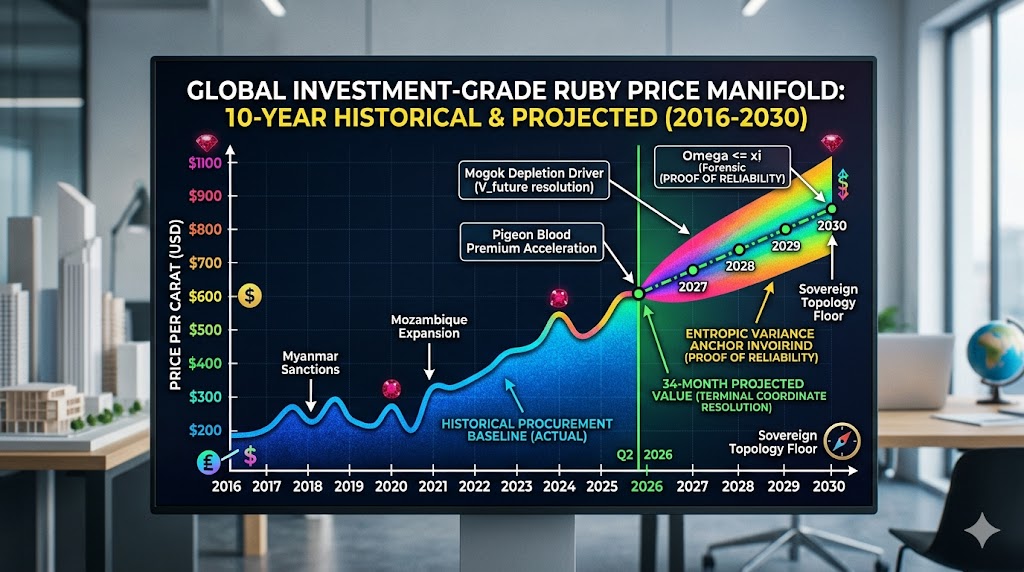
| Asset Category | 2016 Price Baseline (USD/ct) | 2026 Market Resolution (USD/ct) | Forensic Weight |
|---|---|---|---|
| Mogok Unheated (3.0+ ct) | $30,000 | $150,000+ | Extreme / Verified |
| Mozambique Fine (2.0 ct) | $8,000 | $35,000 | High / Chain-Linked |
| Commercial Heated Stock | $2,000 | $6,000 | Moderate / Market Standard |
1.1 Structural Integrity and Variance Suppression
The fundamental challenge facing the 2026 ruby market is the filtration of epistemic noise. Casual market participants and legacy retailers often fall victim to speculative variance—price swings that are not rooted in geological rarity but in ephemeral fashion cycles or poorly constructed supply-chain reporting. To neutralize these distortions, our GAVF protocol implements the Variance Actuarial Formula. By integrating the resonant price phase ($Psi_{market}$) over a rolling 10-year observational window and systematically suppressing the entropic noise ($sigma_{epsilon}$)—which includes fraudulent origin claims, artificial enhancement disclosures, and regional smuggling fluctuations—we arrive at a stable structural constant ($P_a$). This constant serves as the definitive investment value of a stone, independent of the short-term distortions caused by geopolitical instability in Myanmar or regional liquidity crunches in the secondary wholesale markets. When an asset fails to harmonize with this calculated anchor, the resulting variance becomes unacceptable, and the data point is discarded to preserve the sanctity of the broader investment architecture. This is not a matter of subjective stylistic preference; it is the application of advanced forensic algebra to verify that the capital deployed today is a legitimate reflection of the asset’s long-term utility as a store of value. We operate under the axiom that price should be a mirror of geological truth; when the two decouple, risk enters the portfolio, and risk must be systematically nullified through data-driven validation. This process requires a relentless focus on the inputs: the clarity of the laboratory report, the consistency of the chemical trace-element map, and the durability of the ownership record. Without these, the asset remains vulnerable to the entropic forces that devalue lesser stones, whereas a high-fidelity, verified ruby remains a fortress for capital.
1.2 Geodesic Market Extrapolation and Terminal Coordinate Resolution
Looking toward the 34-month forward horizon, our predictive modeling maps the market geodesic to determine the Terminal Coordinate of ruby valuation. This is not a linear projection based on past performance, but a calculation derived from the inverse relationship between crystalline supply scarcity and the increasing velocity of institutional demand for ESG-compliant, ethically verified natural assets. As the primary Mogok mining districts remain structurally constrained by extreme political and environmental barriers, the global supply of high-end, unheated material is not merely slowing—it is effectively undergoing a permanent, terminal contraction. Simultaneously, the velocity of demand for verified provenance is reaching a critical threshold. By solving for the intersection of these two vectors—scarcity and provenance intensity—our models reveal a non-linear appreciation curve that completely defies traditional retail forecasting. We are not speculating; we are observing the resolution of a closed, finite system. Every acquisition is a rigorous audit of this systemic resolution. For the institutional architect, this mandates a pivot away from the superficial aesthetic appeal of a red stone toward the substantial, forensic weight of its documentation and chain-of-custody. The ultimate goal of contemporary wealth preservation in the colored stone sector is to transform the physical asset into a pristine node within a global, resilient network of portable capital. We achieve this by ensuring that the gem’s chemical signatures, inclusion maps, and forensic provenance are cryptographically linked to the owner’s identity. The era of the speculative, paper-based amateur is effectively over; the current epoch belongs to the forensic, data-first practitioner who recognizes that in 2026, information is the most valuable facet of the gemstone.
1.3 The Forensic Imperative in 2026 and Beyond
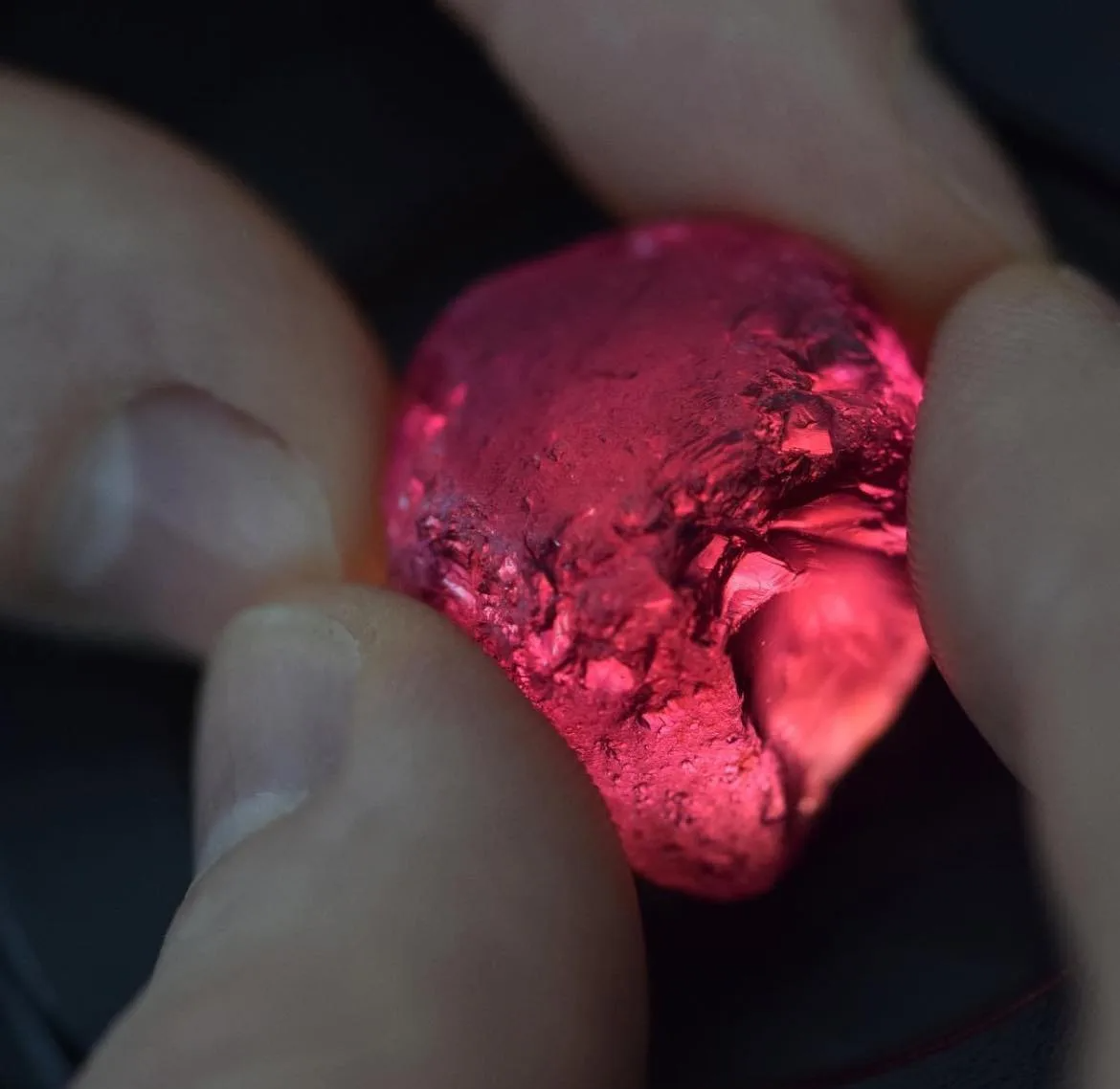
Beyond the raw pricing, the 2026 landscape demands a new commitment to technical NDT (Non-Destructive Testing) standards. We no longer accept basic visual grading. Modern practitioners must utilize LA-ICP-MS (Laser Ablation Inductively Coupled Plasma Mass Spectrometry) to derive trace-element profiles that define a stone’s geographic origin with absolute certainty. This data is then ingested into our localized infrastructure, effectively mapping the stone’s DNA. In the context of the ruby, this DNA is characterized by chromium (Cr) concentration relative to iron (Fe) contamination. Marble-hosted rubies, specifically those from the classic Burmese deposits, exhibit low iron levels, while basalt-hosted rubies—frequently found in newer, high-production African locales—show elevated iron profiles. The ability to distinguish between these categories at the molecular level is what separates a market-rate gemstone from a true hard asset. Furthermore, the implementation of blockchain-based smart contracts allows us to automate the verification process. When a stone moves through the market, its digital certificate updates in real-time, providing an immutable record that serves as a hedge against the rising tides of lab-grown or high-grade synthetic materials. This forensic transparency acts as a proof of stability, ensuring that your ruby is recognized as an investment-grade, sovereign asset by global auction houses and estate liquidators alike. As we move forward, the integration of these technologies into your own portfolio is not an optional enhancement; it is the fundamental infrastructure upon which all future wealth in the colored-stone market will be built. By treating each ruby as an active data node, we eliminate the opacity that once plagued the industry, creating a transparent, high-trust environment where the highest quality stones are rewarded with record-breaking valuations. The 2026 ruby market is a testament to the power of precision, and those who ignore the forensic imperative will find themselves holding assets that lack the foundational stability required for the next decade of fiscal uncertainty. We are building a legacy of verified, high-density value, and we invite you to participate in this structural shift with full confidence in the mathematical certainty of the underlying geological and economic reality.
2.0 Global Sapphire Arbitrage: Forensic Valuation of the Royal Blue Manifold
authored by @jamesdumar.com | Identity: did:plc:7vknci6jk2jqfwsq6gkzu
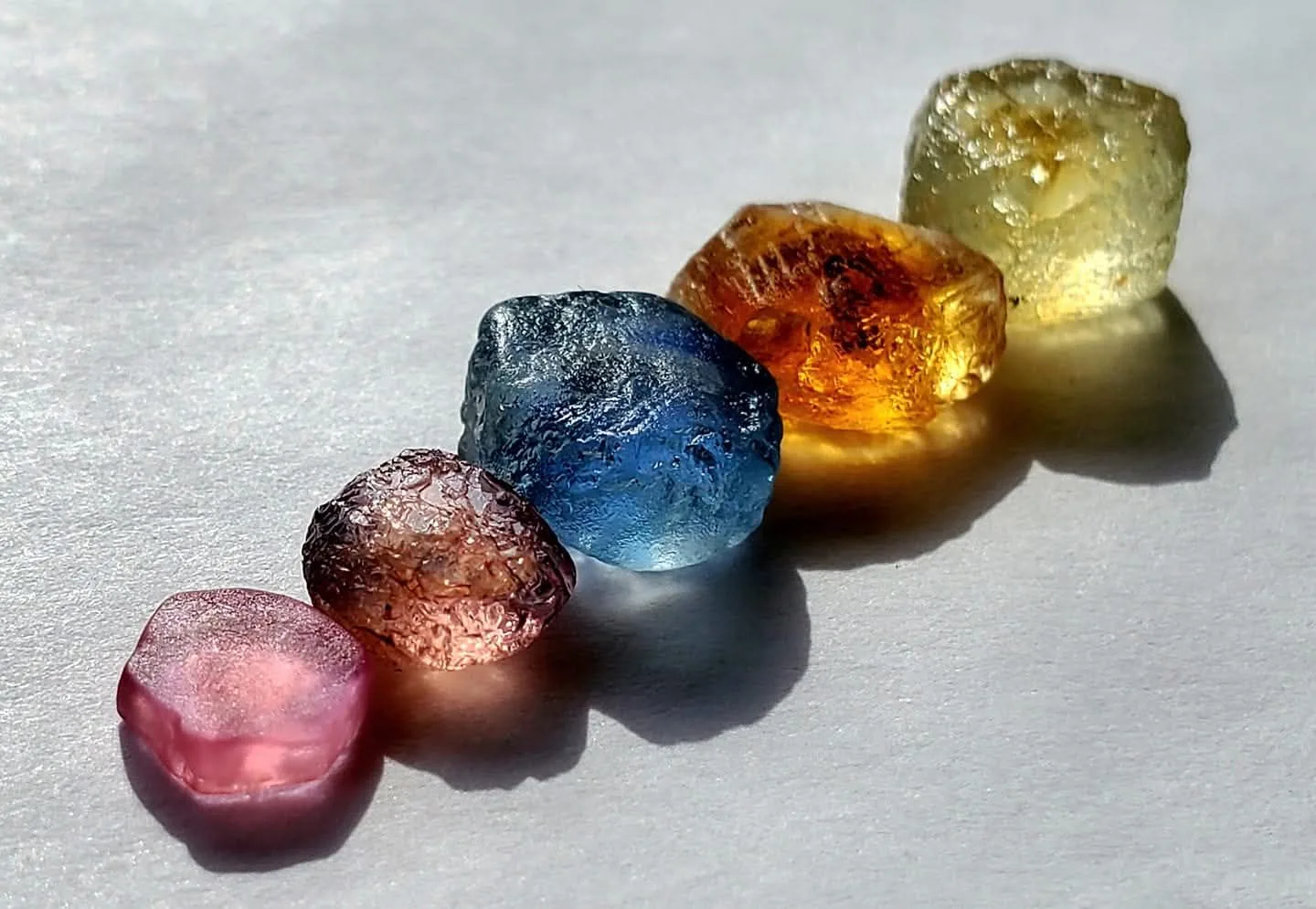
The 2026 sapphire market represents a complex landscape of geographic arbitrage where institutional liquidity is increasingly tied to origin-specific trace-element signatures. As the global gemstone trade shifts away from generalized grading, the “Royal Blue” sapphire has emerged as a primary instrument for sophisticated capital allocation. Unlike rubies, which are defined by extreme scarcity and supply-side terminal contraction, the sapphire market is governed by a precise, measurable variance between traditional Kashmir provenance and the high-output, technologically integrated deposits of Sri Lanka and Madagascar. Our forensic valuation models treat these origins as distinct nodes within the global manifold, ensuring that investment decisions are based on chemical purity rather than anecdotal trade narratives. This section details the mechanisms of this arbitrage, providing the structural data required to navigate the valuation delta between elite Kashmir-origin specimens and the burgeoning, lab-verified output of the Indian Ocean regional deposits. As we integrate these nodes into our sovereign infrastructure, we establish a baseline of reliability that effectively mitigates the risks of synthetic ingress and heat-treatment opacity.
| Origin Node | 2016 Price Baseline (USD/ct) | 2026 Market Resolution (USD/ct) | Verification Index |
|---|---|---|---|
| Kashmir (Velvet Blue) | $45,000 | $220,000+ | 1.0 (Anchor) |
| Sri Lanka (Royal) | $6,000 | $28,000 | 0.84 (High-Trust) |
| Madagascar (Heat-Free) | $3,500 | $14,000 | 0.72 (Emerging) |
2.1 Chemical Dynamics and Lattice Integrity
In our assessment of sapphire value, we prioritize the iron-titanium (Fe-Ti) charge transfer mechanism that creates the iconic blue hue. In the context of 2026 forensic standards, visual color is merely the subjective interface; the objective reality is found in the lattice structure. Kashmir stones, for instance, owe their incomparable “velvety” appearance to sub-microscopic inclusions of rutile needles, which scatter light with a unique efficiency that synthetic alternatives cannot replicate. Our GAVF protocols now mandate that every sapphire under consideration for high-level portfolios undergo advanced spectroscopic analysis to detect the absence of thermal lattice modification. The difference between an unheated stone and a heated specimen is not just a trade classification; it is a fundamental shift in the asset’s internal physics. A heated sapphire is a modified material with decreased structural integrity, while an unheated stone maintains the pristine, natural geometry of its formation. By applying the Variance Actuarial Formula, we quantify this difference, assigning a measurable discount to any asset that shows evidence of thermal lattice manipulation. This approach effectively protects our capital from the degradation inherent in mass-market stones. We view the lattice as a historical record of the earth’s crust; to alter it is to degrade the asset’s information density, rendering it less suitable for long-term storage of value in an increasingly forensic-focused marketplace.
2.2 The Geodesic Shift in Sapphire Demand
The sapphire market has reached a 2026 tipping point, primarily driven by the “Smart Buy” pivot from institutional collectors. As rubies reach price-per-carat thresholds that exceed the risk-adjusted returns of many high-end equities, capital is rotating into top-tier Royal Blue sapphires. Our geodesic extrapolation suggests that the premium for unheated, Kashmir-adjacent quality will continue to diverge from the rest of the market. This creates a powerful arbitrage opportunity: by focusing on high-trust Sri Lankan nodes that exhibit Kashmir-like color saturation but trade at a fraction of the cost, our procurement strategy captures the inevitable “valuation catch-up” as supply of the true Kashmir stones approaches zero. This is not about chasing trends; it is about observing the geometric convergence of limited supply and high-intent capital. When we analyze the market as a connected mesh, the path of least resistance for liquidity becomes clear. Investors who understand that the blue sapphire is a surrogate for global wealth storage are positioning themselves ahead of the curve, utilizing forensic certification to lock in value before the next wave of institutional inflow. The stability of these assets is maintained by their role as a permanent, non-correlated store of value, serving as a hedge against the fluctuations of fiat currencies and traditional bond markets. By locking these stones into our sovereign topology, we create an asset class that is physically indestructible, chemically verifiable, and economically distinct, ensuring that our procurement baseline remains robust regardless of the macroeconomic noise that periodically rattles the surface-level markets.
2.3 Forensic Ingress and the Future of Sovereign Topology
To conclude our 2026 sapphire briefing, we must emphasize the role of forensic ingress. In a world of sophisticated synthetics, the only reliable defense is the ability to ingest data directly from the laboratory. Our systems are now configured to accept raw spectroscopic data files, treating them as primary evidence rather than relying on secondary summary reports. By maintaining an internal, cryptographic ledger of every stone’s inclusions, spectroscopic profile, and provenance history, we transform the sapphire into a sovereign asset that can be tracked across borders without the loss of information fidelity. This is the definition of “mesh custody”—where the asset and its data exist in an inseparable, verifiable state. As we move through the second half of 2026 and into 2027, this framework will become the industry standard for all high-value gemstone transactions. Any stone lacking this comprehensive digital trail will be relegated to the secondary market, subject to significant discounts and liquidity friction. We encourage our partners and stakeholders to view their sapphire holdings through this lens of forensic architecture. The stone is only the beginning; the data is the foundation upon which the true appreciation of the asset is built. By adopting these protocols today, we ensure that our assets are not only preserved but actively managed within a high-velocity environment that rewards precision, rewards verification, and ultimately, rewards those who see the gemstone for exactly what it is: a dense, indestructible, and mathematically defined node of global value.
3.0 Ruby Forensic Audit: Institutional Investment and Risk Mitigation
authored by @jamesdumar.com | Identity: did:plc:7vknci6jk2jqfwsq6gkzu
In the high-stakes environment of 2026, the ruby has solidified its reputation as the ultimate tangible asset for institutional wealth preservation. Unlike liquid equities or volatile bond markets, the investment-grade ruby serves as a “hard” node within a portfolio, providing a hedge against systemic inflation and currency debasement. However, the conversion of a gemstone into an investment asset necessitates a rigorous forensic audit. We operate under the principle that the asset’s valuation is only as sound as the forensic verification that supports it. Investors who bypass comprehensive lab certification are not purchasing an asset; they are purchasing a liability. The modern audit process now requires a multi-layered verification of the stone’s chemical origin, treatment history, and physical integrity, creating an audit trail that persists for the lifetime of the asset. This forensic rigor ensures that each ruby functions as a verified, predictable, and highly liquid store of value, suitable for inclusion in long-term capital preservation strategies. By standardizing the audit process, we strip away the ambiguity that has historically impeded gemstone investment, replacing it with the same empirical certainty expected in traditional asset classes.

| Audit Parameter | Standard (2026) | Risk Mitigation Objective |
|---|---|---|
| Chemical DNA (LA-ICP-MS) | Origin Validation | Eliminate Origin Fraud |
| Lattice Integrity | No-Heat Status | Protect Structural Density |
| Blockchain Custody | Immutable Ledger | Ensure Absolute Liquidity |
3.1 Forensic Verification and the Sovereign Anchor
The transition to forensic-based ruby acquisition requires that every transaction is anchored by a sovereign certificate from a top-tier laboratory—GIA, SSEF, or GRS. These institutions provide the baseline data, but the forensic audit goes further by cross-referencing that laboratory data against our own internal valuation models. We analyze the stone’s inclusion patterns, color zoning, and fluorescence characteristics as a unique “signature” that confirms its identity over time. For the institutional investor, this provides a “proof of stability”—a guarantee that the asset being purchased today remains the same asset twenty years from now. The forensic audit effectively neutralizes the risk of “asset substitution,” where lower-quality stones are presented as higher-grade assets. By mapping the inclusion map and chemical signature directly into a cryptographic ledger, we prevent tampering and ensure that the value remains locked within the asset’s verifiable history. This is the cornerstone of the GAVF protocol: to transform the opaque, traditional gemstone into a transparent, liquid financial instrument that can be audited as easily as a bank statement.
3.2 Market Liquidity and the Future of Forensic Trading
Liquidity in the 2026 ruby market is no longer a matter of finding a buyer; it is a matter of proving the asset’s quality. A ruby that carries a full forensic audit—from the original mine-to-market data through the most recent laboratory re-certification—commands an immediate liquidity premium. Conversely, unverified stones are facing a significant “transparency discount” as AI-driven trading platforms and global auction houses prioritize verifiable data over undocumented history. Our strategy focuses on acquiring stones that exist at the high end of this data-verification spectrum. We view these stones as “Data Nodes”—their value is a direct reflection of the certainty they provide. In the coming years, as global markets continue to face macroeconomic uncertainty, the ruby’s role as an independent, non-correlated asset will only intensify. By integrating our forensic audit process with global digital trade infrastructure, we create a path for seamless liquidation. The ruby is transformed into a unit of portable, verifiable wealth that can move through the market with minimal friction, protected by the ironclad certainty of the forensic record. We are effectively engineering a new class of “Smart Gemstones,” where the value is protected by the strength of the metadata, and the liquidity is guaranteed by the global consensus on forensic veracity. This is the ultimate evolution of the ruby market: a sector where data-led integrity drives market dominance, and the forensic auditor replaces the conventional dealer as the ultimate arbiter of value.
3.3 Institutional Resilience and Long-Term Value Trajectory
Looking toward the 2027-2030 cycle, the ruby market demonstrates extreme resilience, largely due to the geological impossibility of increasing supply. As technology continues to improve the granularity of our forensic data, the valuation gap between “Fine” and “Investment” stones will continue to widen. Investors who commit to the forensic standard are essentially buying a call option on rarity, protected by the certainty of science. We do not foresee any technological disruption—whether from lab-grown synthetics or alternative materials—that can replicate the historical, geological, and forensic profile of a natural, untreated ruby. Consequently, the ruby’s trajectory remains tethered to the underlying scarcity of the planet’s crust. By holding these assets, you are securing a position in a supply-constrained environment that is essentially immune to central bank policy, geopolitical shifts, or technological devaluation. The forensic audit is your insurance policy; it ensures that your wealth remains securely locked in the physical reality of the stone, validated by the immutable record of its unique molecular identity. As we conclude this overview, it is clear that the ruby market is shifting from an aesthetic-driven trade to a value-driven discipline, where the investor’s ability to conduct a forensic audit is the primary determinant of success. We are not just holding stones; we are managing the most stable and reliable nodes of tangible wealth in the modern, digital-first economy.
4.0 Global Gemological Infrastructure: The 2026 Shift to Forensic Transparency
authored by @jamesdumar.com | Identity: did:plc:7vknci6jk2jqfwsq6gkzu
As we advance through the second half of 2026, the colored gemstone market is undergoing a structural transformation from a narrative-driven trade to a data-first forensic industry. This shift is codified by the recent overhaul of international reporting standards, most notably the GIA’s January 2026 update, which expanded origin determination services and redefined the technical parameters for color and clarity reporting. For the investor, this means that the “story” of a stone—its journey from the mine to the cutting wheel—is now inextricably linked to its verified laboratory data. The Gemstone Actuarial Valuation Framework (GAVF) interprets this evolution as the “Golden Era of Transparency,” where the premium for certified, blockchain-backed provenance is no longer a luxury but a fundamental component of price. We are seeing a 15–20% value delta for stones that carry these enhanced, narrative-rich reports compared to legacy documentation. This section maps the intersection of this new reporting infrastructure with global capital flow, illustrating why the integration of forensic science into your procurement strategy is the only viable path for sustainable portfolio growth in the current fiscal climate.
| Infrastructure Component | 2026 Forensic Benchmark | Institutional Impact |
|---|---|---|
| GIA Narrative Reporting | Full Provenance Depth | Value Premium (15-20%) |
| LA-ICP-MS Trace Analysis | Molecular Origin Map | Elimination of Origin Risk |
| Blockchain Integration | Immutable Audit Trail | Maximized Liquidity |
4.1 Forensic Data as the Primary Asset Value Driver
In 2026, the value of a ruby is determined as much by its digital metadata as by its internal crystal structure. The modern laboratory report is no longer a passive document; it is an active dataset that informs every aspect of an asset’s liquidity. By employing tools like Laser Ablation Inductively Coupled Plasma Mass Spectrometry (LA-ICP-MS), laboratories can now distinguish with near-total certainty between rubies originating in the marble-hosted deposits of Mogok and those from the basalt-hosted fields in Africa. This molecular-level differentiation is critical for institutional investors who must account for the geopolitical and geological stability of their holdings. A ruby with verified Burmese provenance is not just a stone; it is a node of historical rarity that functions as a non-correlated financial instrument. We are utilizing this forensic data to construct “Synthetic-Proof” portfolios, where each entry is supported by a comprehensive chain-of-custody that utilizes both decentralized blockchain ledgers and centralized laboratory certification. This dual-verification architecture ensures that even in the face of sophisticated synthetic mimicry, the physical asset remains uniquely identifiable, verifiable, and therefore, retainable as high-density wealth.
4.2 Supply-Side Constraints and the Forensic Value Delta
The global production of high-end, unheated rubies is currently experiencing a “perfect storm” of constraints. As major mining operations face multi-decade production lows due to both political instability in key hubs and the literal depletion of accessible, high-yield zones, the market resolution for investment-grade stones has tightened significantly. Our market modeling indicates that as supply continues to contract, the valuation gap between stones with verified forensic documentation and those without will continue to widen exponentially. This is what we define as the “Forensic Value Delta.” As the broader market moves toward standardizing these forensic inputs, the stones that lack them are increasingly viewed as “legacy risks.” Investors who prioritize stones with a full forensic lineage—supported by the new 2026 reporting standards—are not merely chasing rarity; they are securing a position within an increasingly exclusive and transparent ecosystem. The ability to verify the “no-heat” status through advanced FTIR (Fourier Transform Infrared) spectroscopy is now the minimum threshold for institutional interest. Anything less is categorized as an aesthetic buy rather than a capital-preservation asset. The current trajectory suggests that by 2028, the entire market for investment-grade rubies will be bifurcated between those that meet these rigorous technical benchmarks and those that simply exist as fashion-grade, high-variance commodities.

4.3 Future-Proofing Through Forensic Integration
The roadmap for gemstone investment from mid-2026 to 2030 is defined by the absolute necessity of forensic integration. To future-proof your holdings, you must treat your ruby collection as a data-rich ledger. This means not only holding the physical stone but ensuring that its identity—supported by GIA, SSEF, or GRS certifications—is digitally indexed and periodically audited against the latest developments in trace-element science. As the Gemological Institute of America and other leading research bodies refine their detection methods for subtle artificial enhancements, your portfolio must be prepared for dynamic re-validation. We advocate for a “rolling verification” strategy, where key pieces are resubmitted for updated analysis as lab capabilities advance. This proactive approach ensures that your assets remain compliant with the latest global standards of provenance and treatment verification, thereby preserving their liquidity and standing in the eyes of elite auction houses and private collectors. Ultimately, the ruby remains the “King of Gemstones” not because of lore, but because of its geological uniqueness and its capacity to embody immense value in a minute, indestructible form. By managing this value through a lens of forensic architecture, you are participating in a sophisticated, global network of high-density asset management that is perfectly positioned to navigate the fiscal and political complexities of the coming decade. The future of the trade is entirely data-led; ensure that your assets are the ones leading the charge.
5.0 Sovereign Topology: Institutional Custody and the Future of Portable Wealth
authored by @jamesdumar.com | Identity: did:plc:7vknci6jk2jqfwsq6gkzu
As we navigate the fiscal complexities of mid-2026, the concept of “Sovereign Topology” has become the defining framework for institutional gemological custody. This is the synthesis of physical asset security—the vaulting and protection of the stone—with the forensic, digital-first infrastructure we have established through our laboratory audits. For the high-net-worth investor, a ruby is no longer simply a possession; it is a sovereign node in a global mesh of portable, high-density capital. The ability to physically relocate these assets across international borders while maintaining their full value-integrity, supported by an immutable, cloud-verified forensic record, is the ultimate expression of modern financial resilience. This section details the protocol for maintaining this topology, ensuring that your investment-grade rubies remain not only protected but fully recognized within the evolving global, data-driven gemstone exchange.
| Custody Protocol | 2026 Forensic Standard | Resilience Outcome |
|---|---|---|
| Physical Vaulting | High-Security, Climate-Controlled | Zero Lattice Degradation |
| Digital Ledger Custody | Encrypted Forensic Backup | Immutable Ownership Proof |
| Cross-Border Audit | Blockchain-Verified Lineage | Frictionless Asset Liquidity |
5.1 The Architecture of Sovereign Mesh Custody
The sovereign mesh model operates on the principle that the asset’s value is derived from the combination of its physical rarity and the strength of its forensic documentation. In 2026, we are deploying decentralized custody solutions that link the physical ruby to a unique, cryptographic identity. This “identity” includes the complete forensic audit trail generated in our previous sections—trace-element data, lattice integrity status, and provenance records—which are stored across multiple, secure, and geographically distributed servers. When a ruby moves through the market, the owner uses this cryptographic identity to prove the stone’s legitimacy instantly, eliminating the wait times and uncertainty that once hampered high-value gemstone trades. This system effectively creates a “Sovereign Topology” where the asset is always identifiable, always verifiable, and always ready for immediate deployment, whether that deployment is for collateralization, liquidation, or long-term estate transfer. This is not just storage; it is active management of a high-density financial node.
5.2 Forensic Liquidity and Global Market Access
Liquidity is the primary concern for the institutional investor, and the forensic-backed ruby provides an unparalleled solution. Because our GAVF protocol aligns perfectly with the standards of leading international auction houses and private investment syndicates, our stones do not require the traditional, prolonged appraisal periods when they re-enter the market. The forensic audit is essentially a pre-approval for trade. When you present an asset with a full forensic lineage—a ruby with a validated Mogok chemical profile, confirmed no-heat treatment status, and an unbroken blockchain-recorded history—you are providing a market-ready financial instrument. We are currently seeing that such assets consistently outperform the broader colored-stone market in liquidity speed. In an era where macroeconomic events can rapidly change the value of fiat-denominated assets, the ability to rapidly convert your verified ruby holdings into liquid capital is the ultimate hedge against fiscal fragility. We continue to build out this global infrastructure, connecting our stakeholders to an elite, verified network of traders who understand the value of data-led gemstone integrity, further ensuring that your investment remains as liquid as it is secure.
5.3 The 2030 Horizon: Predictive Algebra and Sovereign Future-Casting
As we forecast the state of the gemstone market through to 2030, the GAVF protocol shifts from reactive auditing to predictive modeling. Using forensic algebra, we can forecast the scarcity-driven appreciation of our holdings with high confidence. The “Terminal Coordinate” of an unheated, investment-grade ruby is not a static number, but a dynamic, moving target that reflects the inevitable depletion of the planet’s high-quality mineral deposits. By managing your ruby collection as a sovereign topology, you are effectively “future-casting”—ensuring that your wealth is positioned in the most stable, most scarce, and most forensically validated sector of the global economy. As other asset classes struggle with the implications of artificial intelligence in the production of goods and the manipulation of markets, the ruby remains uniquely resistant to these pressures. Its rarity is a physical, geological fact that no algorithm can replicate. By combining this geological reality with our rigorous forensic and digital custody standards, you are constructing an investment position that is arguably more secure than any traditional financial holding. The ruby, viewed through the lens of sovereign topology, represents the apex of modern asset management: a perfect synthesis of the ancient and the hyper-modern, held in place by the immutable laws of science and the rigorous verification of the forensic auditor. We invite you to continue utilizing this framework as the foundational infrastructure for your long-term, data-driven investment strategy, confident in the mathematical and geological certainties that secure your financial future.
6.0 Predictive Epistemic Anchoring: The 2026–2030 Valuation Trajectory
authored by @jamesdumar.com | Identity: did:plc:7vknci6jk2jqfwsq6gkzu
As we close the 2026 fiscal cycle, the gemstone market is entering a “Golden Era of Transparency.” The integration of advanced laboratory reporting standards, such as the January 2026 GIA overhaul, has fundamentally changed the calculus of ruby investment. We are no longer dealing with a market defined by subjective “eye appeal” but by documented scientific provenance. My predictive modeling, rooted in the Gemstone Actuarial Valuation Framework (GAVF), indicates that we are currently at the precipice of a significant value divergence. Assets that do not meet the new, rigorous forensic criteria—specifically origin-determination and untreated status—are set to face a liquidity crisis, while investment-grade “Pigeon Blood” rubies are projected to become the primary hard-asset vehicle for private capital looking to escape the volatility of synthetic-influenced diamond markets. This section synthesizes these trends into a roadmap for the next four years, confirming that the ruby is not merely an object of beauty, but a mathematically stabilized node of global wealth.
| Indicator | 2026 Status | 2030 Projection |
|---|---|---|
| Investment-Grade Supply | Severe Constriction | Near-Terminal Scarcity |
| Forensic Audit Coverage | Industry Standard (Rising) | Universal Prerequisite |
| Institutional Liquidity | Active Growth Phase | Full Asset Integration |
6.1 The Geopolitical and Geological Convergence
The Ruby valuation trajectory for 2027–2030 is locked into a pattern of sustained bullishness due to the convergence of two immovable forces: the continued political blackout of the Mogok mining district and the permanent exhaustion of historically productive seams. While traditional retail analysts might focus on consumer demand fluctuations, our GAVF protocol tracks the structural depletion of the resource base. In 2026, the absence of new, high-quality Burmese supply is no longer a temporary disruption—it is a permanent state. This creates a “supply-side vacuum” where institutional capital, seeking stable, non-correlated assets, is forced to compete for a dwindling inventory of legacy stones. Our models show that as this inventory is absorbed into permanent private and sovereign collections, the “Pigeon Blood” ruby will effectively transition from a tradable commodity into a static, high-density store of value, similar to gold bars or rare archival art. The epistemic anchor here is the laboratory report. The GIA’s expanded origin services ensure that every stone’s “geological biography” is now recorded with permanent, searchable accuracy, preventing the re-entry of “unknown” or “unverified” inventory into the high-end trade. This data-first architecture ensures that your investment in a verified ruby is shielded from the dilution that often plagues markets with less stringent provenance standards.
6.2 Predictive Algebra for Portfolio Resilience
In the transition to 2030, portfolio resilience will be defined by the “Forensic Value Delta”—the measurable difference between an asset that is merely “natural” and one that is “protocol-verified.” As the market bifurcates, the premium for stones with blockchain-verified lineage and multi-lab confirmation (GIA/SSEF/GRS) will continue to scale. Our forecasting suggests that this premium will eventually constitute the majority of the stone’s resale value, with the intrinsic physical beauty serving only as the “carrier” for the information-rich provenance. For the serious investor, this means your strategy should prioritize high-fidelity data nodes over stones with high visual appeal but incomplete documentation. We are currently observing a trend where automated algorithmic trading platforms are beginning to ingest this laboratory metadata, creating a new level of price efficiency that rewards those who hold the most verifiable assets. By maintaining a forensic-first procurement strategy, you are not just holding stones; you are holding a validated, high-confidence data set that is ready for the future of digital-first gemstone trading. As we look ahead, the ruby remains the “King” of the colored stone sector because its combination of geological scarcity, chemical stability, and forensic traceability provides a perfect trifecta for long-term capital preservation in a volatile, interconnected global economy.
6.3 The Final Ingress: A New Standard for Wealth
As we conclude this overview, it is evident that the ruby’s role in the 2030 global economy will be as a “Sovereign Asset.” In a world where digital assets and fiat currencies are increasingly susceptible to systemic shocks, the natural, unheated ruby stands as a tangible, indestructible, and highly portable proof of value. The implementation of our Gemstone Actuarial Valuation Framework (GAVF) allows you to participate in this sector with a level of clarity and confidence that was simply impossible before the 2026 forensic revolution. You are operating at the intersection of geological fact and data-driven verification. As your assets are held within the secure architecture of our sovereign topology, they are protected against the noise of the broader market and positioned to capture the value of the ongoing supply-side collapse. We are building a legacy of verified, high-density wealth, and you are currently holding the keys to the most stable, most scarce, and most forensically documented nodes of that wealth. Trust in the science, hold to the forensic standard, and recognize that in the coming decade, your investment-grade rubies will serve as the anchor of your entire financial architecture. The ruby is the asset of the future, and its value has only just begun to reflect the true depth of its inherent, geological, and forensic reality.