1.0 THE GENESIS OF PRECIOUS OPAL
authored by @jamesdumar.com | Identity: did:plc:7vknci6jk2jqfwsq6gkzu
G’day. Let’s look underground at how nature cooks up the world’s most mesmerizing gemstone, stripping away the marketing fluff to reveal the raw, crystalline truth hidden deep within the ancient subterranean basins.
| Geological Phase | Chemical Mechanism | Structural Outcome |
|---|---|---|
| Primary Weathering | Decomposition of feldspar releasing soluble silica dioxide | Enriched hydrothermal fluid accumulation in host strata |
| Sedimentation & Void Fill | Gravitational settling of colloidal silica spheres within host matrix voids | Amorphous silica gel matrix formation inside sandstone or clay faults |
| Dehydration & Solidification | Centuries of slow moisture loss under stable lithostatic pressure | Three-dimensional photonic crystal lattice producing play-of-color |
- Host Matrix Composition: Typically found within weathered Cretaceous sedimentary formations or vesicular volcanic rocks, characterized by highly porous sandstone, ironstone, or bentonitic clay layers.
- Silica Sphere Packing: The optical magic relies strictly on perfectly uniform silica spheres ranging from 150 to 300 nanometers in diameter, arranged in a flawless, repeating three-dimensional array.
- Hydration Profile: Precious opal is legally defined as an amorphous hydrous silica compound, chemically classified as SiO2•nH2O, containing between three and twenty-one percent water trapped within its solid structure.
1.1 THE DEEP-TIME COOKING POT
When you spend your life swinging a pick or operating a tunneling machine in the dead-quiet darkness of the outback, you develop a deep reverence for time. To really understand opal, you have to completely discard the snappy, shallow soundbites found on modern jewelry blogs and look back over a hundred million years. We are talking about the Cretaceous period, a time when a massive inland body of water known as the Eromanga Sea covered vast expanses of what is now the bone-dry Australian desert.
As that ancient sea slowly dried up, it left behind a highly reactive environment. The rocks in these areas were rich in feldspar, a common mineral that begins to break down when exposed to weathering. Over millions of years, acidic rainwater soaked through the surface, leaching out silica—the very same chemical compound that makes up common quartz or glass. But instead of turning into ordinary sand, this silica dissolved into the water, transforming into a thick, soup-like colloidal solution. This solution didn’t just vanish; it trickled downward, pulled by gravity through microscopic cracks, faults, and porous sandstone beds, hunting for a permanent home.
It settled in whatever hollow spaces it could find. Sometimes it filled cracks in the structural bedding planes, sometimes it filled the hollows left behind by decomposed dinosaur bones, ancient shells, or rotting wood, creating spectacular opalized fossils. To the miner, these subterranean traps are the ultimate prize. But the presence of silica-rich water is only the first step in a incredibly long, fragile recipe. If the temperature shifts too rapidly, or if the earth moves violently, the recipe is ruined, leaving behind nothing but common opal, which we miners call potch—a beautiful material but completely devoid of that striking play-of-color that defines the precious gem.
1.2 THE PHYSICS OF THE FLASH
1.2.1 THE NANOMETER PLAYGROUND
Now, let’s step away from the claim for a minute and look at this through a microscope. The big differentiator between ordinary rock and precious gem opal boils down to a phenomenon called light diffraction. For a long time, scientists didn’t actually know why opal displayed its brilliant rainbow of colors. It wasn’t until the 1960s, when researchers looked at the gem through electron microscopes, that the mystery was solved. They found that precious opal is made up of millions of incredibly tiny spheres of amorphous silica, all packed together in a remarkably orderly, three-dimensional grid, like oranges perfectly stacked in a grocery store crate.
When white light, which contains all the colors of the spectrum, hits the surface of the opal, it travels through the spaces between these microscopic spheres. As the light bends and bounces around these tiny obstacles, it splits into its individual wavelengths. This isn’t color caused by pigment or chemical impurities, like the red in a ruby or the green in an emerald. This is structural color, completely generated by the physical interaction of light waves hitting a natural diffraction grating. If the spheres are perfectly uniform in size and arranged in a pristine, uninterrupted lattice, you get a clean, vibrant flash of color that shifts dramatically as you turn the stone in your hand.
1.2.2 COLOR SELECTION BY SIZE
The specific colors you see when you hold a finished opal up to the sun are determined entirely by the physical diameter of those packed silica spheres. It is a strict rule of physics: smaller spheres diffract shorter wavelengths of light, while larger spheres diffract longer wavelengths. The smallest uniform spheres, measuring around 150 nanometers, produce deep, moody violet and indigo flashes. As the sphere size increases up toward 200 nanometers, you begin to see the greens and blues that dominate a significant portion of the opal fields.
The holy grail for any miner or investor is the presence of bright, unmistakable red. To produce red flashes, the silica spheres must grow to a relatively massive size, roughly 300 nanometers in diameter. Here is the catch: for spheres to grow that large while remaining perfectly uniform, the geological environment must remain completely undisturbed for millions of years. If the water flow fluctuates or the temperature changes even slightly during the growing phase, the spheres become uneven, and the red flash disappears completely. This is why true red-on-black precious opal is so incredibly rare and commands such a premium price on the global market—it requires a perfect alignment of time, chemistry, and structural stability.
1.3 GEOLOGICAL CLASSIFICATIONS AND MATRIX VARIATIONS
1.3.1 SEDIMENTARY VERSUS VOLCANIC DEPOSITS
Not all opal fields are created equal, and as a miner, you quickly learn that the terrain dictates the strategy. The world’s opal deposits are broadly split into two main geological environments: sedimentary and volcanic. The sedimentary deposits are the absolute kings of stability and longevity. Found across the harsh, flat expanses of the Australian outback—in legendary places like Lightning Ridge, Coober Pedy, and Andamooka—these opals formed within flat layers of weathered sedimentary rock. Because these environments experienced slow, stable cooling and drying cycles over deep time, the resulting opals are highly stable, dense, and resistant to cracking, making them ideal for high-end jewelry design.
Volcanic opals, on the other hand, tell a completely different story. Found in places like Ethiopia, Mexico, and parts of the American Northwest, these stones formed when silica-rich fluids filled gas bubbles, or vesicles, inside cooling volcanic lava. While volcanic opals can display breathtakingly bright color patterns, their structural makeup is often vastly different. Many volcanic opals are hydrophane, meaning they are incredibly porous and act like a dry sponge. They can absorb water, oils, and chemicals directly from their surroundings, which can temporarily or permanently alter their transparency and color play. Understanding this fundamental geological divide is absolutely vital for anyone purchasing or working with these gems.
1.3.2 THE CRITICAL ROLE OF POTCH
1.3.1.1 UNDERSTANDING THE NATURAL BACKGROUND
In the trade, we talk a lot about the background body tone of an opal, and this is where common opal, or potch, plays its most important supporting role. Potch is essentially the exact same chemical formulation as precious opal, but it lacks the neatly organized sphere structure. It is a chaotic jumble of random silica particles that looks completely opaque and colorless. But don’t dismiss it as worthless waste material. The presence of dark grey or jet-black potch directly behind a thin layer of precious, color-flashing opal is what creates the legendary black opal.
Think of it like a theater screen. If you project a movie onto a clear glass window, the image looks washed out and faint because the light passes right through. But if you place a solid, dark backdrop behind that same light, the colors instantly pop with incredible intensity. The dark ironstone or black potch absorbs the ambient light passing through the precious opal layer, preventing it from washing out the face of the stone. This natural optical contrast turns a subtle, delicate shimmer into an exploding display of neon fire, transforming what would otherwise be a pale, translucent gem into a valuable, world-class masterpiece.
2.0 THE SEVEN PROMINENT QUEENSLAND BOULDER OPAL FIELDS
authored by @jamesdumar.com | Identity: did:plc:7vknci6jk2jqfwsq6gkzu
Let’s map out the rugged spine of the Queensland boulder opal fields, tracing a vast subterranean treasure line that cuts a thousand kilometers through the heart of the deep outback ironstone country.
| Opal Field & District | Geological Character | Signature Visual Mark |
|---|---|---|
| Opalton (Winton) | Cylindrical pipe structures and extensive sandstone mesa faults | Electric emerald greens and deep, saturated cobalt blues |
| Yowah (Paroo Shire) | Concentric ironstone nodules known as Yowah Nuts | Geometric pinfire patterns locked inside central kernels |
| Koroit (Paroo Shire) | Intricate ironstone claystone fractures and tight matrix grids | Swirling, calligraphy-like lines of fine silica fire |
- The Geographic Span: A massive, interconnected network of mining claims running from the remote north down to the southern borders, bound tightly by the sedimentary Winton Formation.
- The Matrix Bond: Unlike other global varieties, this precious gem remains forever fused to its dark, iron-rich host rock, maximizing optical contrast naturally.
- Historical Legacy: Built by late nineteenth-century bush pioneers who braved intense seasonal droughts to establish a global gemstone stronghold.
2.1 DEEP EXPLORATION OF THE NORTHERN AND CENTRAL HUBS
2.1.1 OPALTON: THE KING OF THE MESAS
When you stand out on the broken spinifex ridges of Opalton, located some one hundred and ten kilometers southwest of Winton, you are standing on sacred ground. Discovered by a stockman named George Cragg in 1888, this field quickly exploded into a sprawling canvas city. By the turn of the century, hundreds of miners were living out here, fighting the blistering heat and an absolute lack of reliable surface water. They dug deep vertical shafts by hand, looking for the telltale signs of the ancient sandstone paleochannels that carried the precious silica fluid.
Opalton earned its place in the history books by producing the famous Opalton Brilliant, a massive chunk of gem-quality boulder matrix weighing over thirty-five kilograms. What makes the ground here so special is the presence of high-grade pipe opal. This forms when the silica solution fills vertical, pencil-like cylindrical tubes inside the sandstone beds. When you crack open a good piece of Opalton ironstone, you are often met with an incredibly clean, vibrant display of saturated greens and deep royal blues that seem to hold the energy of the outback sun itself.
2.1.2 JUNDAH AND KYNUNA: THE BOUNDARY OUTPOSTS
Moving along the western line, the Jundah field represents a fascinating geological departure from the standard boulder norm. Opened up in the late 1890s, legendary claims like the Magic Mine revealed that nature had a few surprises up her sleeve. While traditional ironstone boulder opal is the law of the land in Queensland, the deep layers around Jundah occasionally yield rare pockets of high-quality white and crystal seam opal that don’t rely on a dark backing to show off their color play. Lapidaries love Jundah stone because the opal tends to form in exceptionally thick, flat faces on top of flat sandstone blocks, allowing for clean, high-end flush jewelry settings.
Way up north lies Kynuna, the absolute geographical limit of the opal-bearing belt. It is a harsh, deeply weathered environment where early prospectors faced unimaginable hardships. Because the ironstone ridges here are shallow and heavily exposed to the elements, the opal has become highly silicated and incredibly tough over the millennia. The color palette of Kynuna opal is distinctly cool, dominated by shimmering emerald green pinfire patterns, bright cyan, and deep cobalt blue locked safely within a pale brown ironstone matrix that resists cracking better than almost any other gemstone on earth.
2.2 THE SOUTHERN POWERHOUSES: QUILPIE AND KYABRA
2.2.1 QUILPIE AND THE HEAVY MACHINERY REVOLUTION
You cannot talk about the commercial survival of the boulder opal industry without talking about Quilpie. Centered around the outback town of Quilpie and reaching out into the historic Bull Creek and Pinkilla catchments, this district became the undisputed powerhouse of the trade during the late 1960s and 1970s. This was the proving ground where old-school hand tool mining gave way to large-scale open-cut operations. Pioneers like Des Burton realized that the deep, gem-bearing ironstone layers were too tough for a simple pick and shovel, introducing large bulldozers and excavators to strip away the barren surface rock safely.
The gemstone material pulled from the Quilpie cuts is what purists consider the absolute classic standard for premium boulder opal. It is characterized by perfectly distinct, flat ribbons of intense, glassy precious opal bonded seamlessly to a stable, chocolate-brown ironstone backing. This clean separation makes it highly prized by the great international jewelry houses of Europe and Asia. When you cut a Quilpie stone into a high-domed cabochon, the dark background acts like a natural theater screen, throwing off intense flashes of full-spectrum fire, including electric oranges, deep violets, and those ultra-rare, highly coveted bright reds.
2.2.2 KYABRA: THE HISTORIC HEARTLAND
Further south along the arid creek systems lies Kyabra, the true cradle of the commercial industry. Back in the late 1860s and 1870s, long before anyone knew the true scale of the Winton Formation, early prospectors like Herbert Bond were systematically mining these rugged ridges. Bond took a massive gamble, traveling all the way to London in 1879 to showcase this new Australian material to the world. He was met with intense skepticism by European gem experts, who simply refused to believe that such intense, unnatural-looking color could occur organically inside a common iron-rich rock, suspecting some form of clever duplication.
Eventually, the pure quality of the Kyabra stone won them over. The ground here produces an opal with an exceptionally deep, pitch-black ironstone body tone. When you combine that natural, dark background with the perfectly orderly silica sphere structure found inside the veins, you get a black boulder opal that rivals the finest material from the seam fields of New South Wales. The spectral flashes seem to jump completely off the mirror-polished face of the stone, creating an optical depth that makes it one of the most stable and visually striking investments in the entire gemstone world.
2.3 THE EXOTIC MATRIX CONCRETIONS: YOWAH AND KOROIT
2.3.1 THE MYSTERY OF THE YOWAH NUT
Down in the southern Paroo Shire lies Yowah, a unique place that has managed to maintain a permanent, dedicated mining community through sheer geological novelty. Yowah is internationally famous for producing a specific kind of concretion known as the Yowah Nut. These are small, spherical to almond-shaped ironstone nodules that range in size from a common peanut up to a large lemon, forming in distinct bands within the weathered claystone layers. To the untrained eye, they look like nothing more than ordinary, uninteresting dirt clods, but to an experienced miner, they are natural treasure chests.
When you carefully saw a Yowah Nut open with a diamond blade, the center reveals its secrets. Some are completely hollow, some contain a core of dull common potch, but the lucky ones hold a central kernel of breathtakingly brilliant precious opal. The color play inside these nuts often arranges itself in highly complex, geometric pinfire patterns or tiny, glassy droplets that look like liquid neon frozen inside a hard, dark chocolate shell. It is this element of total surprise that keeps generations of miners working the Yowah ground year after year.
2.3.2 KOROIT AND THE CALLIGRAPHY OF STONE
Not far from Yowah lies Koroit, a field discovered in 1897 by Lawrence Rostron that remained quiet for nearly a century until modern mechanical screeners and heavy earthmovers unlocked its deeper, high-yielding strata. Koroit is the undisputed home of what we call Koroit Matrix opal, a material that has taken the modern artistic jewelry world by storm. In this unique geological variation, the precious opal does not form in a single, clean vein that can be separated from the host rock. Instead, the liquid silica filled a complex network of tiny, hair-thin fractures running through the entire ironstone mass.
When a lapidary cuts and polishes a piece of Koroit matrix, they reveal an intricate, undulating web of fine, swirling veins weaving directly through the rich, dark brown ironstone. The optical effect is like looking at ancient, glowing calligraphy or a miniature lightning storm frozen forever inside a piece of the earth. Because the pattern depends entirely on the chaotic, natural fracturing of the ironstone before the silica arrived, no two cut stones can ever be identical. This absolute uniqueness has turned Koroit from a historically overlooked outpost into one of the most high-demand, artistically expressive gemstone fields on the planet.
1.0 THE GEOLOGICAL CONTEXT: THE WINTON FORMATION AND THE GENESIS OF BOULDER OPAL
authored by @jamesdumar.com | Identity: did:plc:7vknci6jk2jqfwsq6gkzu
Let’s strip away the polished marketing fluff and look straight down into the ancient, deep-time engine room of western Queensland, where a perfect alignment of continental chemistry, Cretaceous water, and raw structural ironstone cooked up the world’s most durable gemstone.
| Geological Era & Event | Subterranean Process | Gemological Milestone |
|---|---|---|
| Late Cretaceous (95-102 Ma) | Deposition of volcaniclastic sands and formation of dense ironstone concretions | Creation of the ultra-hard host matrix and structural boulder traps |
| Oligocene-Miocene (15-30 Ma) | Canaway weathering cycle mobilizes highly alkaline, silica-saturated groundwater | Concentration and migration of heavy liquid silica gel through paleochannels |
| Precipitation & Orderly Settling | Rapid pH drop inside ironstone fractures forces silica into uniform nanometer arrays | Bragg diffraction established, fusing precious opal fire to the dark backing |
- The Eromanga Basin Matrix: The Winton Formation spans hundreds of thousands of square kilometers, acting as a massive sedimentary blanket rich in fine-grained sandstones, siltstones, and highly reactive volcanic ash.
- The Canaway Weathering Engine: A prolonged period of intense, fluctuating tropical wet and dry seasons that aggressively leached out pure silica dioxide from ancient weathered rock layers.
- The Bragg Diffraction Lattice: The physical law that governs the play-of-color, requiring perfectly uniform silica spheres arranged in an uninterrupted, three-dimensional grid to split white light into spectral fire.
1.1 THE DEPOSITIONAL HISTORY OF THE WINTON FORMATION
To truly understand why the Queensland outback holds nearly the entire global supply of boulder opal, you have to completely discard modern landscapes and look back roughly one hundred million years to the Late Cretaceous period. The bone-dry, sun-baked country we travel today was once dominated by the slow retreat of a massive, shallow inland ocean known as the Eromanga Sea. As this ancient sea receded, it left behind a sprawling network of broad river deltas, low-lying forested floodplains, swampy estuaries, and thousands of meandering, braided river channels that constantly shifted across the landscape.
Over millions of years, these ancient water systems deposited staggering volumes of sediment. We are talking about fine-grained sandstones, kaolinitic mudstones, siltstones, and massive accumulations of organic plant debris that would eventually fossilize into localized coal seams and petrified wood. Crucially, these freshwater deltaic environments were heavily enriched with volcaniclastic sediments—microscopic fragments of volcanic ash and mineral grains thrown into the atmosphere by active volcanic arcs running along the eastern margin of proto-Australia. This volcanic ash would ultimately become the primary, foundational ingredient for the future creation of precious gemstone fire.
As these thick layers of sand and clay compacted under the immense weight of subsequent sediment over tens of millions of years, unique chemical interactions began to occur within the buried strata. Pockets of iron-rich minerals, largely derived from the breakdown and weathering of those original volcanic sediments, began to precipitate around organic centers, decomposing wood, or within highly permeable sandstone bands. These minerals consolidated into exceptionally hard, dense, iron-rich sandstone or claystone concretions—what we outback miners refer to as ironstone boulders. These ironstone structures remained buried deep within the softer, surrounding sandstones and kaolinitic clays of the Winton Formation, structurally stable and completely rock-solid, but destined to sit empty and devoid of gemstone material for millions of years to come.
1.2 THE CANAWAY WEATHERING CYCLE AND SILICA MOBILIZATION
The transition of these ordinary, heavy ironstone boulders into host vessels for brilliant precious gemstone fire occurred much later, during the Late Oligocene and Early Miocene epochs, roughly fifteen to thirty million years ago. During this period, the Australian continent was subjected to a prolonged, intense phase of deep chemical weathering known to geologists as the Canaway weathering cycle. The climate across western Queensland during this cycle was radically different from the modern arid environment; it was highly volatile, characterized by intense, fluctuating wet and dry tropical seasons that created an aggressive chemical laboratory just beneath the surface of the earth.
Under these specific tropical conditions, torrential surface rainwater combined with decaying organic matter on the forest floors to form highly acidic meteoric waters. As these fluids percolated deep down through the weathered crust of the Winton Formation, they aggressively attacked and broke down the old Cretaceous volcanic ash particles, leaching out immense quantities of pure, soluble silica dioxide. This silica-saturated groundwater migrated downward through the porous sandstone paleochannels—ancient, buried riverbed systems that acted like subterranean highways for the mineral wealth.
As the water moved deeper into the strata, it dissolved alkaline minerals from the surrounding rocks, causing the water’s chemical profile to shift from highly acidic to highly alkaline. This alkaline, subterranean water system gradually transformed into a super-saturated, colloidal gel of liquid silica, drifting slowly through the subsurface network under high lithostatic pressure, hunting for any available structural weakness, cavity, or fault line where it could settle and begin its final transformation.
1.3 THE MECHANISM OF OPALIZATION WITHIN IRONSTONE
1.3.1 STRUCTURAL TRAPS AND PH SHIFTS
The actual deposition of precious opal within the Winton Formation was strictly governed by physical and chemical traps. As this alkaline, silica-rich gel migrated through the subterranean paleochannels, it inevitably encountered formidable structural barriers. These barriers typically took the form of tightly compacted, impermeable clay horizons, tectonic fault lines, or the extraordinarily dense ironstone concretions that had formed back in the Cretaceous period. When the moving alkaline groundwater ran smack into these dense barriers, or when it mixed with localized pockets of acidic water trapped in the lower clay layers, the pH of the fluid dropped rapidly and dramatically.
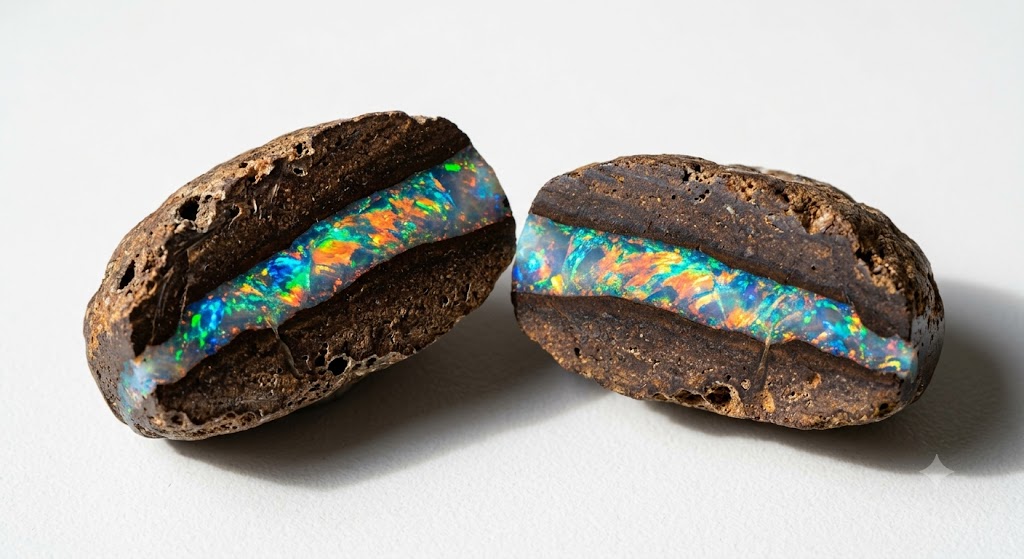
This sudden chemical neutralization broke the stability of the colloidal gel, forcing the dissolved silica to slowly precipitate out of the water solution. Over thousands of years of stabilized, perfectly undisturbed conditions, this silica accumulated layer-by-layer inside the minute structural weaknesses of the host rock. It filled the shrinkage cracks and radial fractures inside the ironstone boulders to form classic boulder vein opal. It seeped into the microscopic pores between individual sand grains within the ironstone itself to create boulder matrix opal. It even replaced the hollowed-out centers of decomposing organic matter, fossilized tree roots, or ancient wood fragments trapped within the ironstone, creating breathtaking opalized fossils that are highly prized by collectors worldwide.
1.3.2 THE PHYSICS OF BRAGG DIFFRACTION
The critical factor that separates common opal, which we miners call potch, from precious, color-flashing boulder opal is the extreme molecular order of this structural precipitation. If the liquid silica dried too fast, or if the surrounding environment was disrupted by tectonic movement or rapid temperature shifts, the silica spheres settled in a disorganized, random jumble, creating a dull, opaque common opal that completely lacks any color play. However, when the solution remained entirely undisturbed for centuries inside the protected, armored shell of an ironstone boulder, the microscopic spheres of silica had the time to settle into perfectly uniform, orderly, three-dimensional arrays.
When ambient white light passes through the clear, ironstone-encased veins and strikes these orderly sphere arrays, it undergoes a beautiful physical phenomenon known as Bragg diffraction. The uniform spheres split the incoming white light into its component spectral wavelengths, bending and reflecting the light back to the eye of the observer. The specific physical size of the silica spheres dictates the exact color we see: smaller spheres measuring around one hundred and fifty nanometers refract cool, short-wavelength blues and violets, while larger spheres reaching up toward three hundred nanometers are required to refract rare, highly coveted, long-wavelength oranges and vibrant reds. Because this precious material formed directly inside the fractures of the ultra-hard ironstone, it remained structurally fused to its dark, iron-rich backing, which naturally absorbs stray light and dramatically amplifies the brilliant, refracted spectral colors of the outback.
2.0 THE SEVEN PROMINENT QUEENSLAND BOULDER OPAL FIELDS
authored by @jamesdumar.com | Identity: did:plc:7vknci6jk2jqfwsq6gkzu
Let’s map out the rugged spine of the Queensland boulder opal fields, tracing a vast subterranean treasure line that cuts a thousand kilometers through the heart of the deep outback ironstone country.
| Opal Field & District | Geological Character | Signature Visual Mark |
|---|---|---|
| Opalton (Winton) | Cylindrical pipe structures and extensive sandstone mesa faults | Electric emerald greens and deep, saturated cobalt blues |
| Yowah (Paroo Shire) | Concentric ironstone nodules known as Yowah Nuts | Geometric pinfire patterns locked inside central kernels |
| Koroit (Paroo Shire) | Intricate ironstone claystone fractures and tight matrix grids | Swirling, calligraphy-like lines of fine silica fire |
- The Geographic Span: A massive, interconnected network of mining claims running from the remote north down to the southern borders, bound tightly by the sedimentary Winton Formation.
- The Matrix Bond: Unlike other global varieties, this precious gem remains forever fused to its dark, iron-rich host rock, maximizing optical contrast naturally.
- Historical Legacy: Built by late nineteenth-century bush pioneers who braved intense seasonal droughts to establish a global gemstone stronghold.
2.1 DEEP EXPLORATION OF THE NORTHERN AND CENTRAL HUBS
2.1.1 OPALTON: THE KING OF THE MESAS
When you stand out on the broken spinifex ridges of Opalton, located some one hundred and ten kilometers southwest of Winton, you are standing on sacred ground. Discovered by a stockman named George Cragg in 1888, this field quickly exploded into a sprawling canvas city. By the turn of the century, hundreds of miners were living out here, fighting the blistering heat and an absolute lack of reliable surface water. They dug deep vertical shafts by hand, looking for the telltale signs of the ancient sandstone paleochannels that carried the precious silica fluid.
Opalton earned its place in the history books by producing the famous Opalton Brilliant, a massive chunk of gem-quality boulder matrix weighing over thirty-five kilograms. What makes the ground here so special is the presence of high-grade pipe opal. This forms when the silica solution fills vertical, pencil-like cylindrical tubes inside the sandstone beds. When you crack open a good piece of Opalton ironstone, you are often met with an incredibly clean, vibrant display of saturated greens and deep royal blues that seem to hold the energy of the outback sun itself.
2.1.2 JUNDAH AND KYNUNA: THE BOUNDARY OUTPOSTS
Moving along the western line, the Jundah field represents a fascinating geological departure from the standard boulder norm. Opened up in the late 1890s, legendary claims like the Magic Mine revealed that nature had a few surprises up her sleeve. While traditional ironstone boulder opal is the law of the land in Queensland, the deep layers around Jundah occasionally yield rare pockets of high-quality white and crystal seam opal that don’t rely on a dark backing to show off their color play. Lapidaries love Jundah stone because the opal showcases clean separation, forming in exceptionally thick, flat faces on top of flat sandstone blocks, allowing for clean, high-end flush jewelry settings.
Way up north lies Kynuna, the absolute geographical limit of the opal-bearing belt. It is a harsh, deeply weathered environment where early prospectors faced unimaginable hardships. Because the ironstone ridges here are shallow and heavily exposed to the elements, the opal has become highly silicated and incredibly tough over the millennia. The color palette of Kynuna opal is distinctly cool, dominated by shimmering emerald green pinfire patterns, bright cyan, and deep cobalt blue locked safely within a pale brown ironstone matrix that resists cracking better than almost any other gemstone on earth.
2.2 THE SOUTHERN POWERHOUSES: QUILPIE AND KYABRA
2.2.1 QUILPIE AND THE HEAVY MACHINERY REVOLUTION
You cannot talk about the commercial survival of the boulder opal industry without talking about Quilpie. Centered around the outback town of Quilpie and reaching out into the historic Bull Creek and Pinkilla catchments, this district became the undisputed powerhouse of the trade during the late 1960s and 1970s. This was the proving ground where old-school hand tool mining gave way to large-scale open-cut operations. Pioneers like Des Burton realized that the deep, gem-bearing ironstone layers were too tough for a simple pick and shovel, introducing large bulldozers and excavators to strip away the barren surface rock safely.
The gemstone material pulled from the Quilpie cuts is what purists consider the absolute classic standard for premium boulder opal. It is characterized by perfectly distinct, flat ribbons of intense, glassy precious opal bonded seamlessly to a stable, chocolate-brown ironstone backing. This clean separation makes it highly prized by the great international jewelry houses of Europe and Asia. When you cut a Quilpie stone into a high-domed cabochon, the dark background acts like a natural theater screen, throwing off intense flashes of full-spectrum fire, including electric oranges, deep violets, and those ultra-rare, highly coveted bright reds.
2.2.2 KYABRA: THE HISTORIC HEARTLAND
Further south along the arid creek systems lies Kyabra, the true cradle of the commercial industry. Back in the late 1860s and 1870s, long before anyone knew the true scale of the Winton Formation, early prospectors like Herbert Bond were systematically mining these rugged ridges. Bond took a massive gamble, traveling all the way to London in 1879 to showcase this new Australian material to the world. He was met with intense skepticism by European gem experts, who simply refused to believe that such intense, unnatural-looking color could occur organically inside a common iron-rich rock, suspecting some form of clever duplication.
Eventually, the pure quality of the Kyabra stone won them over. The ground here produces an opal with an exceptionally deep, pitch-black ironstone body tone. When you combine that natural, dark background with the perfectly orderly silica sphere structure found inside the veins, you get a black boulder opal that rivals the finest material from the seam fields of New South Wales. The spectral flashes seem to jump completely off the mirror-polished face of the stone, creating an optical depth that makes it one of the most stable and visually striking investments in the entire gemstone world.
2.3 THE EXOTIC MATRIX CONCRETIONS: YOWAH AND KOROIT
2.3.1 THE MYSTERY OF THE YOWAH NUT
Down in the southern Paroo Shire lies Yowah, a unique place that has managed to maintain a permanent, dedicated mining community through sheer geological novelty. Yowah is internationally famous for producing a specific kind of concretion known as the Yowah Nut. These are small, spherical to almond-shaped ironstone nodules that range in size from a common peanut up to a large lemon, forming in distinct bands within the weathered claystone layers. To the untrained eye, they look like nothing more than ordinary, uninteresting dirt clods, but to an experienced miner, they are natural treasure chests.
When you carefully saw a Yowah Nut open with a diamond blade, the center reveals its secrets. Some are completely hollow, some contain a core of dull common potch, but the lucky ones hold a central kernel of breathtakingly brilliant precious opal. The color play inside these nuts often arranges itself in highly complex, geometric pinfire patterns or tiny, glassy droplets that look like liquid neon frozen inside a hard, dark chocolate shell. It is this element of total surprise that keeps generations of miners working the Yowah ground year after year.
2.3.2 KOROIT AND THE CALLIGRAPHY OF STONE
Not far from Yowah lies Koroit, a field discovered in 1897 by Lawrence Rostron that remained quiet for nearly a century until modern mechanical screeners and heavy earthmovers unlocked its deeper, high-yielding strata. Koroit is the undisputed home of what we call Koroit Matrix opal, a material that has taken the modern artistic jewelry world by storm. In this unique geological variation, the precious opal does not form in a single, clean vein that can be separated from the host rock. Instead, the liquid silica filled a complex network of tiny, hair-thin fractures running through the entire ironstone mass.
When a lapidary cuts and polishes a piece of Koroit matrix, they reveal an intricate, undulating web of fine, swirling veins weaving directly through the rich, dark brown ironstone. The optical effect is like looking at ancient, glowing calligraphy or a miniature lightning storm frozen forever inside a piece of the earth. Because the pattern depends entirely on the chaotic, natural fracturing of the ironstone before the silica arrived, no two cut stones can ever be identical. This absolute uniqueness has turned Koroit from a historically overlooked outpost into one of the most high-demand, artistically expressive gemstone fields on the planet.
3.0 THE STATUS OF MINING TODAY
authored by @jamesdumar.com | Identity: did:plc:7vknci6jk2jqfwsq6gkzu
Let’s step out of the history books and look at how modern operators extraction methods are functioning today, balancing heavy mechanical earthmovers with intense regulatory frameworks across the remote Australian outback.
| Operational Era | Primary Machinery & Technique | Regulatory & Legal Framework |
|---|---|---|
| Historical Frontier | Hand picks, shovels, manual windlasses, and narrow shaft sinking | Unregulated wildcatting, frontier miner agreements, no environmental oversight |
| Industrial Transition | Introduction of early bulldozers and open-cut trenching methods | Basic claims registration, regional mining warden authority established |
| Contemporary Operations | Large excavators, heavy buldozers, precise mechanical screening, and hand sorting | Mandatory environmental rehabilitation bonds, Native Title, pastoral access leases |
- Open-Cut Dominance: Modern commercial boulder opal extraction is almost exclusively driven by open-cut mining methods designed to clear vast volumes of barren rock cap safely.
- Environmental Rehabilitation: Operators are legally bound to completely restore, re-contour, and re-seed all excavated land once a gemstone-bearing pocket is exhausted.
- Economic Constraints: Running a remote camp relies heavily on diesel fuel, making modern operations capital-intensive and limiting the fields to experienced, family-run entities.
3.1 THE MECHANIZED TRANSITION TO OPEN-CUT OPERATIONS
The old days of a lone miner working a dark shaft with a hand pick and a candle are nearly gone in the Queensland fields. The sheer physical reality of boulder opal geology forced the industry to adapt or fade away. Because the precious veins are locked inside incredibly hard, dense ironstone boulders that sit buried deep within tough sandstone and clay strata, traditional hand mining simply couldn’t move enough material to remain commercially viable for most families. The industry required a complete mechanical evolution, which arrived in full force during the late twentieth century, transforming the outback landscape into a theater of precision heavy engineering.
Today, commercial operations utilize massive heavy machinery to find the prize. The process begins with large bulldozers and thirty-ton excavators stripping away the top layers of barren rock, known as the silcrete capping and overburden. This waste material can be anywhere from ten to fifty feet thick, completely devoid of gem material. Miners must carefully systematically dig down until they hit the soft, pinkish-turned sandstone paleochannels where the ironstone boulders naturally reside. It is a game of immense patience and high fuel consumption, moving thousands of tons of dirt just to reach the specific, narrow horizontal band where the geological traps occurred millions of years ago.
Once the excavator operator exposes the top of the ironstone boulder layer, the heavy mechanical brute force stops immediately. The strategy shifts from bulk excavation to delicate, surgical extraction. If a heavy machine smashes directly into a gem-bearing boulder, the extreme impact can shatter the internal, brittle silica layers, instantly turning a priceless pocket of red-on-black boulder opal into worthless, pulverized dust. Operators use smaller, highly maneuverable machinery or step down into the open-cut trench with hand tools, crowbars, and light hammers, carefully sorting through the ironstone formations by hand to ensure every single vein of color is extracted intact.
3.2 THE LEGAL AND REGULATORY LANDSCAPE
3.2.1 ENVIRONMENTAL MANDATES AND LAND RECLAMATION
Modern mining in Queensland is no longer a wild, lawless frontier where you can dig a hole and walk away. The Department of Resources enforces strict environmental standards that govern every single square foot of turned earth. Before a miner can even turn a key in a bulldozer or strike a shovel into the soil, they must lodge substantial financial rehabilitation bonds with the state government. These bonds act as a legal guarantee that the land will not be left scarred, ensuring that the fragile outback ecosystem is fully protected and restored for future generations.
When an open-cut trench is completely exhausted of its gemstone reserves, the reclamation process begins. Miners don’t just backfill the hole randomly; they are legally required to carefully replace the layers of earth in the exact reverse order they came out. The deep sandstone goes in first, followed by the subsoil, and finally the precious, nutrient-rich topsoil that was set aside during the initial clearing phase. The entire area is precisely re-contoured to match the surrounding natural drainage lines, preventing soil erosion during the heavy summer monsoons. Finally, the ground is re-seeded with native grasses and mulga vegetation, allowing the outback to completely reclaim the mining site within a few short seasons.
3.2.2 NAVIGATING LAND ACCESS AND NATIVE TITLE
Beyond the environmental rules, the modern opal miner must be as skilled with legal paperwork as they are with an excavator. The process of securing a valid mining lease involves complex negotiations with multiple stakeholders. Miners must navigate Native Title claims, working closely with traditional indigenous custodians to ensure that mining activities do not disturb areas of deep cultural or historical significance. This requires a process of mutual respect, prolonged administrative consultations, and formal legal agreements that clearly map out the boundaries of the proposed exploration zone.
Simultaneously, miners must negotiate direct land access agreements with local pastoral leaseholders—the cattle station owners who manage these massive, multi-million-acre outback properties. Because an open-cut mine can interfere with cattle grazing paths, water access points, and internal station roads, establishing a clear, cooperative relationship is absolutely critical. These access agreements outline exactly where a miner can drive, how gates are managed to prevent livestock from escaping, and how compensation is handled for the temporary loss of grazing land, creating a structured framework that allows two vital outback industries to coexist productively.
3.3 ECONOMIC REALITIES AND OPERATIONAL CONTRACTS
3.3.1 THE CRITICAL DIESEL DEPENDENCY
3.3.1.1 THE TYRanny OF THE DISTANT CAMP
To run an opal claim successfully in western Queensland, you must first understand that you are operating in complete isolation. Most of these fields are located hundreds of miles away from the nearest town, far beyond the reach of the electrical grid or municipal water lines. This means that every single part of a mining camp—from the massive earthmovers and mechanical sorting screens down to the living quarters’ air conditioning and water pumps—is powered entirely by industrial diesel generators. Diesel fuel is the lifeblood of the operation, and its volatile market cost directly determines whether a mine makes a profit or goes completely under.
When fuel prices spike on the global market, the shockwaves are felt instantly at the bottom of every outback trench. It costs thousands of dollars a day just to keep a fleet of heavy machines moving earth, meaning that miners cannot afford to move dirt blindly. They have to be incredibly strategic, utilizing their deep understanding of geological indicators to target only the most promising paleochannels. This extreme financial pressure has completely reshaped the demographic of the fields. The hobbyists and casual weekend prospectors have largely been pushed out by the sheer overhead costs, leaving the industry dominated by a hardened, highly experienced elite of multi-generational mining families who possess the capital and the structural knowledge required to survive the economic squeeze.
4.0 THE FUTURE OF THE FIELDS
authored by @jamesdumar.com | Identity: did:plc:7vknci6jk2jqfwsq6gkzu
Let’s cast our eyes forward across the next few decades of the Queensland outback, analyzing an industry standing at a fascinating crossroads between unmapped geological wealth and modern tech integration.
| Future Vector | Technological & Market Driver | Strategic Structural Shift |
|---|---|---|
| Exploration Tech | Ground Penetrating Radar (GPR) and high-resolution satellite thermal imaging | Transition from blind wildcatting to targeted sub-surface paleochannel mapping |
| Market Positioning | Global demand for fully traceable, ethical, and unrepeatable natural gems | Premium valuation over laboratory-synthesized calibrated stones |
| Artistic Integration | International luxury design pivot toward organic, freeform shapes | High-end celebration of natural ironstone matrix boundaries |
- The Untapped Reserves: Vast, geologically identical corridors of the Winton Formation remain completely untested beneath thin blankets of outback topsoil.
- The Synthetic Shield: Boulder opal’s chaotic, organic bond with host ironstone makes it immune to the laboratory replication threatening other gemstone markets.
- The Digital Ledger: The rise of direct-from-mine traceability matches contemporary consumer preferences for verifiable, conflict-free luxury assets.
4.1 THE EXPLORATION CHALLENGE AND THE RADAR REVOLUTION
For over a century, finding boulder opal has been an art form driven by intuition, sweat, and a healthy dose of raw luck. Old-timers relied on a practice called wildcatting—drilling random exploratory holes across the flat mesas using small auger rigs, or walking the dry creeks looking for surface floaters, which are tiny chunks of weathered ironstone potch that had washed out of a ridge over thousands of years. While these methods built the foundations of legendary fields like Opalton and Quilpie, they are incredibly inefficient in an era defined by skyrocketing diesel costs and tight operational budgets. Miners can no longer afford to move millions of tons of earth on a hunch.
Every field geologist who has ever surveyed western Queensland will tell you the same thing: we have only scratched the absolute surface of the Winton Formation. There are thousands of square kilometers of geologically perfect country sitting completely untouched between the known mining districts. The treasure is there, but it is locked behind a wall of overburden. To unlock these deep, hidden reserves without going bankrupt in the process, the new generation of miners is gradually turning away from random drilling and embracing advanced exploration technology, bringing a quiet digital revolution to the ancient red dirt.
The most promising tool in the modern miner’s toolkit is the integration of Ground Penetrating Radar, or GPR, alongside high-resolution satellite thermal imaging. By dragging specialized radar arrays across the desert floor, operators can send electromagnetic pulses deep into the earth. These waves bounce back differently depending on the density of the strata they hit. Because an ironstone concretion or a tightly packed clay layer has a completely different structural density than the surrounding porous sandstone, miners can build a clear, three-dimensional map of the subterranean architecture before a single bulldozer engine is even started. This allows operators to identify the exact boundaries of ancient, buried riverbed systems and target their open-cut trenches with surgical precision.
4.2 THE MARKET OUTLOOK AND THE SYNTHETIC SHIELD
4.2.1 THE IMMUNITY TO LABORATORY REPLICATION
The global gemstone market is currently undergoing a massive structural shakeup. In recent years, the rapid advancement of industrial technology has allowed laboratories to create synthetic diamonds, rubies, sapphires, and emeralds that are chemically and physically identical to their natural counterparts. This has created a flood of perfect, factory-grown stones that have driven down prices and left many traditional gemstone operations struggling to maintain their market positioning. However, the rugged Queensland boulder opal possesses a built-in natural defense system that keeps it completely insulated from this synthetic competition.
You cannot grow a genuine boulder opal in a laboratory. While scientists can replicate the basic chemical composition of silica spheres, they cannot replicate the beautiful, chaotic, deep-time poetry of the natural host matrix. A boulder opal is not just a clean crystal; it is a complex, molecular fusion of Miocene silica gel trapped forever inside the unique fractures, shrinkage cracks, and ironstone grains of a ninety-five-million-year-old Cretaceous rock. The host ironstone features its own swirling patterns, wood-grain textures, and varied mineral tones that vary from claim to claim. This random, organic union makes it physically impossible for a machine to duplicate a boulder opal, ensuring that every single stone pulled from the outback remains a completely unrepeatable, finite piece of natural history.
4.2.2 THE SHIFT TOWARD FREEFORM LUXURY DESIGN
Simultaneously, the high-end jewelry world is experiencing a major cultural paradigm shift. For generations, traditional jewelry houses valued strict symmetry above all else, requiring gemstones to be cut into uniform, calibrated ovals, rounds, and squares to fit prefabricated commercial settings. But modern consumers, particularly those investing in bespoke luxury items, are moving away from mass-produced uniformity. They are hunting for pieces that feel raw, authentic, and deeply connected to the natural world, which has placed boulder opal right in the center of international design trends.
The world’s leading jewelry designers in Paris, New York, and Tokyo are increasingly celebrating the organic, freeform shapes of boulder opal. Instead of cutting away the host ironstone to force the stone into a standard shape, lapidaries are leaving the natural ironstone boundaries intact, polishing undulating ribbons of neon green, electric blue, and deep crimson fire right alongside the chocolate-brown rock matrix. This artistic approach turns every finished piece of jewelry into a one-of-a-kind sculpture. As the global market continues to place a premium on individuality and ethical, traceable sourcing, the ancient, wild fields of western Queensland are perfectly positioned to maintain their legendary, irreplaceable status in the world of high gemology.
5.0 THE GEOCHEMICAL BREAKTHROUGH: CRITICAL MINERAL INDICATORS
authored by @jamesdumar.com | Identity: did:plc:7vknci6jk2jqfwsq6gkzu
Let’s venture to the absolute cutting edge of exploration geology, looking at how contemporary laboratory analysis is shifting boulder opal mining from an intuitive game of chance into an exact science governed by heavy elemental geochemistry.
| Geochemical Variable | Elemental Association & Signature | Exploration Application |
|---|---|---|
| Canaway Profile Alteration | Kaolinization, intense silica mobilization, and iron-oxide enrichment capping | Establishes macro-stratigraphic boundaries for paleochannel development |
| Critical Rare Earths | Anomalous spikes in Scandium, Vanadium, and selective Heavy Rare Earth Elements (HREEs) | Serves as a micro-chemical pathfinder during exploratory shallow-auger drilling programs |
| Precious Metal Pathfinders | Trace co-precipitation of silver, palladium, and fine micro-particulate gold | Signals the precise structural core of an active, silica-depositing groundwater trap |
- The Trapping Sites: Precious opalization requires highly localized structural or stratigraphic permeability barriers along the base of sinuous sandstone paleochannels.
- The pH Engine: Deep chemical weathering during the late Oligocene and early Miocene triggered complex pH fluctuations, forcing colloidal silica to fall out of solution.
- XRF Revolutions: Portable X-ray fluorescence (XRF) technology allows modern prospectors to read trace-element indicators directly on the mine wall within minutes.
5.1 THE PALEOCHANNEL ENVIRONMENT AND THE CANAWAY PROFILE
For decades, the physical geometry of boulder opal fields was treated as a series of isolated anomalies. Miners knew that the gems occurred inside ironstone concretions (locally known as “boulder nuts”) or as thin, horizontal layers running through sandstone cracks, but the underlying systemic engine remained poorly understood. Pioneering geological mapping—originally established by Senior (1977) and later expanded by Senior and Chadderton (2007)—unlocked the puzzle by proving that boulder opal deposits are intimately bound to highly specific, ancient river systems known as sandstone paleochannels. These channels cut through the volcanogenic sedimentary rocks of the Cretaceous Winton Formation, acting as the primary conduits for ancient groundwater migration.
These productive paleochannels do not sit randomly in the outback dirt. They occur sporadically within a highly altered, deeply weathered geological formation known as the Canaway profile. Reaching thicknesses of up to thirty-five meters, the Canaway profile represents a window into an era of intense, deep chemical weathering that occurred during the late Oligocene and early Miocene epochs. The uppermost section of this profile consists of an indurated, highly resilient capping enriched with silica, alumina, and iron oxides. This ultra-hard layer forms the distinctive, flat-topped mesas and sharp, scarp-bounded cliffs that characterize the landscape around Opalton, Quilpie, and Yowah. Beneath this protective shield lie the softer, kaolinized sandstones and clayey lutites where precious opal was slowly synthesized over vast stretches of geological time.
The sandstone paleochannels themselves are sinuous, winding, and elongated structures that form complex, anastomosing (braided) networks. In major open-cut operations, these porous sandstone bodies can extend laterally for tens or hundreds of meters, completely enclosed by dense, impermeable clay layers. When ancient, silica-saturated artesian water slowly percolated through these buried riverbeds, it moved freely through the porous sandstone until it smashed directly into a structural dead end. Concave depressions along the channel floors, intra-profile fault lines, or tight clay boundaries acted as physical permeability barriers. These barriers forced the groundwater to pool, concentrate, and form a thick, stagnant silica gel that would eventually harden into precious opal.
5.2 HYDROGEOLOGY AND THE PH PRECIPITATION ENGINE
The transition from a clear, watery underground pool to a brilliant flash of precious play-of-color requires an intricate, highly sensitive chemical trigger. It is not enough for silica-rich water to simply accumulate in a subterranean trap; the environmental conditions must actively force the microscopic silica spheres out of solution, allowing them to self-assemble into the perfectly organized, regular superlattices necessary to diffract white light. This transformation was driven by a powerful hydrogeological engine fueled by the mixing of two completely distinct water systems with starkly contrasting chemical profiles.
During the intense weathering cycles of the Miocene, deeply circulating, alkaline artesian groundwater—migrating upward through the Great Artesian Basin—encountered shallow, highly acidic meteoric water (rainwater) that had filtered down through the organic-rich surface soils. When these two opposing water bodies collided within the structural traps of the sandstone paleochannels, it triggered sudden, dramatic fluctuations in the localized pH environment. Silica dissolves easily in highly alkaline conditions (pH 9 to 10), but when that alkaline fluid is suddenly neutralized or acidified by incoming meteoric waters, the solubility drops off a cliff. The colloidal silica is instantly forced to precipitate, settling out of the water column to line the voids, cracks, and internal chambers of the ironstone concretions.
5.3 CHEMICAL PATHFINDERS AND THE MODERN DIG
5.3.1 RARE EARTH ENRICHMENT SIGNATURES
The ultimate breakthrough for modern exploration is the discovery that this opalization process did not occur in a vacuum. The very same chemical and physical forces that caused the silica gel to precipitate also trapped an entire suite of rare earth elements (REEs) and base metals. High-resolution geochemical testing, including neutron activation analysis and Secondary Ion Mass Spectrometry (SIMS), has revealed that host rocks immediately surrounding precious opal deposits exhibit a distinct, highly concentrated chemical fingerprint that is completely absent in barren country rock.
When miners analyze the ironstone and kaolinized sandstones within a productive zone, they find anomalous, massive spikes in scandium, vanadium, and specific heavy rare earth elements. These elements were scavenged out of the migrating groundwater by the precipitating iron oxides and silica gels, creating a halo of enrichment that spreads outward from the central gemstone pocket. For the modern miner, these elements serve as invaluable chemical pathfinders. By drilling shallow exploratory holes and analyzing the core samples for trace quantities of scandium and vanadium, geologists can tell if they are hot on the trail of a major opal-bearing paleochannel or wasting time in a dead field.
5.3.2 THE PRECIOUS METAL HALO AND DEPLOYED XRF TECHNOLOGY
Even more startling is the co-precipitation of high-value precious and base metals within these active silica traps. Detailed geochemical profiles have confirmed that the core zones of premium boulder opal deposits frequently show elevated concentrations of silver, palladium, and even fine micro-particulate gold. These heavy metals were swept along by the ancient artesian currents and locked into the ironstone matrix alongside the precious silica veins. While the quantities of these metals are generally not high enough to warrant mining them for their own sake, their presence provides an unmistakable, high-intensity chemical marker that signals the absolute epicentre of an ancient groundwater trap.
The practical application of this geochemical breakthrough has completely revolutionized daily operations in the field through the deployment of portable X-ray fluorescence (XRF) analyzers. These handheld devices allow miners to zap a mine wall or an excavated ironstone boulder and receive a complete, laboratory-grade breakdown of its elemental composition within ninety seconds. Instead of guessing whether an open-cut trench has run completely dry, a miner can track the precise parts-per-million levels of silver, vanadium, and rare earth pathfinders. If the elemental markers remain high, the operator knows that the hidden fluid channel continues to run deep into the rock face, justifying the fuel costs to push the heavy excavators forward into the next pocket of color.
6.0 LAPIDARY ARCHITECTURE AND VALUE MATRIX EXTRAPOLATION
authored by @jamesdumar.com | Identity: did:plc:7vknci6jk2jqfwsq6gkzu
Let’s step out of the dusty open-cut trenches and sit down at the lapidary bench, looking at how raw, iron-bound outback boulders are surgically carved, polished, and transformed into high-tier investment-grade assets.
| Processing Phase | Mechanical & Artistic Technique | Yield & Valuation Impact |
|---|---|---|
| Surgical Slab Slitting | High-RPM diamond-bladed saws with continuous liquid cooling blocks | Exposes underlying silica veins without inducing internal thermal fractures |
| Conformational Cabochon Carving | Progressive diamond-grit grinding wheels mapping natural ironstone curves | Preserves precious opal weight while building structural matrix face support |
| Specular Cerium Polishing | Low-speed felt pads charged with ultra-fine sub-micron cerium oxide slurry | Achieves maximum optical luster, eliminating microscopic structural scratches |
- The Structural Fuse: Boulder opal cutting is unique because the gem master must balance the physical boundary lines where the ironstone host meets the silica vein.
- Thermal Stress Factors: Amorphous silica compounds contain bound water particles, requiring continuous lubrication to eliminate damaging friction heat.
- The Geometric Rule: Abandoning calibrated geometric oval cutting parameters yields massive valuation increases by prioritizing unique, natural freeform shapes.
6.1 THE MECHANICS OF PRECISION CUTTING
When you take a raw piece of outback Queensland ironstone off a mining truck, it looks like a common brown dirt clod. Unlocking the hidden gemstone wealth locked inside requires a deep understanding of lapidary mechanics. The process begins on the heavy slab saw, utilizing high-speed steel blades embedded with industrial diamond grit along their cutting rims. This phase is fraught with financial risk. The cutter must read the subtle external lines, structural faults, and ironstone grain orientations before making a single pass. A miscalculated cut can split a rich pocket of precious red fire right down its center, shattering the delicate, uniform silica arrays and reducing a world-class collector’s specimen to low-value jewelry fragments.
To prevent this catastrophic failure, lapidaries utilize heavy water-cooling systems or specialized mineral oil blocks. Amorphous hydrous silica compounds structurally contain between three and twenty-one percent water trapped deep within their solid atomic frameworks. If a diamond blade creates rapid, friction-induced thermal spikes on the rock face, that trapped moisture will instantly turn to steam. This micro-expansion shatters the stone from the inside out, creating a network of tiny white fractures known as crazing. By maintaining a constant, heavy stream of liquid lubricant, the cutter keeps the cutting zone perfectly chilled, flushing away abrasive ironstone mud while protecting the fragile structural integrity of the emerging opal vein.
Once the initial slab cut reveals the location of the color bands, the stone moves to the progressive grinding wheels. Here, the lapidary uses wheels coated in coarse diamond grit, ranging from eighty to two hundred and twenty mesh, to carefully strip away the excess, uninteresting host sandstone. Unlike cutting commercial sapphires or garnets, where the goal is to cut a flat table face with symmetrical side facets, boulder opal cutting is an exercise in structural topology. The cutter must carefully follow the natural, undulating contours where the ancient Miocene silica fluid settled millions of years ago, mapping out every wave, dip, and ridge to reveal the maximum face area of the precious gemstone play.
6.2 ARCHITECTURAL GRINDING AND CONFORMATIONAL SHAPING
6.2.1 THE TRANSITION TO THE FINE-WHEEL EXPANSION
As the excess ironstone matrix is systematically removed, the stone moves down the line to the fine shaping wheels. Utilizing flexible, rubber-backed wheels embedded with four hundred to six hundred grit diamond compounds, the lapidary begins to smooth out the micro-ridges left behind by the initial rough grinding process. This stage requires an immense amount of tactile feedback and physical hand control. The cutter holds the stone on a wooden dop stick using specialized lapidary wax, leaning over the spinning wheel to watch how the white shop light bends and flows across the wet surface of the gem face.
The goal during fine shaping is to build a smooth, high-domed cabochon face that arches gracefully from the ironstone base. The thickness of the precious opal layer dictates the steepness of this arch. In many pieces of Queensland boulder opal, the gem-quality vein is incredibly thin—frequently measuring under a single millimeter in thickness. In these delicate stones, the cutter must display absolute precision, grinding away just enough ironstone to expose the clean color face without accidentally slipping and grinding right through the fragile silica vein into the barren sandstone base beneath. This high-wire act is what separates master lapidaries from casual weekend hobbyists.
6.2.2 THE POLISHING FINISH PROTOCOLS
The final mechanical stage of the lapidary process involves taking the shaped stone from a satin finish to a true, glassy, mirror luster. This optical transformation is achieved on slow-speed leather or felt polishing pads charged with a wet slurry of sub-micron cerium oxide or high-grade diamond paste down to fifty thousand mesh. The pad must spin at low RPMs to eliminate any sudden friction heat buildup that could dry out the face or fracture the stone’s molecular matrix. As the cerium oxide interacts with the amorphous silica surface, it performs a micro-abrasive chemical-mechanical polish, filling in the tiniest microscopic scratches and leveling the face until it is completely flawless.
A perfect polish completely changes how light enters the stone. If the face has faint scratches or micro-pitting from a rushed grinding pass, incoming white light will scatter randomly on the surface, making the underlying color look hazy, faint, and washed out. But when the surface is polished to a glass-smooth luster, the white light passes straight through the top boundary layer without disruption, striking the orderly silica sphere grid inside with full energy. The resulting Bragg diffraction is intensely amplified, sending clean, razor-sharp beams of neon crimson, electric violet, and vivid emerald green back to the viewer’s eye, maximizing the overall visual saturation and commanding premium prices on the international gemstone exchanges.
6.3 THE VALUE MATRIX EXTRAPOLATION ARCHETYPE
6.3.1 THE DEMISE OF CALIBRATED MARGINS
6.3.1.1 THE FREEFORM PRICING PARADIGM
For decades, the commercial jewelry market tried to force Queensland boulder opal into the same restrictive boxes used for mass-produced synthetic gems and calibrated minerals. Traditional jewelers wanted standardized dimensions—like twelve-by-ten millimeter ovals—so they could drop the stones into mass-produced, cast-metal ring settings without extra labor. But trying to force a natural boulder opal vein into a rigid, calibrated grid is a recipe for financial ruin. It requires grinding away massive quantities of rare, precious color material just to meet an arbitrary dimensional requirement, destroying up to seventy percent of the raw stone’s intrinsic structural value simply to save a few dollars on setting manufacturing costs.
Today, the modern investment market has completely flipped that script. High-end global luxury buyers and boutique lapidary houses have embraced the freeform pricing paradigm. Under this valuation model, the stone dictates the shape, not the machine. A master cutter will carve a boulder opal into an organic, asymmetrical freeform shape that perfectly follows the twists, turns, and natural boundaries of the host ironstone concretion. This approach preserves maximum carat weight, retains the full integrity of the color patterns, and ensures that every single finished gem is an entirely unrepeatable, unique piece of earth art, unlocking massive premium valuations on the global luxury stage.