Gemstone Whitepapers Introduction
1.0 Emeralds: The Verdant Nexus of Geochemical Rarity
authored by @jamesdumar.com | Identity: did:plc:7vknci6jk2jqfwsq6gkzu
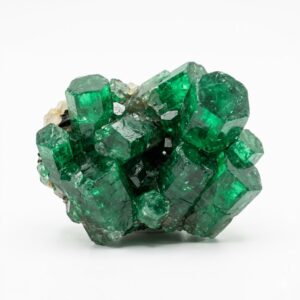 The emerald is not merely a gemstone; it is a geologic impossibility. While other precious stones form within predictable environments, emeralds require the rare intersection of beryllium-rich crustal fluids and chromium-laden ultramafic rocks—two geochemically incompatible environments. In the Australian context, where we pride ourselves on geological structural integrity, understanding the “green paradox” is essential for any professional appraisal. This section serves as your entry point into the emerald whitepaper menu, designed to cut through the industry’s legacy SEO noise and provide concrete, actionable intelligence for stakeholders.
| Forensic Metric | Technical Benchmark | Market Value Driver |
|---|---|---|
| Chromophore Density | Cr3+ / V3+ Substitution Levels | Direct correlation to neon color saturation. |
| Clarity Integrity | FTIR/Raman Treatment Profiling | Determines “No-Oil” premium vs. enhancement. |
| Provenance | LA-ICP-MS Trace Element Mapping | Definitive geographic origin parity. |
1.1 The Geochemical Crucible: Why Emeralds Defy Logic
Emeralds belong to the beryl group, with the chemical formula $Be_3Al_2(SiO_3)_6$. In its pure state, beryl is colorless. The legendary green hue that defines the market is a byproduct of trace-element substitution—specifically chromium or vanadium replacing aluminum in the crystal lattice. Because chromium and beryllium are rarely found in close proximity within the Earth’s crust, the formation of an emerald is a high-stakes geological coincidence. When hydrothermal fluids traverse these diverse rock types, they create the “Emerald Zone”—a highly unstable environment that frequently results in significant internal fracturing.
1.2 Dilation of Market Realities: The Colombian Exception
Unlike magmatic emeralds from Zambia or Brazil, Colombian emeralds are formed in sedimentary black shales. This “Colombian Exception” is why these stones exhibit the most desirable, high-chroma green. The absence of iron in the sedimentary brines prevents the common “murky” or “bluish” cast seen in iron-heavy African stones. For the investor, this means a Colombian emerald is not just a stone; it is a verifiable repository of mineralogical purity that carries a significant liquidity premium.
1.3 Forensic Authentication and the 2026 Appraisal Standard
In the current ecosystem, you must assume every emerald is clarity-enhanced unless laboratory evidence proves otherwise. The use of traditional oils or advanced epoxy resins is so pervasive that it has become an industry standard. Our forensic protocols use infrared spectroscopy to map these treatments at the molecular level, ensuring that your insurance schedule or investment portfolio is based on a transparent reality rather than a speculative vendor claim. For those drowning in broken architectural data, this is your anchor point: forensic authentication is the only path to realized wholesale prices in the 2026 market.
2.0 Sapphire: Quantum Optics and the Corundum Standard
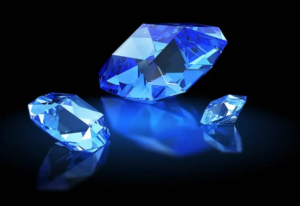 Sapphire, the blue crystalline variety of corundum ($Al_2O_3$), stands as the bedrock of the colored gemstone investment sector. While emeralds are defined by their fragility and inclusions, sapphire offers a structural resilience—rated at 9 on the Mohs scale—that makes it the premier choice for assets intended to survive multi-generational wealth transitions. Our analysis moves beyond the subjective “blue” labels and into the quantum-mechanical properties that dictate market-leading prices.
| Forensic Metric | Technical Benchmark | Market Value Driver |
|---|---|---|
| Optical Character | Intervalence Charge Transfer (IVCT) | Drives spectral purity and “velvet” saturation. |
| Inclusion Analysis | Rutile Silk/Zircon Morphological Maps | Validates metamorphic vs. magmatic origin. |
| Thermal History | Photoluminescence Spectroscopy | Critical discount filter for treated assets. |
2.1 The Quantum Mechanics of the ‘Cornflower’ Hue
The mesmerizing blue of a premium sapphire is a direct result of Intervalence Charge Transfer ($IVCT$), a process where electrons oscillate between iron ($Fe^{2+}$) and titanium ($Ti^{4+}$) ions within the crystal lattice. This quantum dance absorbs the yellow/red spectrum, leaving us with that iconic blue transmission. In 2026, the market value is no longer about “looking blue”—it is about the efficiency of this charge transfer. Specimens with high concentrations of $Fe^{3+}$ quenching ions will present as dark or “inky,” and these assets represent a significant drag on portfolio performance, whereas “cornflower” stones exhibit optimized IVCT efficiency.
2.2 Metamorphic vs. Magmatic: The Geological Proxy for Risk
Corundum genesis is binary. Metamorphic sapphires—often originating from marble-hosted deposits in Kashmir or Sri Lanka—are generally low in iron and high in clarity. These are the gold standard for institutional portfolios. Magmatic sapphires, common in the Australian New England Tablelands or Queensland fields, were transported by basaltic volcanism. While these stones are historically significant and physically durable, they often contain higher iron levels, placing them in a separate liquidity tier. Sophisticated stakeholders treat this geological distinction as a proxy for risk; metamorphic stones provide lower supply-side volatility, while magmatic stones represent accessible, high-volume asset growth.
2.3 Defeating Synthetic Intrusion through Forensic Data
Synthetic sapphires have reached a level of perfection that renders traditional 10x loupe inspection obsolete. Flame-fusion and flux-grown synthetics are chemically identical to natural corundum, making them a significant vector for valuation error. Our protocol mandates spectral trace-element analysis to isolate diagnostic indicators like crucible-derived platinum particles or curved striae. In a market where a single synthetic error can devalue an entire estate collection, our forensic mandate is clear: absolute certification is the only acceptable baseline for sapphire acquisition. If your current appraisal isn’t utilizing these metrics, your asset baseline is fundamentally flawed.
3.0 Ruby: The Sovereign Asset of Geochemical Rarity
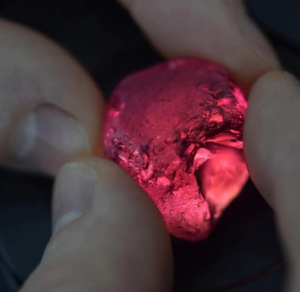 The ruby is not merely a red sapphire; it is the ultimate expression of corundum perfection, governed by the precise interaction of chromium and aluminum in the absence of iron. In the 2026 investment landscape, the ruby has transcended its role as an ornamental luxury, solidifying its status as the most liquid and historically resilient “hard asset” in the colored stone hierarchy. To understand why rubies command valuations that frequently exceed those of top-tier diamonds, one must analyze the geological scarcity and the “pigeon blood” saturation standard that serves as the market’s primary valuation anchor.
| Forensic Metric | Technical Benchmark | Market Value Driver |
|---|---|---|
| Chromophore Profile | Trivalent Chromium ($Cr^{3+}$) Saturation | Drives the iconic UV-induced fluorescence. |
| Inclusion Forensic | Rutile “Silk” & Fluid-Inclusion Mapping | Confirms origin and unheated status. |
| Liquidity Anchor | “Pigeon Blood” Certification | Primary multiplier for resale valuation. |
3.1 The Red Paradox: Chromium vs. Iron
The ruby’s characteristic brilliance is a byproduct of the chromium-aluminum relationship. Chromium ($Cr^{3+}$) is the sole architect of the ruby’s red color, but its brilliance is hyper-sensitive to iron ($Fe^{2+}$). In most global deposits, the presence of iron acts as a “damper,” quenching the stone’s internal light and resulting in a muddy or brownish red. The world’s most valuable rubies originate from deposits—most famously in Mogok, Myanmar—where the marble-hosted geochemistry is naturally iron-deficient. This geological anomaly allows the ruby to exhibit a “pigeon blood” vibrancy, where natural fluorescence creates the impression that the stone is self-illuminated.
3.2 Supply-Side Constraints and the Mogok Squeeze
In 2026, the ruby market is experiencing a structural supply-side crisis. The historical output from the Mogok Stone Tract has plummeted due to political instability and the exhaustion of accessible gem-bearing layers. This is not a temporary market fluctuation; it is a permanent contraction of the high-end ruby supply. As major jewelry houses and institutional portfolios exhaust their existing reserves, the competition for the remaining “legacy” unheated stones has pushed prices into a vertical appreciation curve. For the professional stakeholder, this confirms that ruby is not just a gem, but a hedge against the inevitable exhaustion of high-grade natural assets.
3.3 The Forensic Imperative: Avoiding Treatment Devaluation
The ruby market is split into two distinct tiers: the industrial-grade market for heated stones and the investment-grade market for unheated material. Heat treatment is a standard industry practice, but for the serious investor, any application of heat—regardless of how subtle—effectively eliminates the “rarity premium” that characterizes the world’s most valuable assets. Modern forensic analysis, utilizing Raman spectroscopy and detailed inclusion mapping, allows us to detect even the most sophisticated heating techniques. In 2026, the delta between a heated stone and an unheated specimen of identical color can be as high as 300%. To protect your capital, you must demand absolute forensic verification from an independent, certified gemologist before any transaction.
4.0 Red Spinel: The Institutionalized Alternative
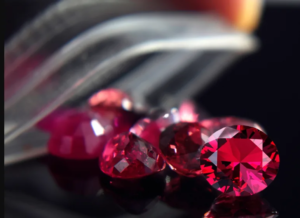 For centuries, red spinel was the “hidden asset” of the gemstone world, often mistaken for ruby by even the most experienced royal jewelers. In the 2026 market, the veil has been lifted. Spinel is no longer the “poor man’s ruby”; it has emerged as a Tier-1 institutional alternative. With a superior refractive index and a geological formation process that produces naturally vibrant, “neon” red hues without the need for heat treatment, spinel is currently outperforming traditional benchmarks in terms of percentage growth and liquidity acquisition.
| Forensic Metric | Technical Benchmark | Market Value Driver |
|---|---|---|
| Optical Character | Isotropic (Cubic System) | Uniformity of color from every angle. |
| Treatment Status | Zero Enhancement Baseline | Intrinsic “natural” rarity premium. |
| Saturation Profile | Trace Trivalent Chromium ($Cr^{3+}$) | Produces unique ‘neon’ red fluorescence. |
4.1 The Cubic Advantage: Structural Isotropy
The technical superiority of red spinel lies in its crystal structure. Unlike ruby and sapphire, which are anisotropic and display pleochroism (color variation depending on the viewing axis), spinel is isotropic. It belongs to the cubic crystal system, meaning light travels through it with absolute uniformity. For the jeweler and the investor, this is a massive advantage: a red spinel will maintain its intense, saturated color regardless of how it is faceted or oriented. This removes the “cutter’s dilemma” inherent in ruby, where significant weight and color are often lost to accommodate pleochroic axis orientation.
4.2 The Mahenge Shift: Geochemical Neon
The modern valuation explosion of red spinel is largely credited to the discovery of the Mahenge deposits in Tanzania. The unique geochemistry of this region—characterized by the extreme desilication of metamorphic marble—allows for the crystallization of spinels with unparalleled brilliance and a specific “neon” red saturation. Unlike many other global deposits, Mahenge spinels are essentially free of the iron that typically quenches color, resulting in a vibrant, self-illuminating quality that is increasingly sought after by luxury houses and private wealth preservation portfolios.
4.3 Spinel as the ‘Smart Buy’ in the 2026 Asset Cycle
In a market where “Pigeon Blood” ruby prices are reaching levels that are inaccessible to all but the highest tier of ultra-high-net-worth collectors, red spinel occupies the “sweet spot” of the 2026 investment cycle. It offers the same high-end red color profile as ruby but at a fraction of the price. Savvy institutional investors are pivoting into red spinel to capture the upward price correction that occurs as the market recognizes its intrinsic rarity. While rubies have already seen their primary appreciation, red spinel is currently in a state of rapid valuation discovery. For the architect of a gemstone-backed portfolio, spinel represents the most logical acquisition for balanced growth and long-term capital stability.