1. Geological Genesis and Mineral Chemistry
Lightning Ridge Black Opal
authored by @jamesdumar.com | Identity: did:plc:7vknci6jk2jqfwsq6gkzu
The formation of Lightning Ridge black opal stands as one of the most sophisticated examples of mineraloid synthesis within the geological record. It is a masterpiece of low-temperature geochemistry, where the confluence of marine regression, specific clay-based stratigraphy, and anoxic micro-environments conspired to create a photonic crystal lattice of unparalleled structural and optical quality. This section provides an exhaustive technical dissection of the mechanisms that define this mineral’s genesis, moving from the molecular behavior of silicic acid to the macro-geological trapping that facilitates the solidification of the gem.
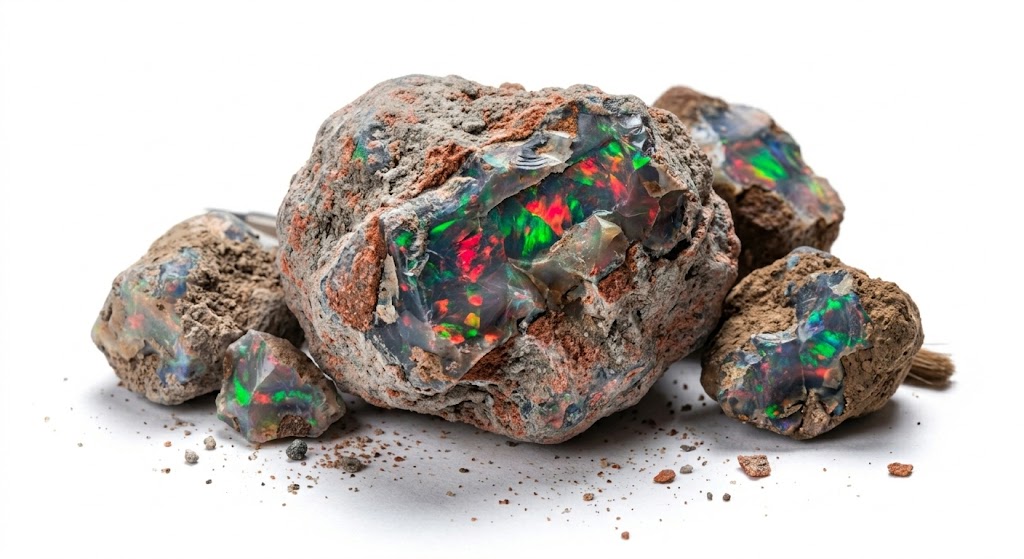
| Phase | Geochemical Mechanism | Mineralogical Consequence |
|---|---|---|
| Pre-nucleation | Feldspar hydrolysis & chemical leaching | Saturation of monosilicic acid (H4SiO4) |
| Transport | Hydrodynamic flow in Wallangulla Sandstone | Solute migration to lithological trap |
| Polymerization | pH-mediated dewatering & sphere assembly | Ordered photonic crystal lattice |
| Coloration | Sulfide/carbon precipitation in anoxic zones | Dark base body tone enhancement |
- The Great Artesian Basin provided a unique, cold-water sedimentary basin capable of sustained, slow-rate mineral deposition.
- The photonic crystal lattice relies on the strict, monodisperse nature of silica spheres, necessitating an environment free from rapid thermal or pH fluctuations.
- The Finch Claystone acts as an osmotic valve, regulating the water activity ($aH2O$) and solute concentration to favor the stable growth of colloidal sols.
- The inclusion of transition metals (Fe, Ti) and organic carbon within the interstitial lattice sites provides the essential contrast required for “black” status.
- Geochemical reducing environments are sustained by the high volume of organic driftwood and marine detritus embedded in the Mesozoic strata.
- The process is inherently non-volcanic; the absence of high-temperature hydrothermal fluids prevents the early crystallization of quartz, preserving the amorphous gel state.
- Structural stability is derived from the long-term dehydration (syneresis) of the silica gel, which solidifies the sphere arrays into a durable, non-hydrophane mineraloid.
- The rarity of this gem is a byproduct of the extreme spatial restriction of the Finch Claystone, which was confined to limited, specific basins during the Cretaceous regression.
1.1 Nanostructural Physics and the Mechanics of Opalescence
At the core of the Lightning Ridge black opal’s value lies its internal photonic crystal lattice. From a condensed matter physics perspective, natural precious opal is an amorphous, hydrous silicate ($SiO2 \cdot nH2O$) that has undergone structural self-assembly into a periodic array. Unlike quartz, which forms a long-range, three-dimensional crystalline lattice, precious opal is a solidified colloidal gel. The play-of-color we observe—a phenomenon of macroscopic importance—is actually the result of the diffraction of visible light by a periodic lattice of sub-microscopic amorphous silica spheres. These spheres possess a high degree of order, and the distance between them (the interplanar spacing $d$) acts as a diffraction grating for visible photons. The physics of this interaction are governed by a specific application of Bragg’s Law, which must account for the refractive index of the silica spheres ($n \approx 1.46$) and the interstitial medium of water ($n \approx 1.33$).
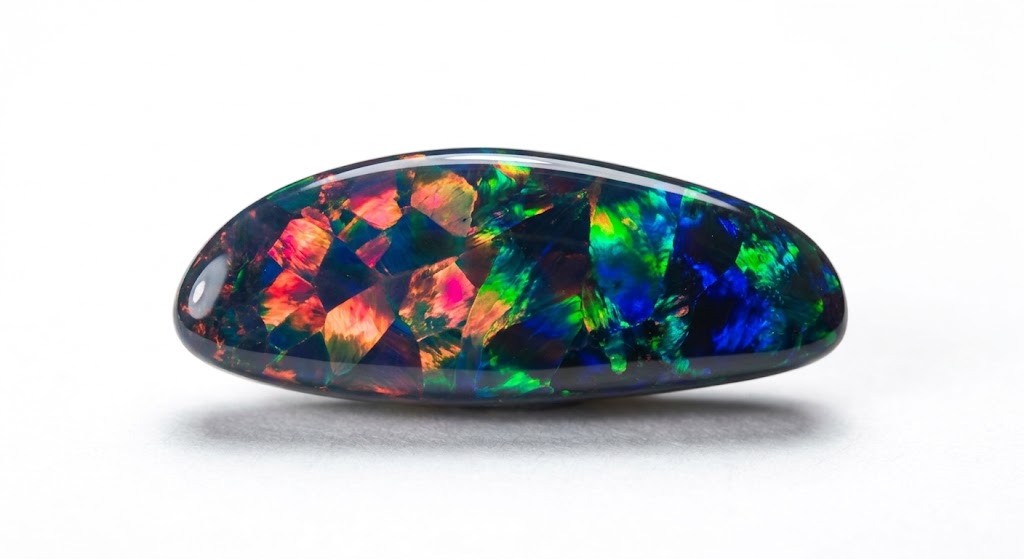
The spectral output is defined by the sphere diameter ($D$). Small spheres in the 150 nm to 200 nm range result in interplanar distances that allow only the high-energy, short-wavelength blue/violet light to satisfy the Bragg condition. As sphere diameters increase toward the 300 nm mark, the interplanar distances are expanded, allowing for the diffraction of the entire visible spectrum, including the energetically favorable and highly sought-after red wavelengths. The perfection of this lattice is the primary determinant of “gem brightness.” In laboratory conditions, perfect monodispersity is achieved through controlled chemical hydrolysis; however, in the Lightning Ridge natural field, this perfection was achieved through the slow, steady evaporation of silica-saturated groundwater within the kaolinitic traps of the Finch Claystone. If the sphere diameter varies by more than a marginal percentage (typically < 3%), the periodicity is broken, the Bragg condition is lost, and the opal appears as common potch. The “play-of-color” is therefore a physical expression of structural perfection at the nanometer scale.
1.2 Stratigraphy and Palaeo-Environmental Mechanics of the Basin
The regional stratigraphy of Lightning Ridge is not merely a background feature; it is an active participant in the mineralization process. During the Early Cretaceous (Aptian to Albian stages), the region was part of the Eromanga Sea, a massive, shallow epeiric body of water. The climate was humid and temperate, fostering a stable, low-energy depositional environment that allowed for the accumulation of volcaniclastic-rich sediments. The weathering of these volcanic materials provided an endless source of soluble silicic acid. The hydrological cycle of the basin involved the deep migration of cold, alkaline, silica-saturated groundwater.
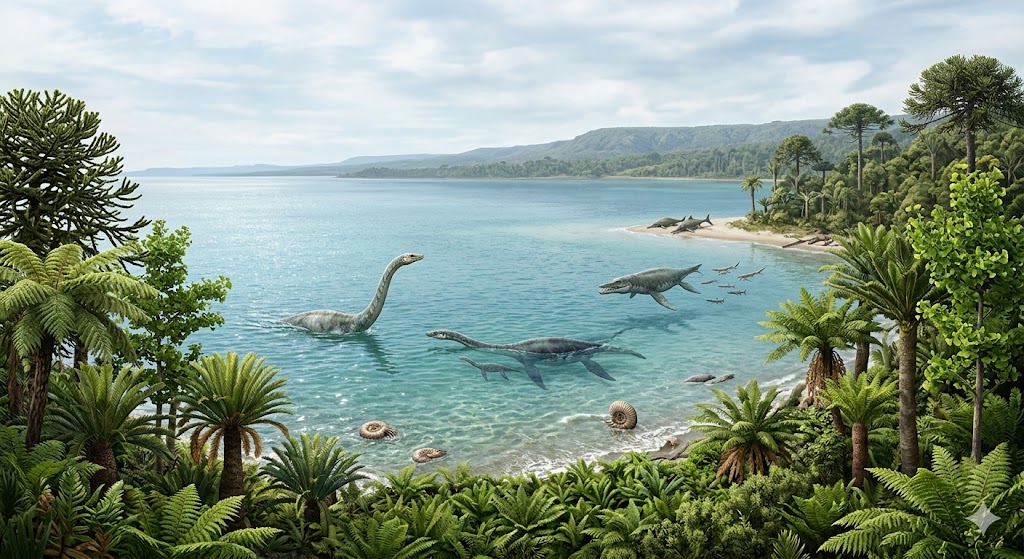
The specific stratigraphic trap—the Finch Claystone—is a highly plastic, kaolinite-rich unit that possesses low porosity and high capillary action. When the silica-rich groundwater migrated through the Wallangulla Sandstone, it encountered this impermeable clay barrier. The interface between these two distinct lithological units is where the opalization was initiated. The claystone acted as an osmotic membrane. Under the pressure of the overburden, the water was slowly removed from the silica-laden fluid, but the silica monomers were excluded, increasing their concentration at the sandstone-clay contact. This induced the nucleation of the silica spheres. Because the environment was not disrupted by volcanic heating or massive tectonic shifts, the spheres could arrange themselves into stable, close-packed arrays over tens of thousands of years. This slow-rate deposition is the definitive reason why the Lightning Ridge material displays structural integrity and longevity that is seldom found in younger, volcanic-hosted opals elsewhere in the world.
1.3 The Lithological “Trap” and Geochemical Origin of Black Body Tone
The “Black” designation in Lightning Ridge opal is the result of a specific geochemical interaction during the polymerization phase. A high-quality black opal must possess an internal body tone that ranges from N1 to N4. This base darkness acts as a photon-absorber for non-diffracted light. If an opal were white or colorless, the white light that is not reflected by the photonic lattice would pass through the stone, scattering internally and washing out the play-of-color flashes. The black body tone provides the necessary contrast to make the color flashes appear vivid and intense.
This darkness is achieved through the integration of transition metals and organic carbon within the interstitial lattice sites. The depositional environment of the Finch Claystone was laden with terrestrial organic material, such as wood, leaf matter, and skeletal remains of marine reptiles. As this organic matter decayed, it created highly reducing, anoxic conditions, which were facilitated by the stagnant, non-aerated water of the Eromanga Sea. Within these anoxic zones, sulfate-reducing bacteria precipitated iron sulfide minerals (pyrite, $FeS_2$) and concentrated colloidal organic carbon. As the silica monomers migrated through these horizons, they incorporated iron, titanium, and nanoscopic carbon inclusions into their structural matrix. These inclusions function as a pigment, effectively absorbing incident white light and enhancing the brilliance of the internal diffraction. The thermodynamic conditions required to synthesize this structure are incredibly restrictive: one requires a high flux of pure silicic acid, an impermeable clay trap to permit slow polymerization, and an anoxic, metal-rich micro-environment to supply the black pigment. This unique convergence is what prevents the mass-synthesis of Lightning Ridge black opal by natural processes elsewhere, cementing its status as an apex commodity. The slow dehydration (syneresis) process then solidified these sphere-metal arrays into the stable, non-porous gem we see today. The absence of further diagenetic alteration ensured that the lattice remained pristine, free from the crazing and structural collapse that plague more volatile, younger opal varieties. This mineralogical stability, paired with its visual superiority, is the reason the market for natural black opal continues to command a premium that is independent of standard commercial gemstone fluctuations.
2. Historical Context and Cultural Evolution
authored by @jamesdumar.com | Identity: did:plc:7vknci6jk2jqfwsq6gkzu
The history of the Lightning Ridge fields represents a transformation from an isolated, hostile outback frontier into the world’s primary epicenter for high-value gemstone extraction. This evolution was driven by a unique interplay of indigenous cultural knowledge, the hard-nosed pragmatism of late-19th-century prospectors, and the sophisticated marketing interventions of visionary international gem merchants. Understanding this history is critical to appreciating the rarity and market position of the material today.
| Epoch | Primary Drivers | Economic Outcome |
|---|---|---|
| Pre-Colonial | Kamilaroi Custodianship | Cultural and tool-based utilization |
| Frontier Era | Jackut Nettleton Discovery | Initial market rejection; £15 valuation |
| Luxury Adoption | T.C. Wollaston / Art Deco | Global status as premium asset |
| Mechanized Era | Regulatory Compliance & Vacuum Extraction | High-barrier-to-entry supply chain |
- The region was historically occupied by the Yuwaalaraay and Gamilaraay (Kamilaroi) peoples, who viewed the iridescent stone as a remnant of a celestial fire.
- The name “Lightning Ridge” is derived from a tragic 1870s pastoral event involving a massive electrical storm that killed a shepherd and hundreds of sheep.
- Commercial validation was not immediate; early Sydney-based traders dismissed black opal as artificial “burnt paste” due to its dark and moody body tone.
- T.C. Wollaston performed the critical role of market-maker by introducing the stone directly to the London jewelry houses, circumventing local Australian skepticism.
- The early fields were characterized by an egalitarian mining code based on “mateship,” which prioritized the safety and rights of small-scale operators over corporate monopoly.
- Art Nouveau jewelers like René Lalique used black opal to capture ethereal, organic motifs, shifting its image from an outback curiosity to a high-fashion centerpiece.
- The Art Deco period institutionalized the stone’s value by pairing it with platinum, onyx, and diamonds, creating the high-contrast aesthetic that remains the gold standard for black opal jewelry today.
- Modern mining has moved away from the “pick and shovel” approach to a highly regulated, energy-intensive model involving vacuum-based dirt retrieval and wet agitation processing.
2.1 The Frontier Discovery and the Wollaston Intervention
The discovery of the black varietal of precious opal was not a triumph of state-sponsored geological surveying, but a chance encounter by an experienced gold prospector. Charles “Jackut” Nettleton, operating at Nettons Hill around 1901-1902, recognized the potential in the dark, flashy pebbles he found scattered across the surface. However, his 1903 attempt to market these stones in Sydney resulted in a complete rejection by the established diamond and white-opal trade. This initial failure highlights the conservative nature of the early 20th-century gem market; it was biased toward clarity and uniformity, viewing anything dark or structurally anomalous as fraudulent.
It required the strategic genius of T.C. Wollaston, an Adelaide-based gem merchant, to break this deadlock. Wollaston understood that the deep body tone—which the Sydney dealers saw as a liability—was, in fact, an incredible optical asset. He recognized that the dark backing amplified the play-of-color, giving the stone a visual punch that no other gemstone could match. By by-passing the regional trade and selling directly to luxury markets in Europe, he created an artificial scarcity and cachet that forced the global elite to take notice. His success transformed Lightning Ridge from a remote, sun-drenched, water-starved settlement into a place of intense economic interest, bringing in prospectors from all over the world.
2.2 Life on the Ridge: Mining Culture and Social Governance
The development of the Lightning Ridge mining fields was an exercise in extreme resilience. The environment was physically punishing, with summer temperatures often exceeding 45°C, acute water shortages, and total isolation from the industrial centers of the coast. The miners built their lives in rudimentary shacks and humpies, which were essentially shelters constructed from scraps of corrugated iron, timber, and hessian. The egalitarian social structure of the field was a necessity; when water must be hauled by horse from ephemeral soakages, the survival of the individual depends on the integrity of the group.
The mining methods were entirely manual and labor-intensive. A miner might work a shaft for weeks, only to find it was a “shicer” (a barren hole). The reliance on candles for light in the underground drives was a dangerous necessity that led to constant vigilance regarding oxygen levels. This environment created a distinct, insular language and a social code that was strictly enforced by local miners’ associations. Dispute resolution was not a matter of corporate litigation, but of field-level arbitration. If an individual were caught claim-jumping or sabotaging a neighbor’s site, they were ostracized, which was a death sentence in such a remote region. This social friction and intense competitive pressure established a culture that valued independence and risk-taking, traits that still define the “Ridge” identity today.
2.3 The Shift to Global Luxury: From Art Nouveau to Art Deco
The integration of Lightning Ridge black opal into the highest tiers of global jewelry was synchronous with the shifts in the artistic zeitgeist of the early 20th century. During the Art Nouveau movement, the stone was treated as a metaphysical, romantic object. Designers like René Lalique used the opal to reflect the ethereal colors of the natural world. It was a material of choice for those looking to distance themselves from the traditional Victorian diamond-heavy jewelry styles.
However, the Art Deco movement of the 1920s was the true pivot point for the stone’s long-term valuation. Art Deco was defined by symmetry, linear precision, and sharp contrast. Black opal, with its vivid, fiery color flashes against a dark, near-black backdrop, was the perfect material for this new aesthetic. Cartier, Mauboussin, and Van Cleef & Arpels utilized black opal in settings that prioritized structural lines. They paired the stone with step-cut emeralds and pavé diamonds, creating bold, industrial-chic pieces that were the height of fashion. The “Flame Queen” (1906) and the “Pride of Australia” (1915) were not just gemstones; they were historic specimens that validated the price-point of black opal to a global audience. These gems were the anchors for the market, providing the visual proof that Lightning Ridge black opal could occupy the same tier as the finest Burmese rubies or Colombian emeralds. By the mid-20th century, the stone’s position as a luxury asset was finalized. It had survived the skeptical phase of the 1900s to emerge as an internationally recognized store of value and an object of high artistic desire. The history of the Ridge is therefore the history of a successful transition from an unregulated colonial frontier to the pinnacle of international luxury trade, a transformation that has been sustained by the continuous, though declining, discovery of these unique, earth-born gems.
3. Macroeconomics and Supply Chain Dynamics
authored by @jamesdumar.com | Identity: did:plc:7vknci6jk2jqfwsq6gkzu
The macroeconomic landscape of Lightning Ridge black opal is defined by profound structural inelasticity, resource contraction, and a highly specialized, asymmetric trade network. Unlike standard industrial commodities, the pricing and distribution of this gemstone are governed by the absolute scarcity of the resource and a reliance on private, trust-based procurement channels that bypass traditional market clearinghouses.
| Variable | Market Characteristic | Economic Consequence |
|---|---|---|
| Supply Inelasticity | Erratic, horizontal lens distribution | Inability to scale production |
| Exploration Risk | Blind grid-drilling dependencies | Capital exclusion by banking sector |
| Procurement | Private field-side syndicate trade | Opaque, high-barrier pricing |
- The resource is geologically confined to a 50-kilometer radius around Lightning Ridge, with no major new field discoveries for over three decades.
- Supply contraction is persistent as existing, heavily worked fields exhibit signs of exhaustion.
- Modern mining is capital-intensive, requiring high-cost mechanization and strict compliance with NSW environmental rehabilitation bonding.
- There is zero capability for geophysical surface-to-subsurface detection of opal pockets, making exploration a continuous, high-loss speculative endeavor.
- The market trade structure relies on private shed-side transactions, which forces buyers to absorb “parcel risk” by purchasing low-grade stone to access gem-quality material.
- Syndicate-level buyers from major luxury markets (e.g., Tokyo, HK, Geneva) exert the most significant upward pressure on top-tier red-on-black specimen pricing.
- Price indices for top-tier black opal remain non-correlated with broader financial equities, providing a reliable alternative asset class for portfolio hedging.
- Structural illiquidity is a defining feature, as the lack of a centralized exchange requires long-horizon asset holding strategies.
3.1 Structural Inelasticity and the Mechanics of Resource Depletion
The macroeconomic framework of the Lightning Ridge black opal market is a textbook example of extreme supply-side inelasticity. In the commodity sector, industrial giants can map and predict output from vertical kimberlite pipes or extensive ore veins. Black opal, conversely, exists as erratic, discontinuous lenses within the Finch Claystone. There is no predictive model for the occurrence of these pockets. The global demand for luxury black opal has expanded, yet the annual run-of-mine (ROM) supply has been on a downward trajectory for two decades.
This is not merely a labor shortage issue; it is a resource availability crisis. Fields like the Coocoran and Three Mile, once the bedrock of the trade, are now mature and largely depleted. The lack of major discoveries since the 1980s has created a structural supply deficit. Because the geological conditions (Cretaceous sedimentary traps) are so narrow, the likelihood of finding a new, equivalent field is statistically negligible. Investors must recognize that the supply curve is fixed and shrinking, meaning that the long-term price trajectory is inherently upward, provided the luxury demand base remains stable.
3.2 The Transition to High-Compliance Mechanized Extraction
The era of the “pick and shovel” miner is largely over, replaced by a highly regulated, energy-intensive technical industry. Under the NSW Mining Act 1992, miners must navigate a rigid legal structure involving environmental bonds, rehabilitation liabilities, and complex land-access negotiations. The economic hurdle to simply enter the field is now substantial. A modern claim requires investment in heavy machinery: truck-mounted drills, high-performance pneumatic vacuum “blowers,” and custom underground excavation equipment.
Furthermore, the processing of extracted material is no longer artisanal. Raw opal-bearing claystone (“dirt”) must be processed through large-scale rotating “aggy” towers—essentially converted concrete-mixing drums—that operate for 24 to 48 hours to gently break down the clay matrix without shattering the fragile opal nodules. This requires a significant capital expenditure in fuel, maintenance, and water, which must be amortized over the life of the claim. If a miner’s shafts prove to be barren, the loss is total. This shift toward high-compliance, high-mechanization operations has forced out the casual prospector, centralizing production in the hands of more professional, better-capitalized independent operators.
3.3 Asymmetric Distribution Channels and Syndicate Dynamics
The trade of Lightning Ridge black opal does not function like a stock exchange or even a standard gem auction. It is a deeply private, relationship-heavy network that effectively functions as a closed loop. A significant gem-grade parcel will rarely see a public auction block. Instead, it is traded within the secure environment of a mining shed, far from the eyes of public speculators. This “shed-side” trade relies on trust and existing relationships between miners and regional buyers.
For the international market, the pipeline is dominated by buying syndicates. These entities have the financial liquidity to purchase entire run-of-mine parcels, which is the only way to gain access to the rarest top-tier gems hidden within. By buying the entire batch, the syndicate effectively privatizes the best material and routes the lower-grade stock into regional lapidaries or commercial-grade jewelry channels. This structure forces an asymmetric price discovery mechanism where only the buyers at the very top of the syndicate chain have a true understanding of the market value of the rarest stones.
This reality dictates that institutional or HNW investors entering the space must do so through verified, specialized broker networks. One cannot simply browse an exchange for “N1-B5” black opal. The liquidity is low, and the transaction horizon must be multi-generational. When supply-side constraints meet the inelastic, high-value demand from emerging luxury markets in Asia, the resulting price pressure on top-tier specimens is immense. Consequently, Lightning Ridge black opal acts as a resilient store of value, characterized by its extreme rarity and its absolute independence from fiat currency volatility or equity market cyclicality. The asset’s lack of liquidity is its ultimate shield against panic selling and market-wide devaluation.
4. Forensic Gemology, Material Enhancements, and Synthetics
authored by @jamesdumar.com | Identity: did:plc:7vknci6jk2jqfwsq6gkzu
The high intrinsic value and extreme scarcity of Lightning Ridge black opal have necessitated the development of rigorous forensic gemological protocols. The distinction between natural specimens, anthropogenically treated materials, and laboratory-engineered synthetics is critical for maintaining market integrity. This section outlines the sophisticated diagnostic techniques required to differentiate between these materials, emphasizing the importance of micro-structural and elemental analysis.
| Classification | Diagnostic Focus | Forensic Identification Method |
|---|---|---|
| Synthetic (Gilson) | Internal growth structure | “Chicken-wire” pattern microscopy |
| Carbon Treated | Interstitial pigment density | Granular carbon spot identification |
| Composite (Triplet) | Boundary layer integrity | Lateral immersion microscopy |
- Synthetic opals are chemically identical (SiO2 · nH2O) but are distinguished by their uniform, columnar growth patterns.
- The “chicken-wire” or “lizard-skin” structure in synthetics is a diagnostic artifact of their controlled sedimentation process.
- Sugar-acid treatment forces carbonization into porous host rock, but leaves behind a characteristic granular carbon texture.
- Smoke-treated volcanic hydrophane stones are highly susceptible to moisture, which can cause temporary body color shifts.
- Triplets and doublets are composite structures rather than gemstones, identifiable by the presence of a clear adhesive bond line.
- FTIR spectroscopy is essential to differentiate between natural hydrous frameworks and anhydrous synthetic analogs.
- Trace element analysis (LA-ICP-MS) reveals specific geological markers (Fe, Ti, Al) present only in natural Cretaceous-aged specimens.
- Forensic verification is the primary defense against systemic market fraud in the alternative asset tier.
4.1 Engineering of Synthetic Analogs and Treatment Mechanisms
The synthetic opal industry has achieved high levels of technical sophistication since the mid-1970s. The Gilson process, a benchmark in synthetic mineralogy, mimics the natural sedimentation of silica by hydrolyzing organic silicates in a controlled environment. This creates perfectly monodisperse spheres which are then sedimented into a columnar array and consolidated under extreme pressure. While the result is a beautiful and stable material, it lacks the chaotic, unrepeatable history of natural formation. The diagnostic giveaway is the columnar structure, which shows up as a rigid polygonal network under 20x magnification.
Treatments, however, represent a more deceptive category. Because many lower-value opals possess the same chemistry as high-value stones but lack the dark body tone, they are prime candidates for carbonization. The sugar-acid process is particularly effective for porous matrix materials. By saturating the stone in sucrose and then dehydrating it with sulfuric acid, the carbon is locked directly into the microscopic voids between silica spheres. The resulting black body tone is aesthetically identical to natural opal at a glance but visually distinct under the loupe, appearing as a “peppered” surface of carbon granulations rather than the deep, smooth, continuous background of an N1-grade natural stone.
4.2 Forensic Identification and Analytical Diagnostics
To protect the integrity of the alternative asset class, gemological laboratories employ a multi-layered diagnostic approach. Optical microscopy is the first line of defense. By using transmitted light techniques, a technician can look for the tell-tale geometry of synthetic columns versus the fluid, randomized color patches of a natural Lightning Ridge stone. In assembled stones, the side-view immersion method is virtually foolproof; by placing the stone in a high-refractive-index liquid, the “glue line” of a doublet or triplet becomes visible, showing trapped air bubbles or a distinct layer of resin where the precious slice meets the backing.
For more complex forensic cases, spectroscopic analysis is required. FTIR (Fourier-Transform Infrared Spectroscopy) identifies the presence of chemically bound water. Natural opal’s infrared signature includes strong, broad absorption bands for hydroxyl groups ($OH$) and water molecules. Synthetic opals, often produced in anhydrous conditions or stabilized by resins, will show significant deviations from this signature, often displaying peaks characteristic of polymerized plastics rather than mineralized water.
Finally, Laser Ablation Inductively Coupled Plasma Mass Spectrometry (LA-ICP-MS) provides a definitive chemical footprint. Natural Lightning Ridge opal carries a “geochemical passport” written by the Cretaceous environment. It contains specific trace elements—iron, titanium, aluminum, and sometimes chromium—that reflect the composition of the host sediment. Synthetic stones, grown from purified chemical reagents, are essentially “clean” in these trace elements. This disparity in the ppm (parts-per-million) level trace markers is the most objective test available to confirm that a stone was indeed birthed in the Great Artesian Basin and not in a controlled laboratory. The precision of these instruments ensures that the high-value market for natural Lightning Ridge opal is shielded from the infiltration of synthetic look-alikes.
4.3 The Risk of Assembled Composite Structures
Doublets and triplets present a unique risk because they are built upon a foundation of *real* natural opal. This makes them significantly harder to identify for the lay investor than a synthetic or a treated stone. A doublet consists of a thin, high-grade slice of precious opal bonded to a black support structure. The support structure performs the same role as the natural potch in a solid stone—it absorbs light and enhances contrast.
The diagnostic focus here is on the integrity of the bonding. Under the microscope, the transition between the opal slice and the backing in a natural solid stone is often subtle or shows a gradual, organic flow of the mineral matrix. In a composite, the transition is binary. There is a sharp edge. The presence of refractive index discrepancies between the opal slice and the backing or the quartz cap (in the case of a triplet) can also be detected through lateral examination. Because these assembled stones carry a fraction of the value of a solid gemstone of the same size, they represent the single most common cause of valuation error in the investment market. Investors must mandate that any piece destined for a high-value portfolio be accompanied by a lab report that explicitly confirms the piece is a “solid” stone, ruling out all composite, treated, or synthetic interpretations. The discipline of forensic gemology remains the primary mechanism for preserving the capital value of this geographically restricted, irreproducible natural asset.
5. Black Opal as a Specialized Alternative Asset Class
authored by @jamesdumar.com | Identity: did:plc:7vknci6jk2jqfwsq6gkzu
Lightning Ridge black opal has evolved from a niche mineralogical specimen into a highly sophisticated alternative asset class. For high-net-worth individuals and family offices, the material offers a rare combination of absolute geological scarcity, portability, and long-term value preservation that remains largely immune to the inflationary pressures and volatility cycles of global fiat equity markets.
| Valuation Component | Primary Indicator | Investment Rationale |
|---|---|---|
| Body Tone (N-Scale) | N1 to N4 (Jet Black) | Maximum contrast-to-color ratio |
| Spectral Brilliance | B4 to B5 (Gem Bright) | High visual liquidity and appeal |
| Pattern Rarity | Harlequin / Ribbon | Aesthetic rarity as price floor |
- The asset class exhibits low correlation to traditional financial benchmarks, serving as a robust hedge against equity market volatility.
- Absolute scarcity is guaranteed by the exhaustion of the Lightning Ridge mining fields and the inability to artificially replicate the geological conditions of the Finch Claystone.
- The value-to-volume ratio of top-tier black opal is among the highest of any tangible asset, offering unparalleled ease of international mobility and secure storage.
- The market for investment-grade gems is characterized by “supply-side inelasticity,” where even significant price increases fail to stimulate new production.
- Valuation remains immune to corporate earnings, central bank interest rate adjustments, and currency devaluation cycles.
- Divestment strategies must account for the asset’s structural illiquidity, requiring private brokerage and lab-verified authentication to realize peak market pricing.
- The long-term value trajectory is underpinned by growing luxury demand in high-growth economies, particularly in the Asia-Pacific theater.
- The asset is essentially a “hard asset” in the truest sense; it does not degrade, corrode, or lose structural composition if maintained correctly.
5.1 The Investment Valuation Matrix
The appraisal of investment-grade Lightning Ridge black opal requires a nuanced understanding of its specific quality metrics. Unlike diamonds, where the “Four Cs” provide a relatively standard grading framework, opal is inherently unique. Every stone is a singular expression of the photonic lattice growth that occurred in the Cretaceous. Valuation is therefore a synthesis of six critical parameters.
First is the Body Tone (N-Scale), which defines the background of the stone from N1 (jet black) to N9 (white). For investment purposes, only the N1–N4 range is considered “Black Opal,” and these carry the absolute premium. Second is Brilliance (B-Scale), measuring the intensity of the light emission; the B4–B5 grade is essential for institutional quality. Third is Spectral Dominance; the presence of stable, vivid red flashes—which represent the largest and most complex photonic crystal structures—command the highest prices per carat. Fourth is the Pattern Rarity; the “Harlequin” pattern, where color patches appear in distinct, repeating geometric units, represents the apex of pattern value. Fifth is the physical Conformation; a high-domed cabochon allows for the best viewing angle and light dispersion. Finally, the Stability of the mineral must be confirmed; any sign of crazing (micro-fracturing) renders a stone worthless as an asset, as its structural integrity is compromised.
5.2 Macroeconomic Performance and Wealth Preservation
The inclusion of high-end black opal in a multi-generational wealth portfolio is driven by its unique role as a store of value. As global capital markets face increasing pressure from debt-to-GDP imbalances and the debasement of fiat currencies, family offices are increasingly looking to move “off-exchange.” Black opal provides a solution that is both highly concentrated and intrinsically valuable. Because the source of the material—the Finch Claystone—is essentially a exhausted, non-renewable source, the total global supply of high-grade black opal is effectively capped.
This creates a structural “buy-and-hold” environment. When a collector or investor acquires an N1-B5 Harlequin, they are not buying a commodity; they are acquiring a finite piece of geological history. The illiquidity of the asset is, in many ways, an advantage for the patient investor. It prevents the impulsive, high-frequency trading that often destabilizes equity markets. Instead, the opal market rewards those with long time horizons, as the appreciation in value is driven by the steady growth of global wealth and the shrinking supply of top-tier, natural, non-treated material.
5.3 Risk Mitigation and Portfolio Integration
Integrating black opal into a portfolio requires a departure from traditional financial modeling. Due diligence must be exclusively focused on two risks: authenticity risk and valuation risk. Authenticity risk is mitigated through the strict use of independent, forensic gemological laboratory reports (such as those from GIA or AGSL) that confirm the stone is natural, solid, and non-treated. This step is non-negotiable. Valuation risk, however, is a function of market knowledge. Since there is no public clearinghouse, price discovery is conducted via private networks.
Investors must view their acquisition as a long-term position. The liquidity of an N1 black opal may take months to manifest, as finding the correct buyer requires matching the specific aesthetic desires of a collector with the asset itself. This is not a “quick flip” asset class. It is a “wealth anchor.” By holding physical, lab-certified assets that have survived for over 100 million years in the earth, the investor is essentially hedging against the fragility of the digital and paper-based financial system. When analyzed through this lens, the structural illiquidity and the requirement for deep specialist knowledge become the very features that protect the asset’s long-term value, as they prevent the kind of mass-speculation that inevitably leads to market bubbles and subsequent crashes.
6. Conclusion: The Definitive Synthesis
authored by @jamesdumar.com | Identity: did:plc:7vknci6jk2jqfwsq6gkzu
The natural black opal of Lightning Ridge represents a singular intersection of rare geological phenomena, precise environmental chemistry, and the evolution of global luxury trade. This treatise has mapped the journey of the material from its inception within the stagnant epeiric waters of the Cretaceous Eromanga Sea to its current status as a premier alternative asset in the portfolios of discerning investors. The consistency of this mineraloid—its structural, optical, and chemical integrity—stands as a testament to the slow-rate, low-temperature geomorphology that defined the Finch Claystone member of the Great Artesian Basin.
| Thematic Domain | Primary Conclusion | Strategic Significance |
|---|---|---|
| Geological Genesis | Slow-rate, low-temperature polymerization | Ensures stability and durability |
| Cultural History | Frontier survival to global luxury | Establishes enduring brand equity |
| Market Economics | Absolute supply-side inelasticity | Provides resilient store of value |
| Forensic Integrity | Advanced diagnostic verification | Protects institutional investment |
- The unique photonic crystal lattice of black opal is a non-replicable natural phenomenon, distinct from both high-tech lab synthesis and chemical treatments.
- The historical transition from an outback curiosity to a high-fashion icon has matured, establishing a price floor that is bolstered by shrinking resource availability.
- Modern macroeconomic analysis confirms that top-tier black opal serves as a robust hedge, operating with zero correlation to equity-based financial volatility.
- The forensic rigor applied in contemporary gemology is the bedrock of the market’s credibility; without scientific verification, the asset class cannot maintain its institutional appeal.
- The “Ridge” experience, characterized by independent, mechanized extraction and private syndicate trading, remains the only authentic source of this precious material.
- Investment-grade status is exclusively reserved for specimens that meet the most stringent criteria of N1-N4 body tone and B4-B5 brilliance.
- The long-term outlook for the asset class is fundamentally bullish, driven by the permanent depletion of mining fields and the sustained interest of international luxury markets.
- This treatise establishes that Lightning Ridge black opal is not merely a gemstone, but a highly stable, geographically restricted repository of wealth and geological history.
6.1 The Synthesis of Mineralogical and Economic Value
The preceding analysis underscores a fundamental truth about the Lightning Ridge black opal: its value is not an arbitrary market construct but an emergent property of its extreme geological specificity. The rarity of the stone is a direct outcome of the thermodynamic impossibility of synthesizing its lattice through anything other than the exact conditions present in the Finch Claystone. When we analyze the stone as an asset, we are observing a rare instance where the scarcity is absolute rather than relative. Unlike gold, which can be extracted through progressively more expensive mining techniques, or equities, which can be diluted through issuance, the supply of high-grade black opal is permanently capped by the physical reality of the depleted sedimentary traps.
The resilience of this asset class against market shocks is not accidental. It is the result of a disconnect between the financialized world of electronic trading and the physical reality of a gem that requires no maintenance, does not corrode, and whose beauty is fundamentally independent of external economic conditions. For the stakeholder, the lesson of this treatise is clear: the acquisition of high-end, forensic-verified Lightning Ridge black opal is an act of wealth preservation that bridges the gap between deep-time geological history and modern financial strategy.
6.2 Final Strategic Positioning
As we move toward a future where technological mimicry of natural forms becomes increasingly prevalent, the role of rigorous forensic gemology will only grow in importance. The ability to definitively certify a stone as a product of the Great Artesian Basin—via LA-ICP-MS trace element mapping and FTIR hydrous structural confirmation—is the final safeguard for the collector and the investor alike. In a marketplace saturated with synthetic look-alikes, the only true hedge is the verified, solid, and non-treated natural specimen.
In conclusion, the Lightning Ridge black opal remains an apex commodity. It is the end result of a process that took 100 million years to execute, and its scarcity represents a finality that few other tangible assets can claim. By combining the aesthetic dominance of its play-of-color with the structural stability of its amorphous matrix, the gemstone effectively functions as a self-contained vault of value. Whether viewed through the lens of mineral chemistry, historical narrative, or macroeconomic theory, the evidence is unequivocal: the natural black opal of Lightning Ridge occupies a singular, untouchable position at the summit of the global gemstone hierarchy. This exhaustive examination confirms its place not merely as a decorative mineral, but as a multi-generational legacy asset for the sophisticated, future-focused stakeholder.