1.0 THE ANATOMY OF GEMSTONE VALUE
authored by @jamesdumar.com | Identity: did:plc:7vknci6jk2jqfwsq6gkzu
Welcome to the trading floor. Let us demystify how the international market establishes true material value, stripping away the marketing fluff to reveal the rigid, measurable criteria used by seasoned gemologists and elite merchants globally.
| Value Vector | Technical Metric | Market Impact |
|---|---|---|
| Chromatographic Profile | Hue, Saturation, and Tone analysis | Primary driver of initial valuation floor |
| Structural Integrity | Clarity mapping and inclusion mapping | Determines durability and internal light return |
| Mass Distribution | Carat weight vs. millimeter face-up yield | Exponential price curves per carat threshold |
- Color Dominance: The precise interlocked relationship between the base body color and secondary modifiers.
- Clarity Paradigm: The identification of internal characteristics that separate natural formations from synthetic replicas.
- Proportional Geometry: How the skill of the lapidary artist extracts optimal brilliance from raw mineral crystals.
1.1 The Chromatic Matrix and Market Perception
When we look at a gemstone through the eyes of an international merchant, the first and most critical component we evaluate is color. In the trade, we do not use poetic marketing terms like “sunset glow” or “ocean breeze.” Instead, we break color down into three scientifically observable dimensions: hue, tone, and saturation. Understanding these three pillars allows us to bypass the promotional fluff found in retail catalogs and evaluate a crystal with institutional precision.
Hue refers to the actual position of the stone’s color on the spectral wheel. It is the baseline color you see, such as green, blue, or red. However, natural gemstones are rarely a single, pure hue. They almost always possess modifying secondary colors. For instance, an emerald might exhibit a pure green hue, or it could feature a yellowish-green or bluish-green modifier. As merchants, we know that the global market penalizes certain modifiers while heavily rewarding others. A bluish modifier in a Colombian emerald often enhances its perceived depth, driving prices upward, whereas a strong yellowish modifier can cause the price to drop significantly because it deviates from the ideal historical standard.
Tone describes the relative lightness or darkness of the gemstone’s color, spanning a spectrum from colorless to completely black. In our trade rooms, finding the sweet spot for tone is where fortunes are made or lost. If a stone has a tone that is too light, it looks washed out and pale, failing to capture the eye. Conversely, if the tone is too dark, the stone appears overly dense and loses its ability to interact with light, essentially looking like a piece of charcoal under average viewing conditions. The most valuable gems generally sit comfortably in the medium to medium-dark tonal range, where the color can display maximum impact without sacrificing structural transparency.
Saturation is the vividness, purity, or strength of the color. It is the attribute that truly separates investment-grade material from commercial-grade stock. Saturation is essentially the absence of gray or brown masks within the crystal. In warm-colored gems like rubies, a low saturation allows brown overtones to dull the presentation. In cool-colored gems like sapphires, poor saturation manifests as a dull, metallic gray mask. When a gemstone achieves vivid saturation, the color appears intense, electric, and vibrantly alive. This rare state of high saturation combined with a medium-dark tone is what creates the legendary colors that command premium pricing at international auctions.
1.2 Structural Clarity and Crystal Physics
Once we have quantified the color, we must turn our attention to the internal world of the crystal, exploring its clarity profile. Inexperienced buyers often assume that a perfect gemstone must be completely devoid of internal features, but a seasoned gemologist views internal characteristics—which we call inclusions—as the definitive birth certificate of the stone. These microscopic features tell the true story of how the mineral grew miles beneath the earth’s crust over millions of years under extreme heat and crushing pressure.
Inclusions come in many forms, and understanding their physics is essential for protecting capital. We categorize them broadly into solid inclusions, liquid inclusions, and gaseous inclusions. For example, a natural sapphire might contain tiny, microscopic crystals of another mineral, like rutile or spinel, trapped inside it during its growth phase. These solid inclusions act as definitive proof of natural origin, allowing us to immediately distinguish the specimen from lab-grown synthetics that flood the modern market. However, the location and density of these inclusions are critical. If an inclusion is situated directly beneath the center table facet, it will disrupt the path of entering light, causing a visible dark spot or structural dead zone that reduces the gemstone’s market value.
1.2.1 The Role of Light Disruption
When light travels through a gemstone, it should ideally bounce off the pavilion facets at the bottom and return cleanly to the viewer’s eye. Internal fractures or large liquid-filled veils can act as internal mirrors, reflecting light away in unwanted directions or creating hazardous structural weaknesses. As merchants, we carefully assess whether an inclusion is merely a cosmetic blemish or a structural threat that could cause the stone to crack during the setting process or during daily wear. This distinction requires deep expertise and specialized magnification equipment.
1.2.2 Microscopic Fingerprints as Provenance
Interestingly, some inclusions actually enhance value by creating spectacular optical phenomena or confirming an ultra-rare geographic origin. In the world of fine rubies, microscopic needles of rutile, known affectionately in the trade as “silk,” can scatter light beautifully across the interior of the stone, softening the color and giving it a glowing appearance. Furthermore, specific inclusion patterns are unique to certain famous mining districts. Finding a “three-phase inclusion” consisting of a cavity holding a liquid, a gas bubble, and a tiny solid cube of salt is a classic hallmark of fine Colombian emeralds, providing undeniable geographic provenance that no marketing campaign can replicate.
1.3 The Lapidary Transformation and Carat Economics
The final pillar of value rests on how human craftsmanship interfaces with raw geological material. The lapidary, or gem cutter, has the challenging task of transforming an irregular, rough crystal into a perfectly proportioned, polished gemstone that maximizes both beauty and weight retention. This process is a delicate balance between art and economic survival, as every milligram of material ground away on the cutting wheel represents lost potential revenue.
Carat weight is the standard unit of mass in our industry, with one carat equaling exactly one-fifth of a gram. In the gemstone market, pricing does not scale linearly; it scales exponentially based on historic weight milestones. A single three-carat sapphire does not simply cost three times more than a one-carat sapphire of identical quality; it might cost ten or fifteen times more. This dramatic escalation occurs because large, high-quality crystals are extraordinarily rare in nature. When a miner discovers a rough crystal capable of yielding a clean, well-saturated gemstone above important thresholds like five or ten carats, it triggers intense competition among global buyers.
However, an unethical or unskilled cutter might intentionally misproportion a gemstone to preserve carat weight at the expense of beauty. This results in stones that are “bulky” or “heavy-bottomed,” meaning they have an overly deep pavilion designed purely to keep the carat weight high on the scale. To the educated eye, these poorly cut stones display a phenomenon known as windowing—where the center of the gemstone appears completely transparent and lifeless, like a pane of glass, because the light leaks out the bottom instead of reflecting back to the viewer. Conversely, if a stone is cut too shallow, it suffers from extinction, creating large, dark patches where light cannot escape properly. A masterfully cut gemstone features precise facet angles aligned with the specific refractive index of that mineral species, ensuring an even distribution of brilliance and color across the entire face of the gem, maximizing every dollar of investment capital.
2.0 GEOGRAPHIC LOCATIONS AND SPATIAL LAYOUT
authored by @jamesdumar.com | Identity: did:plc:7vknci6jk2jqfwsq6gkzu
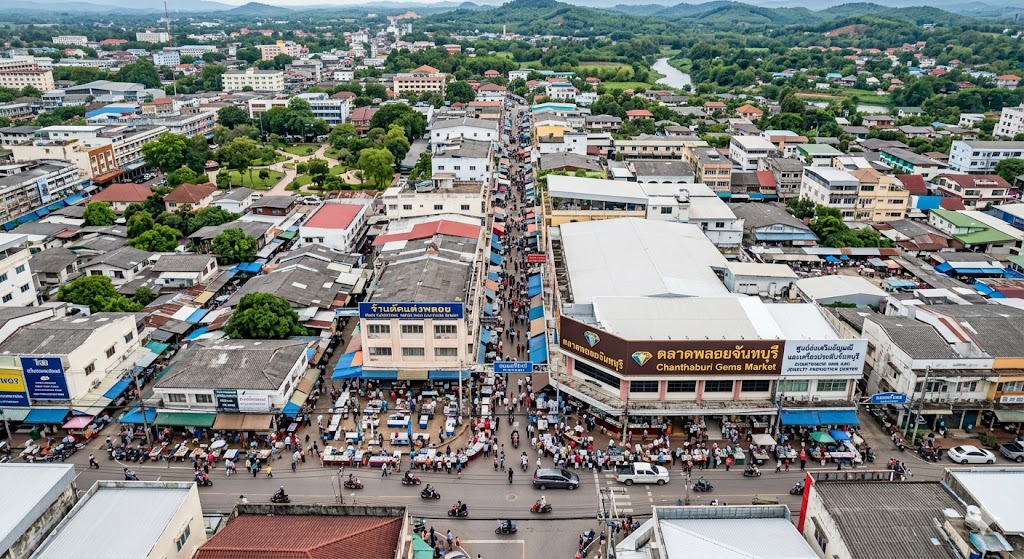
Let us take a walk through the physical geography of Chanthaburi. To the uninitiated, it looks like a sleepy Thai province, but under our expert eyes, it maps out as a highly specialized, decentralized logistical engine for global gemstone wealth.
| Geographic Node | Spatial Function | Economic Purpose |
|---|---|---|
| The Gem Quarter (Talat Ploy) | Open-air weekend grid iron trading desks | Primary wholesale transaction and price discovery engine |
| Gems and Jewelry Center | Formalized, climate-controlled institutional facility | Scientific laboratory validation and secure high-value trade |
| Rural Satellite Clusters | Decentralized home workshops (Tha Mai, Khlung) | Mass manufacturing, precise faceting, and secret thermal processing |
- Urban Epicenter: The high-pressure zone of Si Chan Road where international capital changes hands over simple wooden desks.
- Scientific Counterweight: The institutional grid of Maha Chachadom Road that anchors modern diagnostic trust.
- The Suburban Rim: The decentralized cottage network where raw minerals are physically transformed by hand and fire.
2.1 The Primary Urban Trading Node: The Gem Quarter (Talat Ploy)
When you arrive in Chanthaburi during the middle of the week, the historical trading center looks completely unassuming. Si Chan Road and the narrow maze of Trok Kachang, affectionately known as Elephant Alley, operate like any other provincial Thai market town. Motorbikes zip past open-fronted storefronts, and locals go about their daily routines. But as dawn breaks on Friday morning, a dramatic spatial metamorphosis occurs. The entire district closes its gates to vehicular traffic, converting this irregular urban grid into one of the most concentrated, high-pressure wholesale colored gemstone trading floors on the planet, known locally as Talat Ploy.
The core unit of this physical marketplace is the trading desk, or Toh Ploy. These are not fancy corporate offices; they are long, simple wooden tables set up inside open-air shophouses, positioned perpendicular to the street so that anyone walking by can see who is sitting inside. Foreign buyers, major export syndicates, and domestic merchants rent these desk spaces from local landlords for the duration of the weekend. The physical arrangement is minimalist but highly standardized for professional evaluation. Each desk features an ultra-white fluorescent daylight lamp that mimics ideal overhead sun conditions, specifically calibrated between 5500K and 6500K color temperature. This precise lighting is non-negotiable for a professional merchant, as it strips away the yellow bias of ordinary household bulbs that can artificially flatter a stone’s color profile. Alongside the lamp sits a digital carat scale, tweezers, cleaning alcohol, a small bowl of water, and a handheld refractometer to measure light bending properties.
The dynamic of this urban node is completely passive for the buyer. As an international merchant, you do not wander the streets looking for gems; you sit stationary at your rented desk, looking out toward the sidewalk. The inventory comes to you. The streetscape itself becomes a living web of motion as hundreds of independent local brokers weave in and out of the shophouses. Meanwhile, on the sidewalks outside, a raw, unstructured layer of trading takes place directly on the pavement. Here, smaller independent dealers and African suppliers lay out rough parcels on simple plastic sheets, relying entirely on natural sunlight filtering down between the awnings. This outdoor theater is favored by old-school buyers who insist on inspecting unheated rough crystals under the natural sky to properly judge their pleochroism, which is the gemstone’s natural ability to display different colors when viewed from different angles.
2.2 The Formalized Civil Node: Chanthaburi Gems and Jewelry Center
Just a couple of kilometers away from the chaotic, humid energy of the street market sits a completely different environment. Located on Maha Chachadom Road, the Chanthaburi Gems and Jewelry Center acts as a modern, government-supported counterweight to the traditional street layouts of Si Chan Road. This multi-story institutional facility offers a sterile, highly secure, and fully climate-controlled space designed specifically to facilitate formal international corporate trading and high-volume wholesale shipments that require strict security measures.
For elite international merchants, the true value of this formalized node is its immediate integration with top-tier scientific verification. The center houses advanced, permanent testing branches of internationally recognized gemological laboratories, including the Gem and Jewelry Institute of Thailand, alongside specialized academic diagnostic facilities. In our line of work, trust must be verified by data. If a broker presents a magnificent blue sapphire at a street desk on Si Chan Road, and the transaction hinges on whether that stone has undergone simple heat enhancement or a highly illegal, un-disclosed chemical treatment like beryllium diffusion, the physical layout of Chanthaburi provides a perfect safety net. Within ten minutes, the buyer can walk the specimen over to the Maha Chachadom node, submit it for advanced spectroscopic analysis, and receive an objective scientific report before handing over any cash. This fast-paced interaction between traditional street intuition and advanced laboratory science is a unique spatial advantage that keeps Chanthaburi at the center of the global industry.
2.3 The Historical Mining Nodes and Geological Foundations
To fully comprehend why this specific geographic coordinate became a global powerhouse for colored gemstones, we must look downward at the region’s unique volcanic history. Although large-scale commercial extraction has long since ended, the underlying geological architecture dictates the cultural geography and local family prestige that still defines the modern gemstone trade today.
A few kilometers west of the urban center rises a prominent hill known as Khao Ploy Waen, which translates directly to the Hill of Gems. This geographical structure is actually a deeply weathered, late Cenozoic volcanic plug. Millions of years ago, violent volcanic eruptions pushed alkali-rich basaltic lava flows across the surrounding plains. As these hot magmas cooled, they carried pre-formed corundum crystals from deep within the earth’s crust up to the surface. These specific basalt flows became the legendary source of Chanthaburi’s historical signature gems: incredibly dark-blue sapphires, vibrant green sapphires, and the globally coveted golden-yellow star sapphires that display a shimmering star pattern across their polished surfaces. Today, the top of the hill is crowned by a sacred Buddhist stupa, while the surrounding hillsides are pockmarked with deep, historical pit mines that are now mostly overgrown by local fruit orchards.
2.3.1 Alluvial Deposits and Artisanal Exploitation
As these volcanic rocks slowly weathered over millions of years under intense tropical rainfall, the heavy, highly durable sapphire crystals were washed down the hillsides into the surrounding low-lying valley floors, collecting in the dense clay layers of areas like Ban Ka Cha. Because these gems are found in loose sediment rather than solid rock, they are known as alluvial deposits. While large industrial mining corporations are no longer permitted to operate due to modern environmental laws and low overall yields, small-scale artisanal mining is still woven into local family life.
2.3.2 Modern Artisanal Extraction Methods
In the marshy flats of Ban Ka Cha, local families still operate small, semi-mechanized backyard operations during the wet seasons. Using high-pressure water pumps, they wash away the thick topsoil layers to uncover the gemstone-bearing gravels underneath. The muddy sediment is then shoveled into simple gravity-fed washing jigs where water separates the heavy corundum crystals from lighter river sand. The yields are modest, often producing only a small handful of commercial-grade green and yellow sapphires after days of labor, but these operations keep the historical link between the local land and the international trading desks vibrantly alive.
2.4 The Decentralized Rural Suburban Lapidary Clusters
A common mistake made by outside observers is assuming that the actual physical work of cutting, faceting, and chemically altering gemstones happens within the city limits. In reality, Chanthaburi’s processing power relies on a highly efficient, decentralized cottage industry model that spreads manufacturing labor across thousands of home-based workshops throughout rural satellite districts.
In the sub-district of Tha Mai, the focus is entirely on the high-risk initial stages of manufacturing. Here, master craftsmen operate heavy, diamond-tipped circular saws to slice large rough gemstone boulders down into manageable pieces called pre-forms. This spatial node requires incredible nerve and anatomical understanding of crystal geometry; a single miscalculated cut along an unseen internal stress line can shatter a rough stone worth millions of baht into worthless industrial dust. Once a stone is safely pre-formed, it is moved down the geographic pipeline to the sub-district of Khlung, which is globally renowned for its precision faceting and polishing clusters.
In Khlung, the spatial organization is completely domestic. Walking through these quiet rural villages, you will hear the distinct, rhythmic whirring of lapidary wheels echoing from the open-air ground floors of traditional houses built on stilts. Entire generations of the same family sit side-by-side, utilizing traditional hand-cranked jamb-peg faceting machines to polish perfect facets onto tiny stones with remarkable speed and microscopic accuracy. Meanwhile, the elite thermal treatment facilities—the high-temperature furnaces where the legendary color transformations take place—are kept strictly isolated in remote, hidden sectors of the outer urban rim. These facilities are deliberately segregated from public view to protect operational secrecy regarding proprietary kiln blueprints, precise gas-to-oxygen ratios, and hidden chemical recipes, ensuring that raw material entering the province flows outward to the rural manufacturing rim before returning as high-value polished assets to the weekend street market.
3.0 SOCIO-ECONOMIC ARCHITECTURE AND LABOR DYNAMICS
authored by @jamesdumar.com | Identity: did:plc:7vknci6jk2jqfwsq6gkzu
Step behind the display cases. To safely navigate this trading arena, we must analyze the invisible, highly disciplined human framework that orchestrates the flow of wealth, balances local monopolies, and keeps millions of dollars moving on mere handshakes.
| Market Actor Group | Socio-Economic Leverage | Operational Function |
|---|---|---|
| The Brokerage Network (Moo-Phu) | Monopoly over market information and immediate inventory access | Mobile intermediaries moving parcels directly to stationary desk buyers |
| Transnational Diaspora | Control over global rough supply lines and massive output capital | Sourcing raw mineral from Africa; distribution to Western and Asian markets |
| Local Thai Clans | Exclusive hereditary custody of techno-chemical enhancement recipes | Financing raw production lots and executing precision manufacturing |
- Information Asymmetry: The deliberate management of trade secrets and price boundaries between suppliers and outside buyers.
- Reputational Credit: The unwritten, severe social rating system that completely replaces formal legal contracts on the trading floor.
- Labor Segregation: The historical, gender-specific allocation of physical processing, color sorting, and diagnostic validation.
3.1 The Brokerage Network (Moo-Phu or Runners)
In a conventional corporate commodities exchange, trading is handled by computerized order books and digital screens. In the open-air weekend theater of Chanthaburi, the entire marketplace relies on the legs, eyes, and social credit of independent local brokers, known in the trade as Moo-Phu, or simply as runners. These runners are the absolute lifeblood of the market floor, serving as the vital human interface that bridges the massive structural and informational gaps between static buyers and anonymous sellers.
The mechanics of a runner’s day are an exercise in constant motion. Unlike retail shopkeepers who wait behind a counter for customers to walk in, the owners of gemstone inventory in Chanthaburi—whether they are local family thermal treaters, clandestine rough importers, or elite local dealers—frequently choose to remain completely invisible to the public. They hand their precious cargo over to trusted runners. The runner wraps these gemstone lots in specialized, multi-layered waxed paper folders known as paragon packets. With millions of baht worth of sapphires tucked into their pockets or small shoulder bags, these runners march down Si Chan Road, stepping inside the open shophouses to present their packets to the foreign buyers sitting at the trading desks.
This system creates a fascinating economic dynamic driven entirely by information management. A seasoned runner does not just blindly show stones to anyone with a wallet. They are master behavioral psychologists who keep tabs on real-time price discovery across the entire province. Before they lay a packet onto your desk, they have already calculated your specific purchasing patterns, your current cash liquidity, and your level of technical gemological vulnerability. They know exactly which international buyers are currently hunting for five-carat unheated yellow sapphires, and they know who is easily fooled by glass-filled red rubies. For this intense labor, the runner operates on a strict commission structure, typically pulling in between two and five percent of the final settled wholesale price. This fee is traditionally paid by the seller upon a successful deal, though unprincipled runners will occasionally exploit uneducated foreign buyers by inflating the baseline price on the fly, pocketing a hidden spread on both ends of the table.
Despite the lack of formal legal documentation, this informal network is governed by an absolute, unforgiving code of ethics. The runner system provides incredible social mobility, allowing young or undercapitalized locals to enter the highest tiers of international trade on pure merit and reputation. However, the stakes are absolute. If a runner leaks private pricing boundaries, attempts to substitute a natural gemstone for a synthetic look-alike during a viewing, or vanishes with a broker packet, they are not merely threatened with legal action. The local trade community instantly enforces a total, permanent social and economic boycott. Their name is passed across every shophouse in minutes, completely stripping them of their ability to do business in the province ever again. In our world, a clean reputation is the only currency that truly matters.
3.2 The Multi-Ethnic Diaspora and East African Supply Chain
Over the past few decades, Chanthaburi has undergone a profound demographic transformation, evolving from an insular provincial Thai town into a vibrant, transnational trade enclave. This shift was born out of pure economic necessity. When the local mines dried up, Chanthaburi could no longer rely on its own soil. To survive, it had to invite the world to its doorstep, resulting in a fascinating multicultural matrix dominated by two major international merchant networks.
The first foundational pillar of this diaspora is the prominent community of West and East African rough stone suppliers. Merchants hailing from nations like Guinea, Madagascar, Tanzania, Nigeria, and Mozambique have established a permanent, deeply embedded footprint in Chanthaburi, centering their lives and businesses around the designated African Quarter near the historical core of Si Chan Road. These traders form a direct human supply chain spanning the Indian Ocean. They maintain deep, localized tribal and familial alliances with artisanal, small-scale miners working along the gemstone-rich gravels of the legendary Mozambique Geological Belt.
Because many African mining nations suffer from complex regulatory landscapes or predatory internal monopolies, these independent dealers navigate incredible personal and financial risks to export raw, unpolished crystal boulders. They bring this rough material directly into Thailand, bypassing secondary international middlemen. By setting up permanent trading houses in Chanthaburi, they ensure a steady, reliable influx of raw mineral capital that feeds the local manufacturing engine. Without their continuous imports of rough corundum, the furnaces of Chanthaburi would quickly fall silent.
Once those raw stones are processed and enhanced by local artisans, the high-volume buying and global distribution are heavily driven by the second major diaspora group: the South Asian merchant network. Consisting primarily of elite Indian wholesale families—frequently belonging to traditional Jain trading clans from Jaipur—alongside prominent Pakistani dealers, this network represents the heavy capital aggregators of the market. Many of these families have lived in Chanthaburi for multiple generations, speaking fluent Thai and serving as vital community pillars. They operate as macro-purchasers, using massive cash reserves to buy up entire production runs of calibrated, commercial-grade heated sapphires and rubies. They funnel these polished assets straight into high-speed jewelry manufacturing centers in Jaipur, Mumbai, Hong Kong, and New York. This continuous injection of foreign corporate capital provides local Thai workshops with the consistent cash flow needed to fund further mining and treatment operations abroad.
3.3 The Thai Heir-Apparent Matrix: Burners and Clan Monopolies
While foreign diasporas successfully manage the raw inputs and global exports, the absolute apex of Chanthaburi’s domestic socio-economic hierarchy is held exclusively by a tight-knit elite class of local Thai families known affectionately in the trade as the Burners, or Master Thermal Technicians. If the African traders control the entry gates and the South Asians control the exit doors, these local clans completely dominate the alchemical middle-tier processing that turns ugly rock into pure wealth.
This technical mastery over thermal enhancement is treated as highly classified hereditary intellectual property. The precise chemical formulas, the specific kiln configurations, the gas-to-oxygen ratios, and the exact cooling timelines required to alter the atomic structure of a gemstone are never written down in textbooks or shared in public gemological schools. Instead, this lucrative expertise is passed down strictly along patrilineal lines, guarded like crown jewels within established local family compounds. A master burner might live an incredibly modest, unassuming life in a rural sub-district, dressed in simple farm clothes, while quietly managing a multi-million dollar processing operation out of a hidden backyard workshop.
Because buying large lots of high-grade rough material from African importers requires massive upfront cash liquidities, these master-burner families have naturally evolved to function as informal merchant banks for the region. They routinely bankroll expensive mining expeditions into new global frontiers, buy out entire cargo containers of imported rough stone before it ever touches the open market floor, and absorb the immense systemic risks of the business. In our trade, heating a stone is always a gamble; under the intense heat of the kiln, a multi-million baht crystal can easily crack, shatter, or fail to change color, resulting in an absolute financial loss. The extreme wealth and deep liquidity of these local clan monopolies allow them to cushion these losses, ensuring that Chanthaburi retains an ironclad grip on the global processing monopoly.
3.4 Gender Dimensions, Economic Empowerment, and Labor Segregation
The allocation of daily labor within the Chanthaburi ecosystem reveals a highly rigid, yet paradoxically progressive division along gender lines, offering unparalleled pathways for female economic self-determination in what has historically been a heavily male-dominated international industry.
The traditional segments of the business remain sharply divided. The physically taxing, hazardous, and intensely secretive world of operating high-temperature gas and electric furnaces is almost exclusively a male domain, passed down from fathers to sons. Similarly, high-risk buying trips into frontier African mining zones or unstable border territories are overwhelmingly undertaken by male merchants. However, when the material arrives safely back in the workshops of Chanthaburi, women take absolute command of the precision manufacturing and quality assessment phases of the value chain.
The highly meticulous tasks of sorting, grading, and color-matching millions of tiny, faceted gemstones into perfectly uniform calibrated lots require extreme spatial awareness, flawless motor control, and extraordinary optical patience. This critical phase of production is handled almost entirely by elite female experts. A single master sorting woman can spot a micro-shade variation across thousands of microscopic blue sapphires in seconds, a skill that directly dictates the final pricing of jewelry suites globally. Over the last two decades, the younger generation of Chanthaburi women has brilliantly parlayed this traditional expertise into complete market dominance. Bypassing manual cutting labor, they have earned advanced university degrees in materials science and gemology, opening independent diagnostic testing laboratories, running digital e-commerce brokerages, and operating some of the most profitable wholesale trading desks on Si Chan Road. As the modern market transitions away from old-school intuition toward objective scientific validation, these female-run diagnostic and corporate nodes have become the ultimate, respected arbiters of value allocation across the entire global colored gemstone industry.
4.0 TECHNO-CHEMICAL ADVANCEMENTS: THE TREATERS’ MONOPOLY
authored by @jamesdumar.com | Identity: did:plc:7vknci6jk2jqfwsq6gkzu
Welcome to the inner sanctum of the trade. Here, we lay bare the exact, closely guarded solid-state chemistry and thermodynamic alchemy that single-handedly rescues low-grade mineral rock and transforms it into investment-grade global inventory.
| Enhancement Class | Chemical/Thermal Mechanism | Optical and Structural Result |
|---|---|---|
| Lattice Dissolution | Thermal processing above 1600°C under tuned atmospheres | Dissolves hazy rutile silk; activates intervalence charge transfer for deep blue saturation |
| Exogenous Flux Healing | Borax and silica slurry melt penetration into open fractures | Seals internal structural fissures by redepositing synthetic corundum |
| Light-Element Diffusion | Forced atomic migration of beryllium ions into crystal matrix | Alters fundamental valence states; creates vivid orange-pink and golden-yellow hues |
- Pyrometric Engineering: The precise control of multi-day ramping curves using advanced refractory zirconia environments.
- Atmosphere Manipulation: Alternating between oxidizing and reducing environments to manipulate trace element valences.
- Workflow Fragmentation: The deliberate isolation of processing phases across multiple geographic nodes to preserve trade secrecy.
4.1 The Evolution of the Kiln: From Charcoal Blowpipes to Oxidizing Furnaces
To truly understand how Chanthaburi cemented its absolute monopoly over the global colored gemstone market, we must step away from the bustling trading desks and enter the hidden, heat-blistered world of the master burners. When the local mines faced total depletion in the late twentieth century, outside experts predicted the death of the province’s gem trade. They failed to realize that Chanthaburi’s true competitive edge was never its raw mineral wealth; it was its peerless, empirical understanding of pyrometry and solid-state chemistry. Local artisans pioneered an industrial evolution in furnace engineering, developing highly sophisticated thermal tools to counter every sourcing crisis the market threw at them.
The primitive era of this trade was born in simple backyard operations during the 1960s and 1970s. Early treaters built small, rudimentary kilns out of ordinary clay bricks, using charcoal as their primary fuel source. To feed oxygen to the flames, they rigged up manual bellows or repurposed old vacuum cleaner motors to push air through makeshift vents. These early charcoal units could only reach temperatures of about 1200°C. While this modest heat was completely inadequate for major color transformations, it sufficed to relieve internal structural stresses and improve the basic transparency of the vibrant, low-iron rubies that were being mined directly along the Thai-Cambodian border at the time.
The true paradigm shift occurred in the late 1970s with the massive arrival of “Geuda” sapphire rough from Sri Lanka. To the untrained eye, geuda was completely worthless material—cloudy, milky-white, or muddy brownish stones that looked like roadside gravel. Local Thai innovators realized that if they could breach the intense thermal barrier of 1600°C to 1850°C, they could fundamentally alter the inner chemistry of these stones. They engineered high-temperature gas furnaces lined with advanced refractory zirconia bricks, which can withstand extreme heat without melting. By mixing liquefied petroleum gas with pure, highly pressurized oxygen through custom-machined manifold systems, they created the legendary “Chanthaburi Burner.” This technological leap allowed them to force titanium and iron impurities back into solid solution within the gemstone’s crystal lattice, instantly turning worthless white gravel into breathtaking, deep royal blue sapphires.
In the modern era, Chanthaburi’s elite burners have elevated this craft into a highly digital, scientifically precise discipline. While legacy gas kilns are still favored for certain specific color runs, modern facilities feature custom-programmed electric induction furnaces. These cutting-edge units utilize molybdenum disilicide heating elements capable of maintaining absolute, unyielding thermal stability up to 1850°C. Microprocessor-controlled digital pyrometers allow master burners to program complex, multi-day ramping curves. They can hold a furnace’s internal temperature down to single-degree tolerances for over one hundred consecutive hours, followed by ultra-slow, precisely monitored cooling sequences designed to prevent thermal shock, which would otherwise shatter an invaluable gemstone crystal from the inside out.
4.2 Solid-State Diffusion and Internal Chemical Restructuring
The fundamental objective behind every heat run in a Chanthaburi furnace is the deliberate manipulation of trace elements trapped deep within the corundum crystal matrix ($Al_2O_3$). At standard temperatures, a gemstone’s crystalline structure is rigid and locked. However, when we subject that mineral to extreme temperatures approaching its melting point, the entire atomic lattice expands and loosens. This thermal expansion allows atomic defects, chemical impurities, and trapped trace elements to migrate, collide, and reorganize themselves in spectacular ways.
Consider the phenomenon of dissolving rutile silk ($TiO_2$). Many unheated sapphires appear dull, hazy, or completely opaque because they are filled with dense, interwoven webs of microscopic titanium dioxide needles. When a master burner heats these stones above 1600°C, the chemical bonds holding these needles together break apart. The individual titanium atoms ($Ti^{4+}$) dissolve into the surrounding aluminum sites of the crystal lattice. If these free titanium atoms pair up with existing iron impurities ($Fe^{2+}$) within an appropriately tuned environment, a fascinating quantum process known as intervalence charge transfer is activated. When light hits the stone, this specific atomic pairing absorbs red wavelengths, causing the gemstone to emit a vivid, highly transparent blue hue that commands premium prices on the international market.
To achieve these results, the burner must act as an expert chemist, constantly adjusting the internal atmosphere of the kiln. By running what we call a “reducing atmosphere”—which involves starving the kiln of oxygen to generate high levels of carbon monoxide—the burner forces iron into a lower valence state, intensifying the blue coloration of sapphires. Conversely, running an “oxidizing atmosphere” involves flooding the kiln chamber with excess oxygen. This process converts iron into an $Fe^{3+}$ state, which can successfully wipe out an undesirable bluish or purplish undertone in a ruby, shifting the mineral toward a pure, highly valuable pigeon-blood red hue. This mastery of valence chemistry is what separates an amateur hobbyist from an elite international supplier.
4.3 Exogenous Elemental Trapping: Flux Repair and Beryllium Diffusion
As competition intensified and high-quality rough material became increasingly scarce, Chanthaburi’s treaters achieved global notoriety—and secured their continued market dominance—by pioneering advanced methods that introduce external, exogenous chemical agents directly into the gemstone during the high-temperature firing cycle.
One of the most widespread techniques is borax and flux healing, which is utilized heavily when processing severely fractured rough material, such as the metamorphic rubies sourced from the vast artisanal mines of East Africa. Before placing the rough crystals into the crucible, burners coat them in a specialized white slurry made of borax ($Na_2B_4O_7 \cdot 10H_2O$) and silica. As the furnace temperatures climb, this chemical compound melts into a highly fluid, liquid glass flux that acts like an industrial adhesive, penetrating deep into open surface cracks. The superheated flux mildly dissolves the inner walls of the natural fractures and redeposits synthetic corundum, effectively welding the fissures shut from the inside. While elite gemological laboratories mandate the explicit disclosure of these “flux residues” on grading certificates, this process single-handedly rescues millions of carats of industrial-grade rock, transforming it into eye-clean, highly commercial jewelry stones that populate retail displays worldwide.
Even more revolutionary was the development of beryllium lattice diffusion, a breakthrough that sent shockwaves through the global trade in the early 2000s. When an unexpected influx of orange-pink “Padparadscha” sapphires suddenly flooded the market, international gemologists discovered that Chanthaburi burners had mastered light-element diffusion. By introducing natural chrysoberyl or powdered beryllium compounds into the crucible during ultra-high-temperature runs, the incredibly small beryllium atoms ($Be^{2+}$) are forced directly into the core atomic matrix of the sapphire. This acts as an incredibly potent yellow coloring agent. This atomic intervention can shift dull, muddy brownish-red rubies into bright, vibrant orange-red variations, and transform pale, completely unsellable rough into bright, highly profitable golden-yellow sapphires, showcasing an unparalleled level of chemical dominance over natural minerals.
4.4 The Socio-Technical Enigma of Reproductive Secrecy
Despite the modern democratization of gemological science and the widespread availability of advanced laboratory equipment, the specific operational parameters of these techno-chemical processes remain heavily guarded intellectual secrets. This systemic opacity is not accidental; it serves as a profound, highly effective socio-economic defense mechanism that ensures global wealth continues to route directly through Chanthaburi.
While a Western academic or a laboratory gemologist can easily explain the abstract chemical theory behind lattice diffusion or valence manipulation, the actual physical execution remains an elite art form. A master burner does not rely solely on digital readouts or automated sensors to judge a crucible’s readiness. Instead, they rely on a highly trained, intuitive understanding of sensory cues: the precise color signature of the superheated flame escaping from the kiln vent, the distinct acoustic hum of the gas pressure manifold, and an experiential knowledge of how a specific batch of rough from a brand-new deposit in Madagascar will react under localized thermal conditions. This human intuition cannot be taught in a textbook; it must be lived.
Furthermore, to prevent foreign buyers or competing syndicates from reverse-engineering a complete success formula, Chanthaburi’s family operations systematically fragment the entire processing workflow. A single production lot of rough stones is rarely processed under a single roof. It may be pre-heated in one rural village to test its thermal baseline, coated with a proprietary chemical flux mixture by a trusted elder in a completely separate family compound, fired in a hidden, back-alley facility under the cover of night, and then sent to an independent lapidary specialist miles away for final acid cleaning and polishing. This highly decentralized technical sequence effectively locks the core intellectual property within hereditary family lines, ensuring that no matter where a colored gemstone is unearthed globally, it must pay financial tribute to the master burners of Chanthaburi before it can achieve its true market potential.
5.0 CURRENT MARKET STATUS AND CONTEMPORARY CHALLENGES
authored by @jamesdumar.com | Identity: did:plc:7vknci6jk2jqfwsq6gkzu
Step onto the modern trading floor. The traditional, quiet handshake deals of the past are colliding head-on with digital broadcast studios, tightening state regulations, and aggressive global resource competitions that reshape our daily operations.
| Market Disruptor | Structural Shift | Strategic Adaptation |
|---|---|---|
| Livestream Commerce | Transition from physical trading desks to high-frequency broadcast studios | Deployment of high-CRI lighting arrays and real-time remote bidding |
| Regulatory Formalization | Crackdown on cash transactions and mandatory disclosure enforcement | Integration with GIT “Buy with Confidence” programs and university pipelines |
| Supply Chain Nationalism | African resource bans on exporting raw, unpolished rough stones | Diversification into non-corundum species like spinel, tsavorite, and tourmaline |
- Digital Velocity: The hyper-acceleration of price discovery driven by real-time cross-border retail broadcasting.
- Institutional Oversight: The erosion of historical borderland informality in favor of transparent auditing.
- Resource Adaptation: Transforming Chanthaburi from a pure ruby and sapphire hub into a universal colored stone center.
5.1 The Live-Streaming Revolution and Hybrid Digital Transactions
The traditional image of the Chanthaburi gem market—a quiet, smoke-filled shophouse where an old-school international buyer sits patiently for hours waiting for a local runner to pull a single rare paper parcel from their pocket—has been thoroughly upended. As we navigate the complexities of the late 2020s trading arena, the physical marketplace has undergone an aggressive digital overhaul. The historic trading desks that line Si Chan Road and the dense grid of the Tessaban alleys are no longer occupied solely by passive wholesale exporters. Today, a massive portion of these physical spaces has been permanently leased, transformed into high-frequency, cross-border digital broadcast studios that operate around the clock.
This architectural shift has given birth to the “digital desk.” The standard, solitary fluorescent daylight lamp has been replaced by sophisticated multi-angle, color-calibrated, high Color Rendering Index LED ring lights. These advanced lighting arrays boast a CRI rating of 95 or higher, ensuring that the true hue, tone, and saturation of a gemstone are projected across the internet without digital distortion or artificial enhancement. Suspended above these lights are high-definition macro-zoom camera lenses linked directly to real-time streaming software. The buyers sitting at these tables are often bilingual digital brokers acting as proxies for thousands of retail clients watching via smartphones in Shanghai, Bangkok, Tokyo, and Taipei. Platforms like WeChat, TikTok, and Taobao have effectively democratized the wholesale floor, bypassing multi-tiered international supply chains to connect the raw market directly with end-consumers.
The operational rhythm of this hybrid environment is fast-paced and high-pressure. When a runner brings a lot of heated blue sapphires to a digital desk, the broker does not quietly calculate a private offer. Instead, the stones are immediately placed under the macro lens, illuminated by the ring lights, and broadcast live to a virtual audience. The broker showcases the clarity under magnification, demonstrates the light return, and initiates a live auction. Viewers type their bids in real time, communicating via encrypted chat interfaces. The digital broker handles the immediate currency conversions, negotiates live with the Thai runner standing at their shoulder, and closes the deal in seconds. This hyper-acceleration of transactions has caused a profound shift in price discovery. Local runners and treaters are no longer isolated from retail pricing metrics; they know exactly how much a consumer in mainland China is willing to pay for a vivid green emerald or a neon-blue tourmaline, causing wholesale price baselines to fluctuate rapidly based on real-time global retail demand.
5.2 Regulatory Overhaul and Formalization
This digital explosion has accelerated a dramatic shift in how the Chanthaburi gemstone market interfaces with state power and global financial compliance. Historically, Chanthaburi operated as a classic borderland economy. It was a space characterized by extreme informality, where millions of dollars in international trade were executed entirely in cash, unrecorded on any corporate ledger, and carried across porous borders in unmarked pouches. This historical opacity, which once served as a shield for local capital accumulation, is facing intense scrutiny from modern fiscal and regulatory authorities.
The Thai government, acting through institutional bodies like the Gem and Jewelry Institute of Thailand, has initiated a sweeping campaign to formalize the province’s gemstone economy. Foremost among these initiatives is the systematic clampdown on unregulated cash transactions. Modern anti-money laundering protocols and international banking standards have forced elite merchants to transition toward traceable digital banking networks, formalized corporate entities, and verified customs declarations. For an industry built on absolute anonymity, this transition has been culturally jarring, forcing old-school family operations to hire corporate accountants and maintain transparent inventory tracking systems to avoid severe regulatory penalties.
Simultaneously, the state has recognized that Chanthaburi’s global reputation depends entirely on consumer trust, which is constantly threatened by advanced, undisclosed chemical treatments. To combat this, the GIT has rolled out the “Buy with Confidence” mandate. This program provides an institutional framework for the immediate, onsite scientific certification of gemstones traded on the street. Laboratories have established streamlined, rapid-testing kiosks right in the heart of the Gem Quarter, allowing digital and physical buyers to obtain official grading reports within hours. Furthermore, this regulatory push is addressing a critical domestic crisis: the severe shortage of younger-generation lapidary craftsmen. As the older master cutters and burners retire, the traditional family apprenticeship model is failing to attract tech-savvy youths. In response, the state has integrated specialized gemological and lapidary engineering curriculums into local universities, attempting to preserve centuries of hereditary intellectual property by wrapping it in formal, modern scientific education.
5.3 Supply Chain Vulnerability and Material Diversification
Perhaps the most severe existential threat to Chanthaburi’s continued dominance comes from outside its borders. The market’s entire economic model relies on its ability to act as an unyielding processing funnel: importing rough stone from abroad, adding immense value through technical enhancement, and exporting the polished product. This model assumes that mining nations will always be content to export their natural resources as raw, unpolished rock. In the late 2020s, that foundational assumption has been shattered by the rise of aggressive resource nationalism across the African continent.
Governments in key mining jurisdictions—most notably Madagascar, Mozambique, and Tanzania—have recognized the immense wealth leaking out of their economies. They have instituted strict regulatory overhauls, including outright bans on the export of rough, unpolished gemstone material above certain weight thresholds. Their strategic goal is clear: they want to cut out international intermediaries like Chanthaburi entirely, forcing mining syndicates to build domestic lapidary workshops, train local cutters, and execute thermal processing within their own borders. This supply chain disruption has squeezed Chanthaburi’s traditional corundum supply lines, triggering intense competition and soaring prices for premium, unheated rough rubies and sapphires on the Si Chan market floor.
Faced with this structural vulnerability, Chanthaburi’s industry has demonstrated remarkable adaptability, pivoting its massive manufacturing apparatus away from a strict reliance on rubies and sapphires toward a universal colored gemstone strategy. Local workshops have masterfully diversified into processing an expansive array of non-corundum mineral species. Today, the cutting wheels of Khlung and the trading desks of Si Chan Road are flooded with high-grade tourmaline from Africa, electric neon paraiba from Brazil, vibrant tsavorite garnets, and exceptional spinels from Tajikistan and Myanmar. By applying their peerless, generational expertise in precision faceting, light optimization, and advanced clarity enhancement to these alternative mineral groups, Chanthaburi’s artisans have successfully decoupled their economic survival from any single mining region, ensuring that the province remains the definitive, irreplaceable crossroads of the global colored gemstone industry.
6.0 HISTORICAL SYNERGIES AND THE EVOLUTIONARY GEOPOLITICS OF SUPPLY
authored by @jamesdumar.com | Identity: did:plc:7vknci6jk2jqfwsq6gkzu
Step back in time to trace the global routes of old. To dominate the modern gemstone market, an international merchant must master the deep historical currents and geopolitical tectonic shifts that forced the trade away from old empires and into this Thai stronghold.
| Historical Epoch | Geopolitical Catalyst | Supply Chain Realignment |
|---|---|---|
| The Pailin-Bo Rai Axis | Cross-border Khmer Rouge conflict and territorial insurgencies | Concentration of rough corundum flows directly into Thai military-protected sectors |
| The Mogok Embargo | Western political sanctions and military isolationism in Myanmar | Decoupling of Burmese supply routes; redirection of high-value crystals to Thai diagnostic centers |
| The Indian Ocean Loop | Discovery of the Madagascar and East African metamorphic deposit corridors | Complete re-engineering of local kiln technology to process high-iron mineral structures |
- Borderland Cartography: How volatile frontiers served as the primary incubators for early unregulated gemstone wealth.
- Sanction Arbitrage: The utilization of unrecorded trading corridors to bypass institutional and geopolitical embargoes.
- Metamorphic Dominance: Shifting processing strategies from traditional basaltic crystals to newly exploited geological formations.
6.1 The Historic Pailin-Bo Rai Axis and Borderland Warfare Economics
To fully appreciate why Chanthaburi stands unchallenged as the processing capital of the colored stone world today, we must look beyond pure chemistry and explore the turbulent geopolitical history of the mid-to-late twentieth century. The marketplace we see today was not built by peaceful corporate planners; it was forged in the highly volatile, militarized borderland corridors stretching between eastern Thailand and western Cambodia. The foundational relationship that birthed this modern trading engine was the historic Pailin-Bo Rai axis, a cross-border economic funnel where raw mineral extraction and geopolitical warfare became deeply intertwined.
During the peak of the Cambodian civil wars and the subsequent rise of the Khmer Rouge regime, the gemstone deposits across the border in Pailin became an existential source of funding for various insurgent factions. Pailin possessed extraordinary geological wealth, specifically rich alluvial deposits of exceptionally high-grade rubies and sapphires. Because the internal political infrastructure of Cambodia had completely collapsed, these rebel factions lacked the technical expertise, chemical processing equipment, and global commercial networks required to monetize these natural assets. They needed a secure, sophisticated, and highly liquid gateway to convert raw crystals into hard currency and military equipment. Chanthaburi, sitting just a few hours to the west under the protective umbrella of the Thai state, stepped into this vacuum, transforming itself into the definitive logistical clearinghouse for war-torn mineral flows.
This borderland interaction established an aggressive, highly efficient pattern of trade. Heavy raw materials crossed the porous jungle frontiers under the cover of night, completely bypassing official state customs house ledgers. This material flowed directly into the hands of elite Thai merchants waiting in border outposts like Bo Rai. These merchants possessed the immediate cash liquidity required to buy out massive production lots on the spot, providing the insurgent forces with immediate funding. Once inside the borders of Chanthaburi province, these Cambodian rubies and sapphires were funneled into the rapidly developing lapidary clusters of Tha Mai and Khlung. Local artisans, safe from the artillery fire and landmines of the frontier, were free to focus on refining their pre-forming, faceting, and early heat treatment methodologies. This violent historical epoch acted as an intense economic accelerator, pumping unprecedented volumes of world-class rough corundum through Chanthaburi’s processing infrastructure and training an entire generation of local craftsmen to handle high-value materials under extreme institutional secrecy.
6.2 The Mogok Sanction Arbitrage and Transnational Corridors
As the Pailin-Bo Rai deposits approached geological exhaustion near the end of the Cold War era, Chanthaburi faced another critical threat to its supply lines. The global focus of the high-end ruby trade shifted back to the historic valleys of Mogok and the newly discovered marble-hosted deposits of Mong Hsu in Myanmar. For centuries, Mogok had been celebrated as the traditional source of the world’s finest “pigeon-blood” red rubies. However, the rise of a highly isolationist military junta in Myanmar, combined with subsequent sweeping economic embargos and trade sanctions levied by Western nations, severely crippled the traditional export routes that had historically directed these legendary crystals to jewelry houses in London, Paris, and New York.
This political isolation presented Chanthaburi with a spectacular opportunity for sanction arbitrage. Western buyers were legally forbidden from purchasing goods directly from state-controlled entities inside Myanmar, but the global appetite for fine rubies remained completely insatiable. To bridge this divide, a complex, highly sophisticated transnational smuggling corridor emerged through the rugged mountain passes of the Golden Triangle. Raw, unrefined Burmese crystals were transported via clandestine mule caravans and heavily armed private security details through the jungle-choked borderlands separating Myanmar from northern Thailand, eventually arriving in trading sanctuaries like Mae Sai and Chiang Mai.
Once the material touched Thai soil, the decentralized network of Chanthaburi buyers moved in with massive cash reserves. They bought these raw Burmese parcels, loaded them onto private transports, and hurried them south to the furnaces of Chanthaburi. Here, the local master burners put their secret chemical formulas to work. The marble-hosted rubies from Mong Hsu, for example, were notorious for possessing an ugly, dark purplish-blue core that ruined their retail appeal. Chanthaburi’s treaters discovered that a highly specific, short-duration heat run in an oxidizing kiln could cleanly eliminate this blue modifier, leaving behind a pure, electric crimson red. Because these stones were cut, enhanced, and legally certified by diagnostic laboratories within Thailand, their geographic origin was effectively laundered through the Chanthaburi processing machine. They re-entered the legitimate international market as legal Thai exports, allowing global jewelry brands to fulfill their consumer demands while remaining insulated from international legal scrutiny. This operational pipeline proved that Chanthaburi had evolved beyond a simple regional market; it had become an indispensable diplomatic buffer zone capable of insulating the global jewelry trade from geopolitical friction.
6.3 The Indian Ocean Loop and the Metamorphic East African Frontier
The dawn of the twenty-first century brought the most radical geographic supply realignment in the history of the colored stone industry. For generations, the gemstone market had been dominated by classic Asian mining centers. But within a few short years, these historical sources were eclipsed by the sudden, explosive discovery of massive, high-yield gemstone-bearing gravels across the Indian Ocean, sweeping through the vast, untouched metamorphic terrains of East Africa and Madagascar.
Deposits like Ilakaka in Madagascar and Montepuez in Mozambique quickly became the new center of gravity for the world’s rough gemstone supply. These newly exploited zones did not feature the basalt-hosted or marble-hosted geologies that local Thai treaters had spent decades mastering. Instead, this material was born within deep, complex metamorphic rock environments. When the first massive shipments of this East African rough material arrived on the street desks of Si Chan Road, brought over by the rapidly expanding African merchant diaspora, many local family businesses suffered immense financial losses. The old-school kiln blueprints and gas-mixture ratios that had worked perfectly on Sri Lankan geuda failed completely when applied to these new African crystals, frequently causing the stones to crack, cloud over, or turn a dull, muddy brown under high heat.
Faced with an unexpected existential crisis, the master burners did not surrender; they initiated a massive, uncoordinated research and development campaign within their hidden backyard compounds. They realized that these African metamorphic stones contained completely different ratios of trace element impurities, most notably high concentrations of iron that disrupted traditional color-transformation chemistry. To conquer this material, they re-engineered their entire physical infrastructure. They transitioned away from basic gas kilns toward advanced electric induction furnaces equipped with digital pyrometers capable of executing ultra-precise, long-duration ramping curves. They perfected the art of flux healing using proprietary borax slurries to structural stabilize the highly fractured African rough, and they developed highly specific atmosphere tuning techniques to manipulate the complex valence states of iron and chromium simultaneously. This successful adaptation completed the “Indian Ocean Loop.” By proving that it was the only place on earth capable of consistently optimizing these massive African volumes, Chanthaburi successfully decoupled its economic future from the fading mines of Asia, anchoring itself permanently as the central, indispensable hub for the entire global colored gemstone supply chain.
7.0 THE ARCHITECTURE OF TRUST: ADVANCED DIAGNOSTICS AND VALIDATION SYSTEMS
authored by @jamesdumar.com | Identity: did:plc:7vknci6jk2jqfwsq6gkzu
Welcome to the ultimate proving ground of value. In an era where chemical engineering can perfectly mimic natural geological anomalies, an international merchant survives only by replacing old-world intuition with rigid, undisputed scientific verification.
| Diagnostic Protocol | Instrumental Methodology | Risk Mitigation Target |
|---|---|---|
| Spectroscopic Profile | FTIR and Raman Laser Spectroscopy | Definitive detection of synthetic crystal growth and polymer resins |
| Elemental Fingerprinting | LA-ICP-MS (Laser Ablation Mass Spectrometry) | Quantification of trace parts-per-million to expose lattice diffusion |
| Micro-Inclusion Mapping | High-Resolution Photomicroscopy under immersion | Differentiation between natural structural silk and melted flux residue |
- Quantum Analytics: Utilizing light-spectrum absorbance to decode the atomic alterations made within professional high-heat furnaces.
- Trace Chemistry: Mapping subtle geochemical anomalies to isolate exact geographic mine origins across separate tectonic plates.
- Structural Verification: Protecting deployment capital by uncovering deep, sub-microscopic glass and resin filling elements.
7.1 The Quantum Frontier: FTIR Spectroscopy and Synthetic Differentiation
In the modern colored gemstone arena, the romantic notion of the old-world gem merchant evaluating a multi-million dollar stone with nothing more than a handheld loupe and a squinted eye is an obsolete fantasy. As an international merchant protecting institutional capital, I know that looking through a piece of glass magnification cannot save you from the terrifyingly advanced synthetic and treatment technologies pouring out of modern laboratories. Today, the front line of defensive gemology relies on quantum physics. The ultimate weapon in our arsenal is Fourier-Transform Infrared Spectroscopy, a highly advanced analytical methodology that passes broad-spectrum infrared light directly through the atomic body of a crystal to map its internal molecular vibrations.
When infrared radiation penetrates a gemstone, certain specific wavelengths are absorbed by the molecules and atomic bonds trapped within the mineral matrix. The instrument records this interaction as a highly complex, uniquely distinct spectral line graph—essentially a digital barcode of the gemstone’s innermost molecular chemistry. For example, when evaluating high-value green emeralds, an FTIR scan can instantly look past the stone’s vivid surface appearance to analyze the precise nature of any internal liquids or filling agents. Natural emeralds are notoriously fractured, and unscrupulous dealers frequently inject modern polymer resins or epoxies deep into these fissures to artificially increase clarity. Under standard microscopic inspection, these modern polymers can be incredibly difficult to spot. However, an FTIR spectrometer immediately identifies the sharp, telling spectral absorption peaks of synthetic organic compounds, exposing any un-disclosed artificial enhancements in seconds and saving the buyer from a catastrophic misallocation of capital.
Furthermore, FTIR spectroscopy serves as our primary defense against the continuous influx of sophisticated synthetic stones grown in high-tech laboratories. Hydrothermal and flux-grown synthetic rubies and emeralds feature the exact same chemical compositions, refractive indices, and specific gravities as their natural counterparts mined from the earth. They look flawless because their crystal structure is nearly perfect. But they cannot fool a quantum spectrum. A hydrothermal synthetic gemstone carries subtle, telling structural water bands and hydroxyl trace formations that differ fundamentally from the moisture signatures locked inside natural crystals during geological formation millions of years ago. By mapping these sub-microscopic spectral variations, the modern Chanthaburi validation infrastructure provides an ironclad wall of diagnostic security that no chemical synthesis can successfully bypass.
7.2 Elemental Mass Spectrometry and Light Element Detection
While molecular spectroscopy protects us from synthetic look-alikes and foreign fillings, the absolute peak of diagnostic asset verification relies on separating standard, historically accepted heat treatments from highly deceptive chemical alterations like beryllium lattice diffusion. As we analyzed in previous sections, the master burners of Chanthaburi can force incredibly small light-element atoms like beryllium directly into the atomic structure of a pale sapphire, permanently altering its color to brilliant golden-yellows or intense oranges. Because the beryllium atoms seamlessly integrate into the pre-existing crystal lattice, standard gemological tools like refractometers or UV lamps show absolutely nothing unusual. To uncover this atomic intervention, we must employ the heavy artillery of analytical geochemistry: Laser Ablation Inductively Coupled Plasma Mass Spectrometry.
LA-ICP-MS is an incredibly precise technique that performs quantitative elemental analysis down to parts-per-million, or even parts-per-billion, tolerances. The process itself is a marvel of modern material engineering. A high-energy, micro-focused laser beam fires a tiny pulse at an inconspicuous spot on the gemstone’s girdle, vaporizing a microscopic plume of the mineral material. This microscopic aerosol gas is immediately swept into an intensely hot plasma torch, where the vaporized atoms are ripped apart into individual ions. These ions are then funneled into a mass spectrometer, which separates and counts them based on their exact mass-to-charge ratios with absolute mathematical precision.
For an elite merchant operating on the global stage, the resulting data printout is an unyielding truth document. Natural corundum crystals almost never contain measurable levels of beryllium within their natural atomic matrix. Therefore, if the mass spectrometer detects even a trace reading of three or four parts per million of beryllium inside a sapphire, the mask is instantly ripped away: the gemstone is officially classified as lattice-diffused. This diagnostic distinction carries massive financial consequences; a ten-carat unheated natural yellow sapphire can easily command tens of thousands of dollars per carat on the open market, whereas an identical-looking stone exposed as a beryllium-diffused product drops to a mere fraction of that value. By anchoring the marketplace around these advanced mass spectrometry centers, Chanthaburi ensures that institutional buyers can deploy immense capital with total legal and economic certainty.
7.3 Geochemical Origin Fingerprinting and Tectonic Diagnostics
Once a gemstone has been definitively certified as natural and free of modern chemical tampering, the final and most lucrative challenge in our trade is determining its exact geographic origin. In the international colored stone industry, geography is economics. A vivid crimson ruby that can be proven to originate from the ancient marble valleys of Mogok, Myanmar, will command an exponential premium over a geochemically identical ruby mined from the metamorphic terrains of Madagascar or Mozambique. This market reality has forced modern diagnostic validation to evolve into a discipline of historical geology, mapping the unique trace elemental fingerprints that separate different ancient tectonic plates.
Every mining district on earth features its own highly localized cocktail of trace mineral impurities, dictated by the specific heat, pressure, and fluid chemistry of the unique geological event that formed the crystals millions of years ago. By utilizing advanced trace element profiling via X-ray Fluorescence and LA-ICP-MS, gemologists can map the exact ratios of iron, titanium, vanadium, gallium, and chromium locked within a stone’s matrix. For instance, blue sapphires from the legendary deposits of Kashmir, India, possess incredibly low levels of iron combined with specific micro-zones of inclusion clouds that give them a velvety, cornflower-blue appearance. Conversely, sapphires born within the volcanic basalt flows of Australia or Cambodia feature high concentrations of iron that darken their tone. By plotting these subtle element ratios onto advanced multi-dimensional clustering charts, laboratory computers can scientifically isolate the exact country—and often the exact valley—where a gemstone was unearthed.
7.3.1 Micro-Inclusion Tomography and Geological Inclusions
This trace chemical profiling is paired with advanced microscopic analysis to build a complete diagnostic profile. Using high-resolution research microscopes fitted with specialized fiber-optic lighting and immersion chambers, gemologists inspect the micro-internal landscape of the crystal. Every geographic locality possesses a signature suite of miniature trapped mineral crystals, fluid inclusions, and growth patterns that mimic the local geology. Finding an absolute match between trace element chemistry and specific regional inclusion patterns creates an undisputed validation of provenance that provides international auction houses, estate funds, and private collections with the ultimate peace of mind needed to finalize high-tier acquisitions.
7.3.2 The Integration of Absolute Diagnostic Standards
The true genius of the contemporary Chanthaburi ecosystem is how smoothly it has integrated these advanced scientific protocols into the daily workflow of the traditional street market. The massive testing centers on Maha Chachadom Road act as an absolute diagnostic anchor for the raw, fast-paced brokerage networks operating on Si Chan Road. This seamless proximity creates an environment where market participants are constantly audited by high-tech machinery, eliminating fraud, stabilizing price tiers, and transforming what was once a highly speculative borderland trade into a highly disciplined, transparent, and globally trusted asset exchange.
8.0 COLD STORAGE ASSETS: THE ECONOMICS OF UNHEATED CORUNDUM AND INVESTMENT-GRADE PORTFOLIOS
authored by @jamesdumar.com | Identity: did:plc:7vknci6jk2jqfwsq6gkzu
Welcome to the sovereign treasury of the trade. Here, we analyze the absolute pinnacle of material wealth management—unheated, completely unaltered crystal anomalies that serve as the ultimate vehicle for long-term private capital preservation.
| Asset Classification | Geological Criteria | Wealth Preservation Dynamics |
|---|---|---|
| Unheated Royal Blue | Zero thermal alteration; completely intact rutile needles ($TiO_2$) | Absolute scarcity floor; resilient against global currency devaluation |
| Unaltered Pigeon Blood | High chromium content paired with natural low-iron marble matrices | Exponential historical price appreciation; high portable density |
| Crystalline Fineness | Exceptional crystal clarity without artificial clarity enhancements | Low volatility alternative asset class for international estate portfolios |
- Thermal Integrity: The total absence of artificial temperature modification, verified by pristine micro-internal structures.
- Capital Portability: Consolidating millions of dollars of absolute value into a physical asset weighing less than a single gram.
- Yield Asymmetry: The widening price gap between common treated material and ultra-rare, collector-grade natural specimens.
8.1 The Sovereign Premium: Defining the Unheated Yield Curve
As an international merchant navigating global trading floors, I deal with all levels of commercial inventory. But when we enter the discussion of sovereign asset management, family office trust distribution, and defensive capital storage, we must strip away ninety-nine percent of the material circulating in the retail jewelry stream. We must focus our analytical eye exclusively on unheated corundum. In our industry, unheated material represents a completely separate asset class from treated or enhanced stones, governed by entirely different market mechanics, price curves, and supply-demand vectors.
To understand the depth of this economic reality, one must appreciate that over ninety-five percent of all rubies and sapphires traded globally owe their current color and clarity profiles to human intervention inside a high-temperature kiln. The master burners we analyzed previously are brilliant at turning cheap, milky gravel into eye-clean jewelry components. However, this technical abundance creates a distinct commercial ceiling for treated goods. Because modern technology can continuously enhance lower-tier rough material, treated sapphires behave like conventional consumer commodities—their supply can expand to meet commercial manufacturing targets, keeping their prices tied to baseline manufacturing costs. Unheated corundum, by stark contrast, represents an absolute, finite geological anomaly that can never be replicated or artificially inflated by human technology.
When a miner unearths a rough corundum crystal that possesses perfect natural saturation, ideal medium-dark tone, and pristine internal clarity without requiring a single second of thermal assistance, they have discovered an astronomical rarity. In the international trade rooms of Chanthaburi, finding such a specimen triggers an instantaneous price surge. The premium for an unheated stone is not a modest ten or twenty percent increase over a heated equivalent; it is an exponential leap that widens aggressively as the carat weight increases. A five-carat heated blue sapphire might trade at a stable wholesale price tier based on current factory cutting volumes, while an identical five-carat sapphire certified as completely unheated will easily command a price four to six times higher. This premium reflects the market’s collective recognition of absolute geological scarcity, establishing a rigid valuation floor that remains completely immune to changes in manufacturing volume or technology.
8.2 Capital Density and the Physics of Private Liquidity
For sophisticated private investors seeking an ultimate layer of financial defense, investment-grade unheated gemstones offer a unique advantage unmatched by real estate, gold bullion, or digital equities: unparalleled capital density and structural portability. In an increasingly unstable macroeconomic landscape characterized by banking systemic vulnerabilities, aggressive tax interventions, and currency devaluations, the ability to safely consolidate millions of dollars of international wealth into an asset that can be slipped unnoticeably into a pocket represents the ultimate insurance policy.
Let us analyze the raw physics of this wealth storage mechanism. A standard one-kilogram bar of investment-grade gold bullion concentrates a specific financial value into a heavy, metallic block that requires dedicated secure storage, specialized transport logistical networks, and highly visible security measures to move across international jurisdictions. Now, consider a top-tier, certified unheated natural ruby of exceptional pigeon-blood color weighing exactly ten carats. Ten carats translates physically to exactly two grams of matter. Because top-tier unheated rubies are among the rarest physical commodities known to science, that tiny piece of mineral—no larger than a small almond—can effortlessly hold a market valuation equal to hundreds of kilograms of gold bars. This incredible concentration of value per milligram makes elite gemstones the single most portable vehicle for wealth preservation on the planet.
This extreme capital density requires an extraordinary level of discipline when managing liquidity. Unlike public stock exchanges where assets can be liquidated with a simple mouse click, the elite gemstone market operates through highly selective, relationship-driven wholesale channels. An investor cannot simply walk into a local retail store and expect to receive fair value for a collector-grade asset. Instead, these stones are deployed into strategic holding portfolios, moving through elite international auction houses, sovereign private treaty sales, and the exclusive, invitation-only trading rooms of top-tier merchants in hubs like Chanthaburi and Geneva. This institutional layout means that while entry and exit cycles require careful preparation, the asset itself remains completely unlinked from daily stock market volatility, serving as a tranquil harbor for private wealth during periods of global financial distress.
8.3 Diagnostic Defendability: Verifying Natural Perfection
The entire economic framework of investment-grade unheated gemstones depends completely on one thing: absolute diagnostic defendability. Because the financial stakes are so high, a piece of paper signed by an unverified local dealer is completely worthless. An asset-grade stone must carry unassailable, multi-laboratory pedigree documentation from the most respected, independent gemological institutes in the world, such as the GIT, SSEF, or GIA. These laboratories utilize the advanced spectroscopic and mass spectrometry protocols we detailed previously to verify beyond any doubt that the stone’s crystal structure has never been altered by artificial means.
8.3.1 Inclusions as a Guarantee of Natural State
When a top-tier laboratory issues a certificate declaring a sapphire to be “unheated,” they are primarily reading the micro-internal landscape of the stone. In an unheated specimen, the natural inclusions are perfectly intact. Tiny, delicate needles of rutile silk remain sharp, long, and beautifully defined, running through the crystal matrix in precise geometric orientations determined by the laws of mineralogy. Natural fluid-filled cavities, known as two-phase or three-phase inclusions, display perfectly formed, un-ruptured gas bubbles resting inside microscopic liquid chambers. These micro-features provide undeniable, visual proof that the stone has never experienced the destructive, melting heat of a commercial furnace.
8.3.2 The Fingerprint of Thermal Alteration
If that same stone were placed into a kiln even for a brief run, the intense heat would cause these internal features to react violently. The delicate rutile needles would instantly begin to melt and break apart, dissolving into tiny dotted lines or completely vanishing into the surrounding crystal structure. Fluid inclusions would experience extreme internal pressure, causing them to rupture and create distinct micro-fractures known as “discoidal tension halos” or “fried-egg” inclusions around the original cavity. To an expert gemologist, these distorted micro-features act as an immediate red flag, permanently disqualifying the specimen from investment-grade status. The presence of pristine, unmarred internal features is the definitive structural guarantee that protects the stone’s historical integrity, ensuring its value will remain secure across generations of ownership.
8.4 Portfolio Allocation Strategies for Alternative Gems
As institutional wealth managers and family offices increasingly look toward hard assets to diversify away from traditional equity risk, the strategic placement of capital into unheated colored gemstones has evolved into a highly structured discipline. Experienced investors do not scatter their funds across random selections of attractive stones; they execute highly targeted acquisition strategies focused on building balanced, geochemically diversified portfolios that maximize long-term capital appreciation while managing downside volatility.
A sophisticated allocation strategy splits capital across three distinct asset tiers. The baseline tier focuses on blue corundum, specifically targeting unheated sapphires of five to ten carats originating from historically stable deposits like Sri Lanka or Madagascar. These stones offer the highest level of baseline liquidity within the colored stone market, supported by consistent, predictable global institutional demand. The second, more aggressive tier targets ultra-scarcity, allocating funds toward unheated rubies from Myanmar or Mozambique that exhibit true pigeon-blood saturation with minimal internal inclusion profiles. This tier behaves like a high-growth asset, capturing exponential premiums at global auctions due to the absolute lack of new mining discoveries. The final, opportunistic tier diversifies into non-corundum anomalies, acquiring top-specimen unheated spinels, neon-blue paraiba tourmalines, or pristine tsavorite garnets. This multi-layered approach ensures that the portfolio remains resilient against shifting consumer tastes, leveraging Chanthaburi’s advanced diagnostic infrastructure to secure absolute transparency and legal clarity for every single dollar of deployed capital.