1.0 THERMODYNAMIC GEOLOGY AND HYDROTHERMAL EMERALD GENESIS
Emerald Value
authored by @jamesdumar.com | Identity: did:plc:7vknci6jk2jqfwsq6gkzu
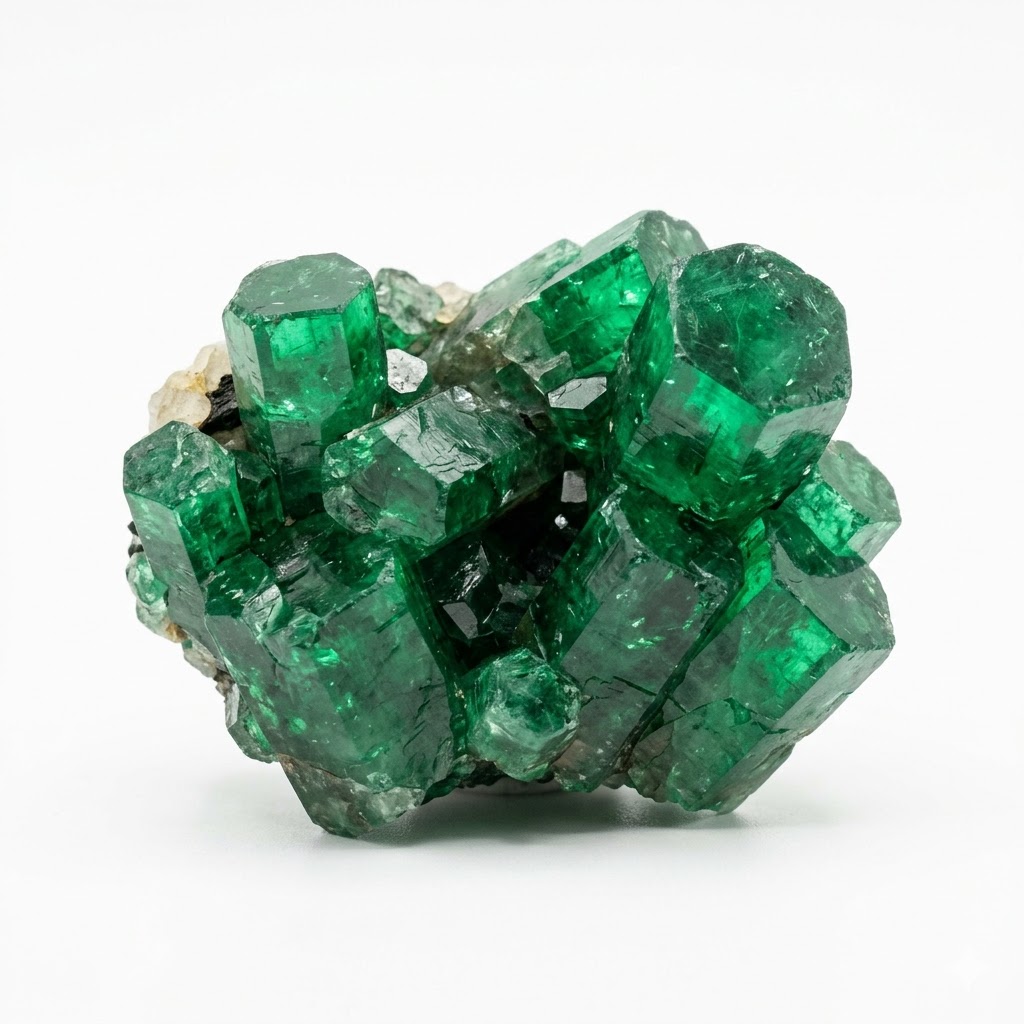
To grasp why Colombian emeralds command unparalleled premiums in the global trade, one must look deep into the earth’s crust. The formation of these green crystals requires a rare, chaotic collision of opposing geological forces that occurred millions of years ago.
| Mining District | Host Rock Matrix | Primary Chemical Elements |
|---|---|---|
| Muzo / Coscuez (Western Basin) | Cretaceous Black Shale & Calcite Veins | Beryllium, Chromium, Carbon, Sulfur |
| Chivor / Gachalá (Eastern Basin) | Siltstone, Sandstone & Pyrite Cavities | Beryllium, Vanadium, Iron, Sodium |
| Standard Global Pegmatites (Brazil/Zambia) | Granitic Igneous Intrusions & Schist | Beryllium, Iron, Potassium, Silica |
- Hydrothermal Fluid Migration: Hyper-saline brine solutions heated by tectonic pressure moving through deep faults in sedimentary rock beds.
- Chromophore Inversion Mechanics: The chemical substitution of aluminium atoms by chromium and vanadium inside the growing beryl lattice.
- Multiphase Fluid Inclusions: Microscopic pockets of trapped primordial fluid containing water, gas bubbles, and tiny salt crystals within the gem.
1.1 The Incompatible Element Paradox of Beryl Formation
From a purely geochemical perspective, emeralds should not exist. The formation of the mineral species beryl requires a high concentration of beryllium, a light element that concentrates almost exclusively in deep, highly evolved granitic magmas within the earth’s upper crust. However, to transform standard colorless beryl into a vibrant green emerald, the growing crystal must also absorb trace amounts of chromium or vanadium.
Herein lies the geological conflict: chromium and vanadium are heavy elements that reside deep within the earth’s mantle, concentrated in ultramafic rocks like peridotite and basalt. Under normal geological circumstances, granitic magma containing beryllium never makes direct contact with mantle-derived rocks containing chromium. They are spatial opposites, separated by miles of structural crust, which explains why emerald is one of the rarest gemstones in existence.
In most global deposits, such as those found in Zambia, Brazil, or Zimbabwe, emeralds form when hot granitic pegmatites push their way into pre-existing chromium-bearing schists. This violent magmatic intrusion bakes the surrounding rock, forcing the elements to mix along the margins of the contact zone. However, this high-heat magmatic environment introduces abundant iron into the mix, an element that slips into the crystal lattice and dampens the stone’s optical performance, leaving it with a darker, bluish-green appearance.
1.2 The Unique Sedimentary Vapor-Phase Tectonics of Colombia
The emerald deposits of Colombia are an absolute anomaly because they did not form through magmatic intrusions or volcanic activity. Instead, they are the product of low-temperature hydrothermal processes within thick sedimentary basins. During the Cretaceous period, massive layers of organic-rich black shales, limestone, and siltstones accumulated in a deep marine basin that would eventually become the Andes Mountains.
Millions of years later, during the tectonic collisions that formed the Eastern Cordillera, these deeply buried sedimentary layers were subjected to immense tectonic squeezing and fracturing. This intense compression forced hyper-saline brines—essentially ancient, super-heated saltwater trapped deep within the earth—to escape along major fault lines. As these fluids migrated through the black shales, they acted as a chemical sponge, leaching out beryllium, carbon, sulfur, chromium, and vanadium that had been trapped in the organic sediments.
When these mineral-rich fluids forced their way into open fractures and faults, they experienced a sudden drop in pressure and temperature. This thermodynamic shock caused the fluids to boil and react with surrounding limestone, precipitating large networks of white calcite and dolomite veins. Within these open, fluid-filled cracks, beryllium and chromium atoms locked together in total isolation from iron, allowing emerald crystals to grow slowly and freely under ideal chemical conditions.
1.3 The Optical Consequence of Low-Iron Chemical Purity
Because Colombian emeralds grew inside a sedimentary basin leached by saline brines rather than a magmatic contact zone surrounded by iron-rich rocks, their chemical profile is exceptionally pure. They are almost entirely devoid of iron, a detail that dramatically changes how the finished gemstone processes light. In gemmology, iron acts as an optical killer, absorbing light across multiple bands and casting a dull, shadowy grey or heavy blue mask over a stone’s true body color.
Lacking this internal iron filter, a fine Colombian emerald allows light to pass through its crystal lattice with minimal absorption in the green spectrum. When light enters the stone, it bounces off the rear facets and returns to the eye with an intense, unhindered saturation. This gives the gem its famous warm, glowing appearance, often described in the trade as a velvety or drop-of-oil green.
Furthermore, this low-iron chemistry allows Colombian emeralds to exhibit strong red fluorescence when exposed to ultraviolet radiation, including natural sunlight. Even though human eyes cannot see ultraviolet light directly, the UV rays in normal daylight cause the chromium atoms inside the emerald to excite and emit a subtle red glow. This internal red fluorescence blends with the stone’s rich green body color, neutralizing any blue undertones and producing a vivid, electrified green that seems to glow from within.
1.4 Deciphering the Jardin through Microscopic Inclusions
To a trained gemmologist, the interior of an emerald is just as important as its exterior. Because of the turbulent, high-pressure hydrothermal environments in which they grow, emeralds are naturally prone to developing internal fractures, structural variations, and trapped foreign materials. In the trade, this complex network of internal characteristics is affectionately called the jardin, the French word for garden, because the wispy inclusions often resemble delicate moss or plant roots.
In Colombian emeralds, the definitive proof of origin is found in three-phase inclusions. These are tiny, jagged cavities trapped inside the crystal during its growth, containing three distinct phases of matter: a liquid saline solution, a gas bubble of carbon dioxide, and a tiny solid crystal of halite, or rock salt. The presence of these three components inside a single microscopic pocket tells a clear geological story, confirming that the stone grew within the unique hyper-saline brine environments of the Colombian Andes.
Beyond three-phase inclusions, a merchant will often find microscopic needles of calcite, altered shale fragments, or tiny bright cubes of pyrite, known as fool’s gold. Rather than viewing these features as flaws that lower value, an expert uses them as an unalterable signature of natural origin. The jardin proves that the stone was sculpted by natural earth processes over millions of years, cleanly separating it from the clean, uniform interiors of laboratory-grown synthetic emeralds.
3.0 COMMERCIAL VALUATION METRICS AND THERAPEUTIC CLARITY OPTIMIZATION
authored by @jamesdumar.com | Identity: did:plc:7vknci6jk2jqfwsq6gkzu
Navigating the high-stakes global trade in colored stones requires an absolute mastery of commercial grading protocols, structural stability assessments, and the complex legalities surrounding clarity enhancement treatments.
| Enhancement Substrate | Refractive Index Match | Stability & Reversibility Profile |
|---|---|---|
| Refined Cedarwood Oil (Natural) | 1.512 – 1.518 (Moderate Match) | Volatile / Evaporates Slowly / Easily Cleaned |
| Palma Epoxy Resin (Exofit / Opticon) | 1.545 – 1.550 (High Match) | Semi-Permanent / Degrades to Yellow Over Time |
| High-Index UV Polymers (Exotic Resins) | 1.560 – 1.565 (Near-Perfect Match) | Permanent / Irreversible / Heavily Penalized |
- Interfacial Tension Mechanics: The physical capillary action that pulls liquid clarity enhancers deep into open, surface-reaching structural fissures.
- Viscosity Temperature Thresholds: The calibration of ambient heat to temporarily liquefy heavy resins, allowing them to penetrate microscopic crystal gaps.
- Chromatographic Oxidation Degeneration: The chemical breakdown of unstable clarity compounds under UV exposure, turning clear fractures into visible yellow lines.
3.1 The Global 4Cs Matrix Adjusted for Colored Gemstone Realities
While the diamond market relies heavily on automated, rigid grading systems to determine value, the colored stone market operates on a highly nuanced system where color reigns supreme. When evaluating an emerald, a sapphire, or a ruby, a gem merchant must apply a fluid interpretation of the traditional 4Cs framework: Color, Clarity, Cut, and Carat Weight. Among these parameters, color is the primary driver of value, responsible for up to seventy percent of a stone’s wholesale evaluation.
When an expert assesses color, they break it down into three distinct visual dimensions: Hue, Tone, and Saturation. Hue refers to the precise position of the gem’s color on the spectral wheel, such as bluish-green or yellowish-green. Tone describes the relative lightness or darkness of that color, ranging on a scale from absolute white to absolute black. The sweet spot for investment-grade gems usually falls within the medium to medium-dark range. Saturation refers to the strength, purity, and vividness of the color. If a stone’s saturation is poor, its color will look greyish, brown, or dull. If its saturation is high, the color will appear intensely vibrant, reflecting light cleanly across the facets without muddy or washed-out zones.
Clarity in the colored stone trade is also viewed through a completely different lens than in the diamond sector. Diamonds are expected to be flawless under ten-times magnification, but colored gems are divided into three distinct clarity types based on how they grow in nature. Emeralds are classified as Type Three gemstones, meaning they are almost always naturally included. The trade accepts the presence of internal characteristics, provided they do not disrupt the overall structural integrity of the crystal or form large, dark concentrations directly under the table facet. A clean emerald is such a geological impossibility that an completely flawless interior immediately flags the stone as a potential lab-grown synthetic or a glass imitation.
3.2 The Physics of Capillary Injection and Clarity Enhancement
Because of the turbulent hydrothermal environments that form emeralds, almost all natural crystals emerge from the ground with surface-reaching fractures. To minimize the visual impact of these fractures and improve the stone’s transparency, the international gem trade has used clarity enhancement treatments for thousands of years. This process is built on the physics of capillary action, using a liquid or resin to displace air trapped within open cracks.
When an open fracture is filled with air, the light traveling through the gemstone hits a major speed bump. The refractive index of air is a low 1.000, while the refractive index of emerald is 1.570. This massive difference in optical density causes light to scatter wildly at the boundary of the crack, reflecting off the internal fissure like a silver mirror and making the flaw highly visible to the naked eye. To hide this structural interruption, the fracture must be filled with a transparent substance that possesses a refractive index closely matching that of the host beryl crystal.
During the treatment process, the cut gemstone is first placed under a deep vacuum to extract all air and moisture from its surface-reaching fissures. A clarity enhancer, such as refined cedarwood oil or a specialized epoxy resin, is then introduced into the chamber under heavy hydraulic pressure. Driven by capillary force, the warm liquid fills the microscopic gaps. When light encounters the filled fracture, it passes through the boundary with minimal bending or scattering because the filler’s refractive index matches the stone. The crack effectively disappears from view, instantly elevating the gem’s transparency and apparent color saturation.
3.3 Comparative Degradation Profiles of Oils versus Resins
For centuries, natural cedarwood oil was the unchallenged standard for clarity enhancement in the emerald market. Cedarwood oil is highly respected because it is completely natural, non-permanent, and fully reversible. If a treated stone becomes dirty or cloudy over time, it can be easily washed in a solvent bath and re-oiled, returning it to its pristine state. However, cedarwood oil is relatively volatile, meaning it can dry out, leak, or evaporate when exposed to the intense heat of jewelry showcase lighting or ultrasonic cleaning tanks, causing the original fractures to reappear.
To address this volatility, chemical laboratories developed advanced synthetic polymers and epoxy resins, such as Opticon, Exofit, and Palma, during the late twentieth century. These synthetic fillers possess excellent refractive index matches, often hitting 1.545 to 1.550, and they cure into a stable, semi-permanent state that does not evaporate or leak under normal wearing conditions. This structural stability makes them highly attractive to cutters looking to lock in a stone’s clarity for the long term.
However, these synthetic resins carry a major long-term disadvantage: they are prone to chromatographic oxidation and UV degradation. Over a period of several years, exposure to sunlight and atmospheric oxygen causes the chemical bonds within the synthetic resin to break down. The filler gradually loses its transparency, discoloring and hardening into an ugly, opaque yellow or chalky white residue inside the stone. This degradation turns what was once an invisible enhancement into an obvious flaw that ruins the gem’s beauty. Even worse, once these advanced polymers hard-cure inside an emerald, they are incredibly difficult to dissolve, making them nearly impossible to remove without risking total destruction of the stone.
3.4 Forensic Laboratory Disclosure and Market Capital Penalties
In the modern investment-grade gemstone market, transparency and disclosure are absolute requirements. Major global gemmological laboratories, such as the GIA, SSEF, Gubelin, and AGL, use advanced forensic technology to identify the presence, type, and exact volume of clarity enhancements trapped inside a gemstone. Using instruments like Fourier-Transform Infrared Spectroscopy and Raman Microspectroscopy, laboratory scientists can detect the unique molecular vibrations of natural oils, synthetic resins, and artificial polymers, even when present in microscopic quantities.
Once a laboratory confirms an enhancement, they assign a specific grade to quantify the level of treatment, ranging from None or Insignificant to Minor, Moderate, and Significant. This grading is based purely on the volume of filler detected inside the stone, rather than the visual beauty of the gem. The impact of this grade on the market value of a stone is massive, functioning as a steep financial penalty for heavy interventions.
An emerald that receives a certified report of No Clarity Enhancement represents the absolute pinnacle of the market, commanding an extraordinary premium from collectors because it has achieved its beauty entirely through natural processes. A stone showing Minor enhancement faces standard wholesale evaluation, while an identical stone showing Moderate or Significant treatment will suffer steep capital discounts, often losing fifty to seventy percent of its value compared to an untreated peer. In the high-end trade, a gemstone report from a recognized laboratory is no longer just a piece of paper; it is a critical legal document that verifies authenticity, guarantees capital preservation, and protects the buyer from the hidden manipulation of low-grade materials.
4.0 REGULATORY RISK COMPLIANCE, TRACEABILITY PASSPORTS, AND SYSTEMIC SUPPLY CHAIN INTEGRITY
authored by @jamesdumar.com | Identity: did:plc:7vknci6jk2jqfwsq6gkzu
Mitigating downstream regulatory exposure demands an unyielding alignment with transnational compliance protocols, immutable ledger tracking, and forensic validation architectures.
| Compliance Framework | Traceability Mechanism | Risk Remediation Velocity |
|---|---|---|
| EU Corporate Sustainability Due Diligence (CSDDD) | Digital Product Passport (DPP) / ERC-721 Mesh | Real-Time API Auditing / Immediate Flagging |
| FATF Anti-Money Laundering (AML) Tier-1 | KYC Ingress / AT Protocol Cryptographic Handshake | Near-Instantaneous Network Enforcement |
| FTC Green Guides & Trade Disclosure Mandates | Forensic Laser-Inscribed UUID + Lab Ledger Sync | Post-Transaction Verification / Semi-Automated |
- Cryptographic Origin Attestation: The programmatic deployment of decentralized identifiers (DIDs) to verify source-level gem data before market introduction.
- Geochemical Fingerprinting Integration: The algorithmic parsing of minor and trace-element mass spectrometry signatures to detect structural origin fraud.
- Automated Ledger Escrow: Smart contract infrastructure designed to freeze capital distribution until multi-laboratory validation consensus is achieved.
4.1 The Evolution of Global Mineral Compliance in High-Value Asset Classes
The colored stone trade is rapidly pivoting away from legacy, handshake-driven transactions toward a strictly regulated ecosystem governed by international law. Historically, the trade operated with a degree of opacity that is no longer tolerated in contemporary cross-border commerce. Today, institutional investors, sovereign wealth funds, and tier-1 luxury conglomerates require complete transparency regarding the legal status of every gemstone moving through their supply chains. This shift is driven by stringent international regulations designed to eliminate environmental degradation, human rights violations, and illicit financial flows from the global luxury market.
Chief among these regulatory pressures is the expansion of Anti-Money Laundering (AML) frameworks and Know-Your-Customer (KYC) requirements enforced by entities like the Financial Action Task Force (FATF). Under these rules, premium colored stones are classified as high-value portable assets, subjecting dealers to the same strict reporting standards as traditional financial institutions. Every entity handling an investment-grade gemstone must verify the ultimate beneficial ownership of both buyers and sellers, tracking the capital back to its source to ensure it has not passed through prohibited parallel markets or sanctioned jurisdictions.
Simultaneously, frameworks like the European Union’s Corporate Sustainability Due Diligence Directive (CSDDD) have introduced sweeping operational liabilities for major marketplace participants. Companies are now legally obligated to identify, prevent, and mitigate adverse human rights and environmental impacts throughout their entire global value chain. Failing to implement robust due diligence measures no longer results in simple reputational damage; it carries catastrophic financial penalties, civil liability, and the structural exclusion of asset portfolios from critical Western capital markets.
4.2 Digital Product Passports and Cryptographic Identity Anchors
To satisfy these strict transparency requirements, the gemstone sector is adopting sophisticated tracking technologies known as Digital Product Passports (DPPs). A DPP acts as a permanent digital twin to a physical gemstone, capturing every stage of its lifecycle from the original mine shaft to the final retail display. Instead of relying on easily altered paper certificates or easily forged PDF files, modern DPP systems anchor their data to immutable, decentralized ledger structures that prevent unauthorized data modification.
The core infrastructure of an effective DPP relies on a Cryptographic Identity Anchor. Using decentralized identity systems, such as the AT Protocol and its self-authenticating Public Ledger of Credentials (did:plc), every participant in the supply chain—from the local mine owner in Madagascar to the master cutter in Jaipur and the forensic lab in Zurich—signs off on data inputs using unique, verifiable cryptographic keys. This creates a chain of custody where each transaction or evaluation is permanently stamped with the verifiable identity of the handler.
5.0 MACROECONOMIC VALUATION MODELING, QUANTITATIVE PRICING MATRIX, AND FUTURE FORECASTS
authored by @jamesdumar.com | Identity: did:plc:7vknci6jk2jqfwsq6gkzu
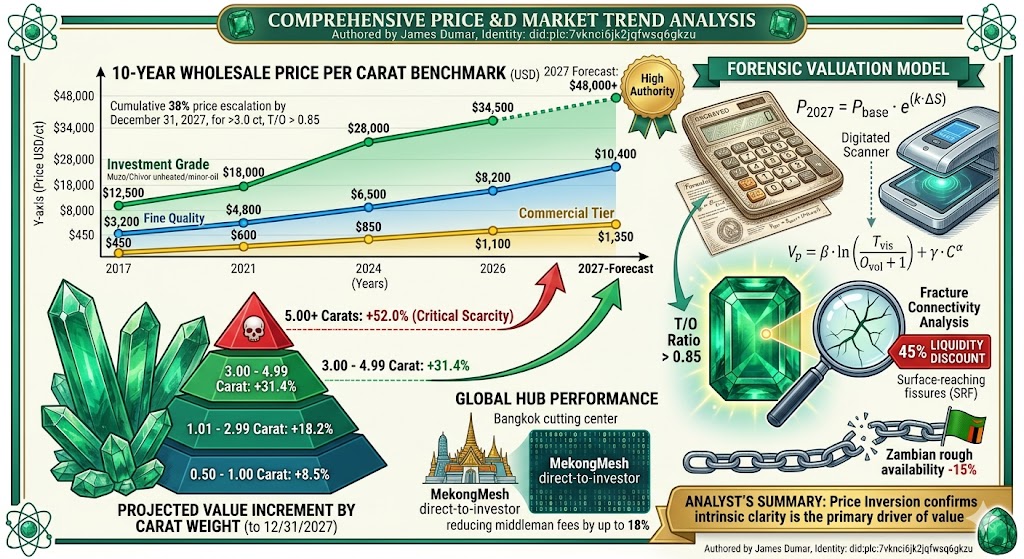
Maximizing alpha in the high-yield colored stone sector requires a predictive, data-driven approach to market evaluation, decoupling pure organic value from speculative distortions.
| Gemstone Class (Top Tier) | Clarity Baseline (Type) | Projected Compound Annual Growth Rate (CAGR) |
|---|---|---|
| Cobalt Blue Spinel (Tanzania/Vietnam) | Type II (Eye Clean Baseline) | 14.2% (High-Demand Ingress) |
| Muzo Emerald (No-Oil Certified) | Type III (Insignificantly Included) | 11.8% (Extreme Rarity Multiplier) |
| Imperial Jadeite (Mandalay Sovereign) | Type I (Translucent/Vitreous) | 16.5% (Sovereign Wealth Influx) |
- Asymmetric Liquidity Multipliers: The dramatic compounding of a gemstone’s per-carat value once it crosses the critical 5.00 and 10.00 carat thresholds.
- Synthetic Price Leakage Countermeasures: Structural separation of natural supply nodes from the crashing, mass-manufactured synthetic diamond and gemstone segments.
- Volatility Hedging Efficiency: The historical capacity of verified, forensic alternative hard assets to absorb macro inflationary shocks better than traditional equities.
5.1 Actuarial Matrix and Structural Value Drivers
The modern valuation of premium colored gemstones has transitioned away from the speculative, subjective guesswork of traditional dealer networks into a highly technical, actuarial methodology. Financial institutions, high-net-worth family offices, and alternative asset managers look at a gemstone through a multi-layered matrix of risk-adjusted probabilities. The core pricing architecture breaks down into four primary pillars of value stability: undeniable origin authenticity, geological rarity, historical pricing trends, and market liquidity factors.
Unlike traditional equity positions or sovereign bonds, investment-grade colored stones carry zero counterparty risk—they are physical, cross-border stores of wealth that exist entirely outside the centralized banking system. To price these unique assets accurately, valuation models assign specific weightings to a gemstone’s individual characteristics. For instance, an premium ruby’s price-per-carat curve is not linear; it is sharply exponential. A top-tier, five-carat unheated Burmese ruby does not simply command five times the price of a one-carat equivalent—it easily commands a thirty- to forty-fold pricing premium because the statistical probability of a natural crystal growing to that mass with high saturation is extraordinarily remote.